

Description
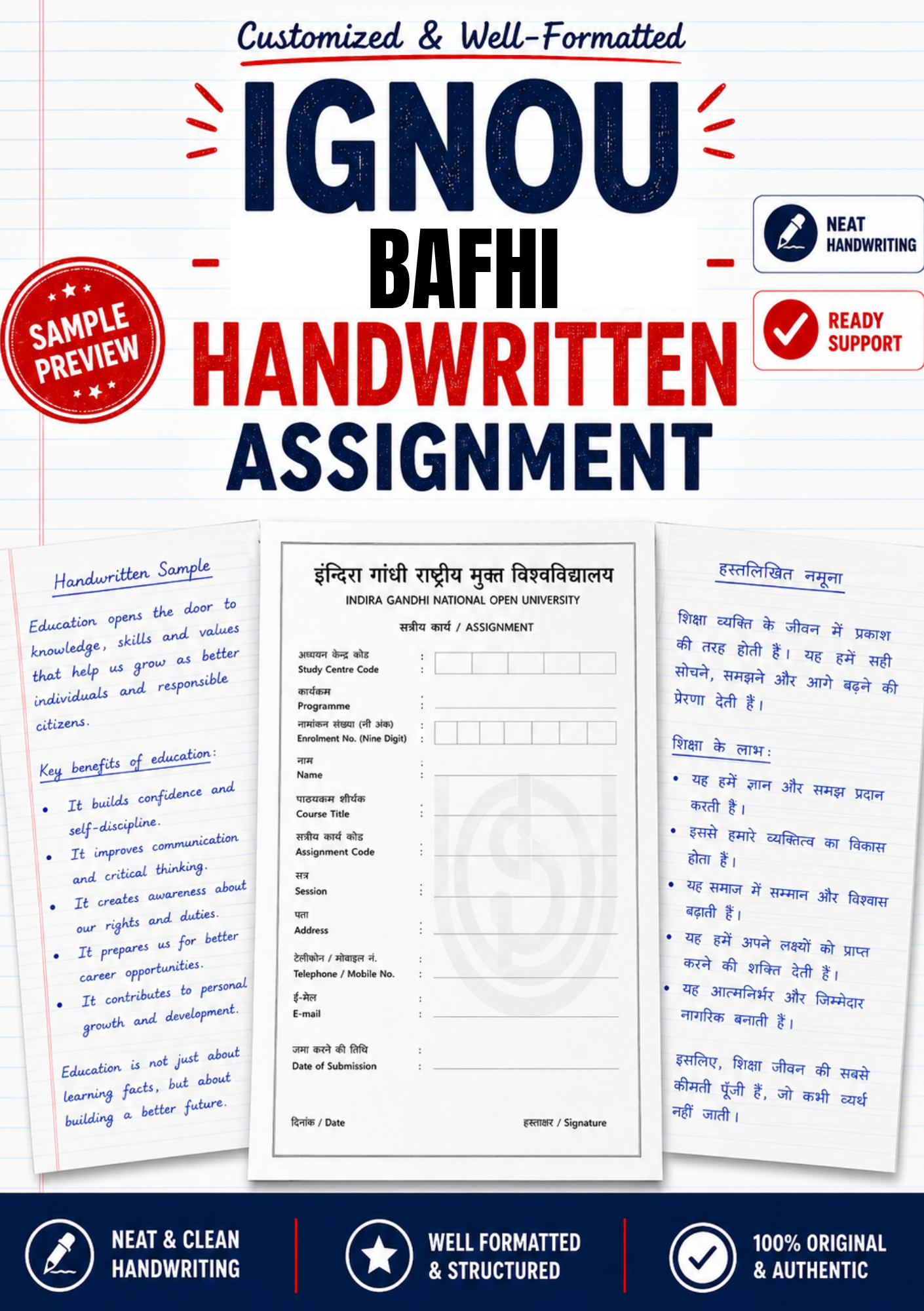
In short. An IGNOU BAFHI handwritten assignment is the Tutor Marked Assignment for one course code of the Bachelor of Arts (History) Major, the four-year NEP programme the School of Social Sciences has offered since the January 2024 session, answered by hand on paper and handed to the Coordinator of your Study Centre, and Shri Chakradhar Publication writes that set code by code: the ten BHIC major papers from BHIC-101 History of India – I to BHIC-113 History of India – VIII, with BHIC-104 or BHIC-111 in the one slot where the prospectus lets you choose, plus the minor, skill, ability and value-added codes printed on your own record. The rate is ₹320 per subject, hard copy only, with courier included in that price and no separate shipping charge. On the two 2026-27 BHIC booklets read for this page, the School prints 31 March 2027 for learners admitted in July 2026 and 30 September 2027 for the January 2027 batch, while a January 2026 learner still answering the 2025-26 paper is working to 30 September 2026.
Inside the BAFHI Envelope
Each BHIC code you order arrives as four physical things, and it helps to know them before the packet is opened. The first is the answer set itself, written in ink in the order the School of Social Sciences sets it. Every History booklet read for this page follows the same three-part pattern of one hundred marks: Assignment I asks two descriptive questions of about 500 words for 20 marks each, Assignment II asks three analytical questions of about 250 words for 10 marks each, and Assignment III asks five short notes of about 100 words for 6 marks each. Added up, that is roughly 2,250 words of answer for a single six-credit code before a heading or an introduction is counted.
The second item is the IGNOU-format front page, filled in with the enrolment details you send and left unsigned, because the declaration on it is yours to sign. The third is a copy of the official TMA paper the set answers, clipped with the answers so that you, and later the Coordinator, can check question against answer without hunting for a download. The fourth is the courier packaging that brings all of it to the address you give. No soft copy or PDF is sold.
Paper size is one detail the BAFHI booklets leave open. None of the four BHIC booklets opened for this page names A4 or foolscap; they ask only that the final version be written neatly with key points underlined. The set is written on A4 unless you say otherwise, so if your Study Centre has told its learners to use foolscap, put that in your order message and it is settled before you pay.
Where the ₹320 Goes on a BHIC Code, and Where It Stops
The subject rate buys the writing of one course code against the paper you name, the free front page, the printed copy of that paper and the courier to your door. It does not change with the length of the paper, so a BHIC code with ten questions costs the same as a four-credit skill course with a shorter booklet. There is no minimum order: one subject or fourteen, same rate. The product listing shows a regular price of ₹350 beside the ₹320 you pay; that difference is fixed and is not tied to any date.
Three things sit outside the rate. The first is the act of submission. IGNOU asks you to hand the set to the Coordinator of your Study Centre and to obtain a receipt, so the carrying and the queue remain yours or those of whoever you send. The second is online upload. The 2025-26 BHIC-101 and BHIC-107 booklets both mention that a Regional Centre may allow online submission on its website; if yours does, scanning the handwritten pages is a step you take after the packet arrives, because the product is the paper original. The third is the result, which no one outside the university controls.
Delivery depends on your pin code and is confirmed for your order before you pay. No figure is promised on this page.
Downloaded Model Answers or a Hand-Inked Set: Which One a BAFHI Learner Needs
Two different products travel under the word assignment, and BAFHI learners meet both in the same search results. A solved assignment is a soft-copy reference file of model answers for a course code and session, read on a screen or printed, and used to understand what a good answer to that year’s questions looks like. A handwritten assignment is the answers written out by hand and submitted in hard copy at the Study Centre, which is what this product is.
The BHIC booklets themselves settle how the set reaches the university. The Faculty of History tells learners to write the answers to all the TMA questions in their own words, and then to write down the final version for submission, writing each answer neatly and underlining the points to emphasise. The document you hand over is therefore a handwritten one. A solved file, however carefully prepared, is something you read before you write; a printed copy of it is still a solved file and is not the set the Coordinator is waiting for.
| Point of comparison | Solved assignment | Handwritten assignment |
|---|---|---|
| Format | Soft-copy file of model answers | Answers in ink on paper, with front page and question paper |
| What you do with it | Read it, then write your own answers | Read it, sign the front page, hand it to the Coordinator |
| Who it suits | Learners who will write the BHIC set themselves and want a reference | Learners who need a submission-ready set for codes they are behind on |
| Price line on this store | Sold separately as a download | ₹320 per subject, courier included |
On a narrow screen, slide the table sideways to see every column.
If a reference file is what you are after, the store keeps its IGNOU BHIC solved assignment files on a single shelf, currently labelled under BAHIH because the two History programmes answer the same BHIC booklets. That shelf, not this page, is the place to buy one. A learner who already owns a solved file and still orders here is paying for the writing, not the reading.
Short on two BHIC codes, or all ten?
₹320 per subject · hard copy · courier included · any cycle, backlogs included
The Ten Major-Course Slots Behind Every BHIC Paper
Section 5.5 of the IGNOU Common Prospectus July 2026 lists the Discipline Specific Courses for the Bachelor of Arts (History), programme code BAFHI, under the School of Social Sciences. It prints ten slots of six credits each. Nine of them name a single code, and the tenth offers a choice between BHIC-104 Social Formations and Cultural Patterns of the Medieval World and BHIC-111 History of Modern Europe – I (c. 1780 – 1939). Ten slots at six credits give sixty credits, which matches the sixty credits the same prospectus assigns to the Discipline Specific category of every Bachelor of Arts Major, so the table below was checked against that total before it was trusted.
| Slot | Course code | Official title in the prospectus | Credits |
|---|---|---|---|
| 1 | BHIC-101 | History of India – I | 6 |
| 2 | BHIC-102 | Social Formations and Cultural Patterns of the Ancient World | 6 |
| 3 | BHIC-103 | History of India – II | 6 |
| 4 | BHIC-105 | History of India – III (c. 750 – 1206) | 6 |
| 5 | BHIC-107 | History of India – IV (c. 1206 – 1550) | 6 |
| 6 | BHIC-109 | History of India – V (c. 1550 – 1605) | 6 |
| 7 | BHIC-110 | History of India – VI (c. 1750 – 1857) | 6 |
| 8 | BHIC-112 | History of India – VII (c. 1605 – 1750) | 6 |
| 9 | BHIC-113 | History of India – VIII (c. 1857 – 1950) | 6 |
| 10 | BHIC-104 or BHIC-111 | Social Formations and Cultural Patterns of the Medieval World, or History of Modern Europe – I (c. 1780 – 1939) | 6 |
| Total for the major | 60 | ||
Titles follow the prospectus wording; slide sideways on a phone to read the credit column.
Two features of this table matter when you order. The Roman numerals do not run in date order: History of India – VI covers c. 1750 to 1857, while History of India – VII goes back to c. 1605 to 1750, so a learner sorting papers by period will find BHIC-112 sitting chronologically before BHIC-110. And slot ten is the only place your record, rather than the prospectus, decides the code, so tell the publisher which of BHIC-104 and BHIC-111 you registered for.
The older three-year BA (Honours) History, BAHIH, answers the same BHIC booklets but carries fourteen cores, including BHIC-106 and BHIC-108 on the Rise of the Modern West and BHIC-114 History of Modern Europe – II, and it makes BHIC-104 and BHIC-111 both compulsory. None of BHIC-106, BHIC-108 or BHIC-114 appears in the BAFHI table. If one of them is on your record, you are either enrolled in BAHIH or holding a code the prospectus does not list for BAFHI, and the admission record is the document to check. The fourth, Honours year of BAFHI carries four more discipline courses and a twelve-credit project or equivalent coursework, but the prospectus states that the fourth-year course details will be provided subsequently, so no code is listed here for it.
Minor, Skill, Ability and Value-Added Codes That Travel With the Major
The sixty BHIC credits are half of the three-year Major. The prospectus fills the other sixty from five further categories, and each of them issues its own assignment booklet from whichever school owns the course. A BAFHI record therefore mixes BHIC papers from the Faculty of History with codes such as BEVAE-181 Environmental Studies, a language course, a skill course and a value-added course, all of which are written at the same ₹320 per subject.
| Category | Courses | Credits | How the codes are chosen |
|---|---|---|---|
| Discipline Specific (BHIC) | 10 of 6 credits | 60 | Fixed, except the BHIC-104 or BHIC-111 slot |
| Minor and Vocational | 6 of 4 credits | 24 | Three vocational courses plus three minors from one discipline other than History |
| Ability Enhancement | 2 of 4 credits | 8 | BEVAE-181 Environmental Studies, then one language course such as BEGAE-182 or BHDAE-182 |
| Skill Enhancement | 4 of 4 credits | 16 | One per semester in the first, fourth, fifth and sixth semesters |
| Interdisciplinary | 1 of 6 credits | 6 | A course outside both the major and the minor discipline |
| Value Added | 1 of 6 credits | 6 | BEDSV-101 Value Education or BNME-001 Philosophy of Swami Vivekananda |
| Three-year Major | 120 | A fourth year of 40 credits leads to the Honours degree at 160 | |
The six categories sum to 120 credits, the figure the prospectus gives for the Major; scroll the table sideways on a small screen.
One rule in this structure is written with History as its own example. The prospectus states that a learner enrolled in the BA Major in History cannot take minor courses from the History discipline, which rules out BHIM-161, BHIM-162 and BHIM-163 for a BAFHI learner even though those three History minors sit in the same list. The skill-course list, on the other hand, does contain a Faculty of History paper open to you: BHIS-183 Traditions and Perception of Craft in Bharat. Learners preparing for its term-end paper sometimes pair the handwritten set with a BHIS-183 guess paper in Hindi, and the broader shelf of skill enhancement course books for the new BA syllabus covers the other skill codes on the list.
The exit points follow the same arithmetic. A learner leaving after one year receives a UG Certificate on 40 credits plus a four-credit vocational course, and after two years a UG Diploma on 80 plus four. The value-added course is offered only in the first semester, so a pending BEDSV-101 is always a first-year code however late it is submitted; guides for it sit with the value-added course books. Dates for every non-BHIC code are printed on that code’s own booklet, which may come from a different school with a different calendar, so read them there rather than assuming the History dates apply.
Eight Places IGNOU’s BAFHI Paperwork Contradicts Itself
Reading the prospectus, IGNOU’s programme page and the History booklets against one another turns up disagreements that change what a BAFHI learner should write and when. None of them is resolved on this page by guesswork. They are listed so that you can take the right question to your Study Centre, and so that an order is written against the document you actually hold.
Read these before you send your code list. Where two documents disagree, your admission record and your Regional Centre decide, not this page.
1. BHIC-111’s 2026-27 cover leaves BAFHI off. The July 2026 to January 2027 booklet for BHIC-111 names only the Bachelor of Arts History Honours Programme (BAHIH) on its cover, while the BHIC-105 booklet for the same cycle names BAHIH and BAFHI together. The prospectus offers BHIC-111 to BAFHI learners in slot ten, so a BAFHI learner who chose it is answering a paper whose cover does not mention their programme.
2. BHIC-107 had two different 2025-26 papers. Two booklets for July 2025 and January 2026, both carrying the assignment code BHIC-107/ASST/TMA/2025-26 and both naming BAHIH and BAFHI, set entirely different questions. One opens with the expansion of the Delhi Sultanate under the Khaljis; the other opens with Sanskrit inscriptions as a source for the twelfth to fifteenth centuries. Tell the publisher which file you downloaded.
3. IGNOU’s BAFHI programme page lists codes the prospectus does not. The live course list on ignou.ac.in shows BHIC-133, which the prospectus places in the BAM programme; MLIP-002 Project, which is a Master of Library and Information Science code; and the History minors BHIM-161 and BHIM-162, which the prospectus bars for History majors. It shows only five of the ten BHIC slots from section 5.5.
4. Duration is printed two ways. The prospectus gives BAFHI a minimum of three or four years and a maximum of six or eight, reflecting the Major and Honours exits, while the programme page states 36 months minimum and 72 months maximum.
5. The History cut-offs moved. The 2025-26 and 2026-27 BHIC booklets print 31 March and 30 September. The July 2022 to January 2023 BHIC-101 booklet printed 30 April and 31 October, the pair many aggregator pages still repeat, and it dated the July 2022 session to 30 April 2022, before that session had begun.
6. A History booklet describes Economics. The 2025-26 BHIC-101 booklet tells learners its descriptive questions test introductory concepts of Economics and its short notes test economic concepts, a sentence carried over from another faculty’s template. The 2026-27 BHIC-111 booklet prints its own course title as History of Modrern Europe on the question page.
7. Titles drift between prospectus and booklet. The prospectus titles BHIC-105 History of India – III (c. 750 – 1206); the 2026-27 booklet prints (750-1206 CE) without the approximation, and the 2025-26 booklet prints (c. 750-1206 CE). Copy the title from the booklet you are answering.
8. This store has contradicted itself too. No BAFHI solved-assignment shelf exists on shrichakradhar.com; BHIC solved files are filed under BAHIH. The BAFHI guess-paper category is labelled BA History Honours although BAFHI is the Major. The BPCM-161 product page, which lists BAFHI among its programmes, quotes a handwritten price of ₹350 and a working-day delivery window. The handwritten category page quotes its own delivery window and gives 2012 as the founding year where other pages give 2010, and older handwritten product pages carry a marks assurance and an unsupported claim to have been the first such provider in the country. None of those statements is repeated here, all are queued for correction, and this page governs wherever they disagree with it.
31 March and 30 September: The School of Social Sciences History Cut-Offs
Submission dates at IGNOU are printed school by school, and sometimes faculty by faculty, so the only safe source for a BAFHI date is a BHIC booklet. Every current History booklet opened for this page uses the same pattern: a booklet is valid for two admission cycles, the July cycle submits by 31 March of the following year and the January cycle submits by 30 September. The dates below were read directly off the booklets named in the first column.
| Booklet read | Admission cycle | Submit by |
|---|---|---|
| BHIC-105 and BHIC-111, 2026-27 | July 2026 | 31 March 2027 |
| BHIC-105 and BHIC-111, 2026-27 | January 2027 | 30 September 2027 |
| BHIC-101 and both BHIC-107 files, 2025-26 | July 2025 | 31 March 2026 |
| BHIC-101 and both BHIC-107 files, 2025-26 | January 2026 | 30 September 2026 |
| BHIC-101, 2022-23 (superseded) | July 2022 / January 2023 | 30 April 2022 / 31 October 2023 |
Rows are grouped by booklet cycle; on a phone, slide sideways to read the date column in full.
At the time this page was written, in September 2026, the most pressing of those dates is the 30 September 2026 cut-off for learners admitted in January 2026. Learners admitted in July 2026 have until 31 March 2027 against the new booklets. The university also issues term-end notices that extend submission windows for a whole cycle, and those notices can move a date after a booklet is printed. When a notice and a booklet disagree, the notice is the later document, and your Regional Centre can confirm which applies to you.
A booklet also expires. The 2026-27 History papers are marked valid for the July 2026 and January 2027 admission cycles, and the School replaces them with fresh questions for the following cycle. A set written against an expired paper answers the wrong questions, which is why the order message asks for the cycle and not only the code.
Decoding BHIC-105/ASST/TMA/2026-27 Before It Goes on Your Front Page
Every BHIC question page carries an assignment code, and the front page asks you to copy it. The current History form has three parts. The course code comes first, then the marker ASST/TMA, which the Faculty of History uses where some other schools print TMA alone, and finally the validity span of the booklet, written as two years joined by a hyphen. BHIC-105/ASST/TMA/2026-27 and BHIC-111/ASST/TMA/2026-27 are the two current examples read for this page.
The form has not always been this. The January 2024 booklet for BHIC-101, printed for the first FYUP History batch, carried the code BHIC-101/ASST/TMA/24 with a single year, and the 2025-26 papers moved to the two-year span. If you are submitting a backlog code against an older paper, copy the code from that paper exactly rather than rewriting it in the current form. The set is prepared with the code from the booklet you name, and the front page uses the same string.
The BHIC-107 case shows why the code alone is not enough. Both 2025-26 BHIC-107 files print BHIC-107/ASST/TMA/2025-26, yet their questions differ completely. When a Coordinator checks a submission, the questions are what match or fail to match. That is the reason a copy of the paper you answered travels inside the packet.
Your Own Hand as the Template
Send a photo of a page you have written yourself and the handwritten set is matched to your handwriting at no extra charge. The purpose is consistency. A BAFHI learner may write some BHIC codes personally and order others here, and matching the slant, size and letter shapes of your own writing keeps the ordered set visually in line with the pages you wrote yourself.
What Makes a Usable Sample Photo
One full page of your ordinary writing is enough, in the language of the medium you study in, so Devanagari for a Hindi-medium BAFHI learner and English script for an English-medium one. Photograph it flat, in daylight, with the whole page in the frame, and write at your normal speed rather than your neatest. A few lines copied carefully from a textbook show less about how you actually write than a paragraph of your own notes. Before any payment, a sample of the matched hand is sent back for your approval, and the order proceeds only after you have seen it.
English or Hindi Paper, Current Cycle or a Pending Backlog
The prospectus lists English and Hindi as the media of instruction for BAFHI, and the School of Social Sciences posts its Hindi booklets as separate files from the English ones. The service covers all mediums IGNOU issues the TMA paper in, at the same price. Tell the publisher which medium your admission is in, and the set follows the paper issued in that medium.
Any session is accepted, current cycle or older, including backlog courses, at the same ₹320 per subject. BAFHI is young enough that its oldest learners date only from January 2024, yet with a four-year Honours track and a maximum of six to eight years, a code can stay pending across several booklet cycles. Which cycle’s paper a pending code must answer is decided by IGNOU and your Study Centre, so confirm that first; the set is then written against whichever paper you name.
The Short Message That Starts a BAFHI Order
Five details let the order be priced and written without a second round of questions. First, the course codes exactly as your re-registration record prints them, including which of BHIC-104 and BHIC-111 you chose. Second, your medium, English or Hindi. Third, your admission cycle, such as July 2026 or January 2026, so that the right booklet is used. Fourth, the name or a screenshot of the booklet you downloaded, which matters most for BHIC-107 in 2025-26 and for any paper whose cover leaves BAFHI off. Fifth, your pin code, from which delivery is confirmed.
Add the sample photo described above and the enrolment details you want on the front page. The quickest route is to open WhatsApp with the five details pre-filled and complete the blanks.
Already holding the 2026-27 BHIC booklet?
₹320 per subject · printed question paper and front page included · no minimum order
Once the Courier Arrives: Checks Before the Study Centre Counter
Open each code’s bundle and lay the printed question paper beside the answers. Check that every question of Assignments I, II and III has an answer in the right order, that the assignment code on the front page matches the booklet exactly, and that your name, enrolment number and Study Centre code are correct. Read the answers through. You sign the declaration on the assignment cover page, so you should read and review the content before submitting it, and satisfy yourself that it represents your own understanding of the course.
Then follow the instructions the History booklets print. Submit the set to the Coordinator of your Study Centre within the stipulated time, obtain a receipt and keep it, and if possible keep a photocopy of the assignment. The booklets add that the Study Centre should return evaluated assignments to you and send the marks to the Student Evaluation Division in New Delhi, and they tell learners to insist on the return. Keep the receipt until the marks for that code appear against your enrolment, because it is the only proof of submission you hold.
If your Regional Centre accepts online submission, scan the signed set as a single file in the order of the booklet before uploading it, and keep the paper original with your receipt.
Books, Guess Papers and Sibling Products Around a BAFHI Order
A handwritten set covers the thirty-per-cent share of a course; the term-end examination is prepared for separately. The store’s BA History Major help books for BAFHI are shelved by programme, and because BHIC papers are shared with the older degree, the BAHIH history guides covering the same BHIC codes are also worth a look before buying twice. For examination practice, the BHIC solved guess papers are organised by course code.
Interdisciplinary courses sit outside both your major and your minor, and the store keeps interdisciplinary course guides for the new BA syllabus on their own shelf. Learners enrolled in the multidisciplinary BA rather than the History Major meet some BHIC codes too, and their order belongs on the handwritten product for BAM discipline codes, which is built around that programme’s structure. For programmes with no dedicated product page yet, the general IGNOU handwritten assignment category is the starting point.
BAFHI Ordering Questions, Answered From the Booklets
Can I hand in a downloaded BHIC solved assignment instead of a handwritten one?
The History booklets ask you to write the final version of each answer for submission, in your own words, and to hand it to your Study Centre Coordinator. A downloaded solved file is a reference to write from, not the submission itself. If you have the reading done and not the writing, the handwritten set for that BHIC code is the product that fills the gap. No soft copy or PDF is sold.
What is the difference between a solved assignment and a handwritten assignment for BAFHI?
A solved assignment is a soft-copy file of model answers for one course code and session, useful for understanding the questions. A handwritten assignment is those answers written out by hand on paper, with the front page and question paper, ready for the Study Centre. For BAFHI the two share nothing but the BHIC code on the cover.
Is a printed or typed BHIC answer set accepted at the Study Centre?
No BHIC booklet read for this page invites a typed submission; each describes writing the final version neatly and underlining key points by hand. Acceptance at the counter is decided by your Study Centre and IGNOU, not by any seller, so if you have been told something different locally, follow your Study Centre.
I already bought a BHIC solved file. Do I still need the handwritten set?
Only if you are not going to write the answers yourself. The solved file stays useful as revision for the term-end paper, which carries seventy per cent of the course result. The handwritten set is for the codes where time, not understanding, is the problem.
What is the last date for BAFHI assignments in the 2026-27 cycle?
The 2026-27 BHIC-105 and BHIC-111 booklets print 31 March 2027 for learners admitted in July 2026 and 30 September 2027 for the January 2027 batch. Codes from other schools on your record follow their own booklets, and any university-wide extension notice supersedes a printed date.
I joined in January 2026. Is 30 September 2026 still my BHIC date?
On the 2025-26 BHIC-101 and BHIC-107 booklets, yes: the January 2026 cycle submits by 30 September 2026. Check the Regional Centre notices before relying on it, since extensions for a term-end cycle are announced separately from the booklets.
My BHIC-111 paper only says BAHIH on the cover. Is it the right one for BAFHI?
The prospectus offers BHIC-111 to BAFHI learners as the alternative to BHIC-104, and the 2026-27 BHIC-111 booklet is the paper IGNOU currently publishes for that code, even though its cover names only BAHIH. Confirm with your Study Centre if in doubt, and name that booklet in your order so the set follows it.
Which BHIC-107 paper should I write against for 2025-26?
IGNOU published two BHIC-107 booklets for July 2025 and January 2026 under the same assignment code, with different questions. Answer the one your Study Centre or Regional Centre recognises, and send a screenshot of its first question page with your order so there is no mix-up.
Are BAFHI and BAHIH assignments the same paper?
For the BHIC codes both programmes share, the same booklet is issued, and most current covers name both. BAHIH carries BHIC-106, BHIC-108 and BHIC-114, which the BAFHI table does not, and it makes BHIC-104 and BHIC-111 both compulsory where BAFHI asks you to pick one.
Can my BAFHI set be written in Hindi?
Yes. BAFHI is offered in English and Hindi, and the History booklets are posted in both. Send the Hindi booklet you are answering and a page of your own Devanagari writing, and the set follows both.
How long is one BHIC handwritten set?
Each current BHIC paper asks for two answers of about 500 words, three of about 250 and five short notes of about 100, which comes to roughly 2,250 words of answer for one six-credit code. The printed word limits are followed for each section.
Does the ₹320 also cover my minor, skill and ability enhancement codes?
Yes. Every code on a BAFHI record, from BEVAE-181 to a vocational or minor course from another discipline, is written at the same ₹320 per subject. There is no minimum order: one subject or fourteen, same rate. Those codes carry their own booklets and dates, so name the booklet for each one.
Why does IGNOU’s BAFHI page show BHIC-133 and MLIP-002?
Neither appears in the BAFHI table of the July 2026 prospectus; BHIC-133 belongs to the BAM programme and MLIP-002 is a library science project. The page appears to mix codes from other programmes, so rely on your admission record for the codes you must submit.
What should the assignment code on my front page look like?
For the 2026-27 History booklets it takes the form BHIC-105/ASST/TMA/2026-27, with your own course code at the start. Older papers used other forms, such as BHIC-101/ASST/TMA/24 on the January 2024 BAFHI booklet, so copy the string from the booklet you are answering.
Can I order a pending code from the January 2024 BAFHI batch?
Yes. Any session is accepted, current cycle or older, including backlog courses, at the same ₹320 per subject. Ask your Study Centre which cycle’s paper it will take for that pending code, then send that booklet with your order.
Three Separate Sources Behind This Page
The prospectus. Programme structure, course codes, official titles, credits, medium, duration and exit awards come from the IGNOU Common Prospectus July 2026: the programme listing for BAFHI, the Four-Year Undergraduate Programme structure template and course lists, and the BAFHI table in section 5.5. The credit arithmetic was checked against the stated totals of 60 for the major and 120 for the three-year degree. The comparison with BAHIH uses the BA (Honours) History core table and structure in the same edition.
The live booklets and programme page. Submission dates, assignment-code formats, the question pattern and cover-page applicability were read from BHIC booklets on the IGNOU assignment download service: BHIC-105 and BHIC-111 for 2026-27, BHIC-101 and both BHIC-107 files for 2025-26, the January 2024 BHIC-101 BAFHI booklet and the July 2022 to January 2023 BHIC-101 booklet. The course list quoted in the conflicts box was read from IGNOU’s BAFHI programme page on 19 September 2026.
The publisher’s commercial terms. The rate, what it includes, the handwriting match, the medium and session coverage and the ordering route are Shri Chakradhar Publication’s own terms and nothing more. If you would rather write the set yourself, the step-by-step guide to writing an IGNOU handwritten assignment on the sister site ignouproject.com walks through the process.
Written and reviewed by BK Sahni, Founder, Shri Chakradhar Publication Pvt. Ltd. and ignouproject.com, who has guided 5,00,000 students till date. ORCID 0009-0005-8092-459X.
Important Notice
Shri Chakradhar Publication Pvt. Ltd. and shrichakradhar.com form an independent IGNOU study-support publisher. This is not the official website of Indira Gandhi National Open University, is not affiliated with, endorsed by or authorised by the university, and no page on this site should be treated as an official IGNOU communication.
Programme structures, course codes, submission dates and rules change, and only ignou.ac.in and your Regional Centre can confirm the current position for your enrolment.
Assignments carry 30 per cent of the final course result and the term-end examination carries the remaining 70 per cent.
No claim is made about the marks any assignment will receive, about how an evaluator will assess it, or about whether it will be accepted. Assignment evaluation is entirely a matter for IGNOU.
Put Your BHIC Codes in One Message
The rate is ₹320 per subject, hard copy only, with courier included in that price and no separate shipping charge.
List the codes from your record, your medium, your admission cycle and your pin code, and the reply confirms the paper each set will answer and the total before anything is paid.
Start a BAFHI order on WhatsApp or, if you want to judge the writing first, request a matched handwriting sample. WhatsApp +91 93546 37830.