

Description
In short. This product is an IGNOU MSCFSQM handwritten assignment set: the answers to the School of Agriculture assignment questions for the M.Sc. in Food Safety and Quality Management, written out by hand and couriered to you as a hard copy, one course code at a time. Across the programme’s 72 credits, only nine papers carry an assignment in the ordinary way (MVP-001, MVPI-001, MVP-002, MVP-003 and MVP-004 in the first year, and MVP-005, MVP-006, MVP-007 and MVP-009 in the second), with a tenth slot for the SWAYAM paper MVP-008 appearing for the first time in the 2026 second-year booklet. The 2026 SOA booklets print 30 September 2026 as the cut-off for the January 2026 cycle and 31 March 2027 for the July 2026 cycle, and they ask for foolscap sheets with a 4 cm margin on the top, bottom and left. The rate is ₹320 per subject, hard copy only, with courier included in that price and no separate shipping charge. No soft copy or PDF is sold.
Inside the MSCFSQM Parcel, Paper by Paper
An MSCFSQM order is built around the course code, not around the year or the session, because two learners in the same batch rarely hold the same list of pending papers. One learner may be writing all five first-year papers for the January 2026 cycle; another may have cleared MVP-001 and MVPI-001 already and need only MVP-002, MVP-003 and MVP-004 against the July 2026 booklet. The parcel is assembled from whichever codes you name, and each code arrives as a separate set so that you can hand them in separately at the study centre, which is how the School of Agriculture numbers and evaluates them.
Each set contains the five answers that the SOA booklet asks for on that code, written by hand in ink on loose sheets. Every MVP theory paper printed in the 2026 booklets fetched for this page follows the same shape: five questions, ten marks each, a fifty-mark total, and the instruction to attempt all of them. The MVP-005 page adds a length cue of about 500 words for each answer; the MVP-001 and MVP-009 pages print no length cue at all, so the answers on those codes are sized to the ten-mark weight of each question rather than to a number the booklet never gave.
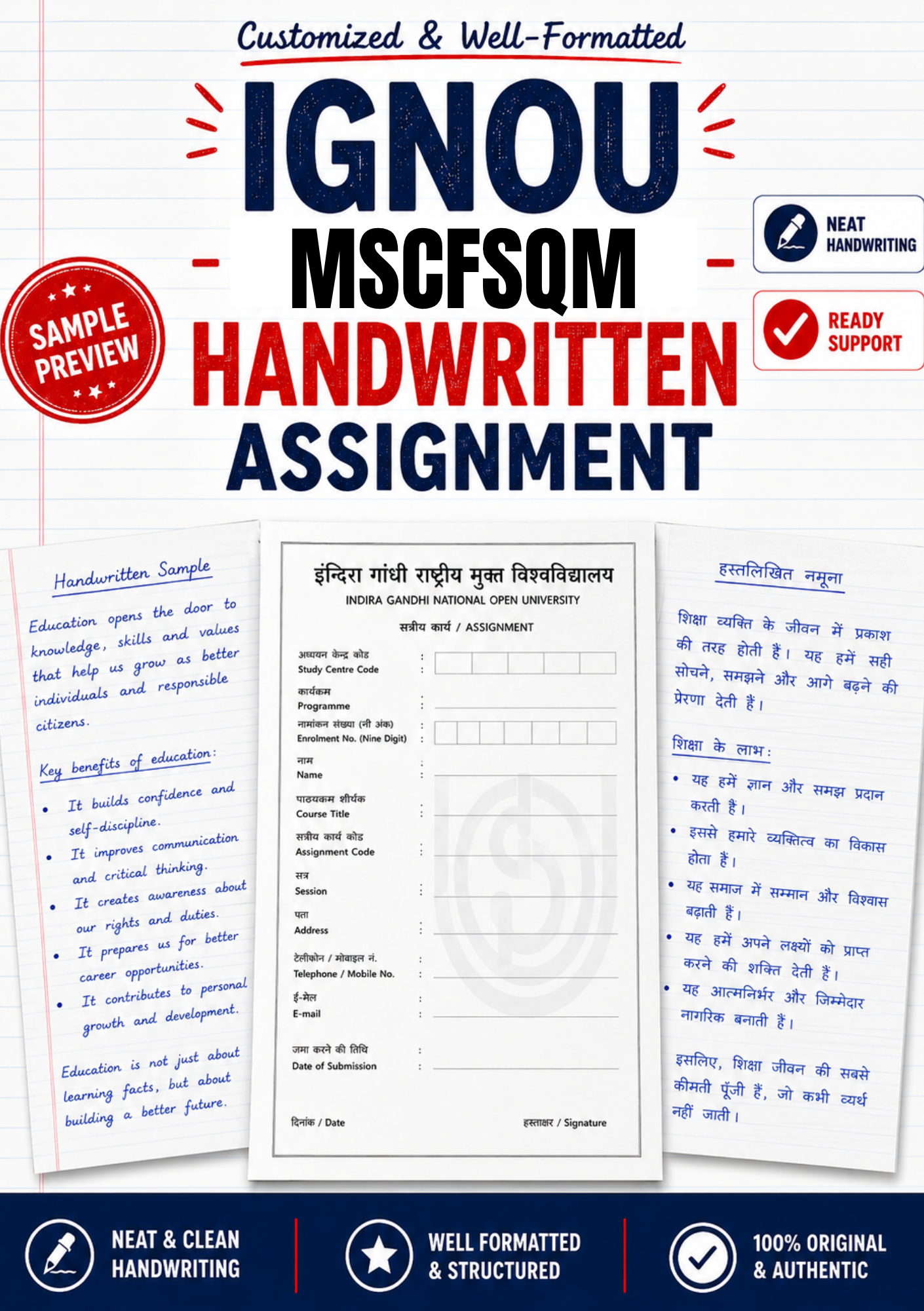
Alongside the handwritten answers, each set carries a free front page and a printed copy of the official question paper for that code and cycle. The front page is laid out with the fields the SOA booklet lists for the top of the first answer sheet: enrolment number, name, address, course code, course title, study centre name and code, and date. You fill in your own personal details, so nothing about your enrolment has to be shared beyond the codes and cycle needed to pick the right questions. The fourth item is the courier packet itself, addressed to the pin code you give.
What the parcel does not contain matters as much. There is no typed version, no scanned copy and no file sent by email or WhatsApp. No soft copy or PDF is sold. That is a deliberate line, because the only object the School of Agriculture collects at the study centre is the paper script, and a second, digital version of the same answers would add nothing you can submit.
Where the ₹320 Stops: Included Items and Excluded Ones
The rate is ₹320 per subject, hard copy only, with courier included in that price and no separate shipping charge. On the store the listed price reads ₹350 with ₹320 as the selling price, which is where the “₹30 off” line on the product card comes from; nothing on this page asks you to act before a price changes, and the rate is not tied to a date.
Inside the ₹320, per code, sit four things: the handwritten answers to the five questions, the free SOA-style front page, the printed question paper for that code and cycle, and the courier charge to your pin code. The handwriting match described further down is also inside the same figure. There is no minimum order: one subject or fourteen, same rate. For MSCFSQM the realistic ceiling is lower than fourteen, because only nine or ten papers in the whole programme carry an assignment, so a complete two-year set costs between ₹2,880 and ₹3,200 depending on how MVP-008 is resolved for you.
Outside the ₹320 sit the parts of MSCFSQM that are not assignments at all. The two practical courses, MVPL-001 Food Safety and Quality Auditing and MVPL-002 Chemical Analysis and Quality Assurance, are assessed through guided and unguided experiments at the Programme Study Centre, not through a written assignment. MVPP-003 Project Work 1, MVPP-002 Dissertation, MVPS-001 Seminar and, for lateral entrants, MVPP-004 Project Work 2 are separate pieces of work with their own evaluation route. None of them appears in any SOA assignment booklet read for this page, and none of them is part of this product. Delivery depends on your pin code and is confirmed for your order before you pay. No figure is promised on this page.
Reference File or Foolscap Script: Which One an MSCFSQM Learner Needs
Two different products share the word “assignment” on this store, and MSCFSQM learners ask about the difference more often than about the price. Put simply, a solved assignment here means a typed set of worked answers for one MVP code and one cycle, sold as a download and read on a phone or laptop as study material. A handwritten assignment means those five answers already put down in ink on sheets of paper, laid out to the booklet’s margins and handed over the counter at your study centre as the submission itself.
| Point of comparison | Solved assignment (reference) | Handwritten assignment (this product) |
|---|---|---|
| What it physically is | A typed answer file for one MVP code and cycle | Loose sheets written in ink, one set per MVP code |
| What you do with it | Read it, then write your own script from it | Read and review it, fill in your details, submit it |
| Who it suits | Learners with time to write every answer out themselves | Learners short of writing time before an SOA cut-off |
| Paper and margins | Not applicable; nothing is printed for submission | SOA layout: foolscap, 4 cm top, bottom and left |
| Price line | Listed per code on the solved-assignment shelf | ₹320 per subject, courier included |
On a narrow screen, swipe the table sideways to see every column.
IGNOU’s own wording settles the submission question. Section 5.0 of the MSCFSQM Programme Guide (November 2024) tells learners that they “have to write answer in your own handwriting”, and in the same sentence says not to send a typed assignment response. A printed or photocopied solved file is therefore reading material only. It does not turn into a submission by being printed, stapled or signed.
The same section of the guide carries a second instruction that every buyer of either product should read before ordering. It advises learners not to reproduce the course material or the assignment responses of others, and states that a learner found doing so may be awarded zero marks. That instruction is quoted here because it is IGNOU’s and because it bears directly on how you use any set you receive, from this store or anywhere else. You sign the declaration on the assignment cover page, so you should read and review the content before submitting it, and satisfy yourself that it represents your own understanding of the course.
If what you actually want is the typed reference to write from, it sits on a different shelf: the MSCFSQM solved assignment files, listed code by code, where each MVP paper has its own entry. This page does not sell those files and does not try to.
Ready to hand over the writing on your pending MVP papers? Send the codes, the cycle printed on your booklet and your pin code, and the quote comes back per paper.
The rate is ₹320 per subject, hard copy only, with courier included in that price and no separate shipping charge.
The MVP Papers That Carry an Assignment, Year by Year
Section 3.78 of the IGNOU Common Prospectus July 2026 lists sixteen rows for MSCFSQM: eight in the first year and eight in the second, the last of which applies only to lateral entrants. The prospectus prints no total under the table, so the credits were added up for this page: the first year sums to 36 (seven four-credit courses plus the eight-credit project), and the second year sums to 36 before MVPP-004 (three four-credit theory papers, the three-credit MOOC, the four-credit research methodology paper, the one-credit seminar and the sixteen-credit dissertation). That 72-credit total matches the figure printed in section 3.7 of the Programme Guide, and the first-year 36 matches the stated total of the PG Diploma in Food Safety and Quality Management table in section 8.30 of the prospectus.
The titles below are the prospectus spellings. The “nature” column comes from the Programme Guide, because the prospectus does not classify courses as theory, integrated or practical. The last column records what the 2026 SOA assignment booklets say about each code.
| Code | Official title (prospectus) | Credits | Nature (guide) | Assignment in 2026 booklet |
|---|---|---|---|---|
| MVP-001 | Food Fundamentals and Chemistry | 4 | Theory | Assignment 1, 50 marks |
| MVPI-001 | Food Microbiology | 4 | Integrated (2 theory + 2 practical) | Assignment 2, 25 marks |
| MVP-002 | Food laws and Standards | 4 | Theory | Assignment 3, 50 marks |
| MVP-003 | Principles of Food Safety and Quality Management | 4 | Theory | Assignment 4, 50 marks |
| MVP-004 | Food Safety and Quality Management Systems | 4 | Theory | Assignment 5, 50 marks |
| MVPL-001 | Food Safety and Quality Auditing | 4 | Practical | None |
| MVPL-002 | Chemical Analysis and Quality Assurance | 4 | Practical | None |
| MVPP-003 | Project Work -1 | 8 | Project work | None |
Swipe sideways on a phone to read the assignment column. First-year total: 36 credits.
| Code | Official title (prospectus) | Credits | Nature (guide) | Assignment in 2026 booklet |
|---|---|---|---|---|
| MVP-005 | Food Toxicology and public health | 4 | Theory | Assignment 1, 50 marks |
| MVP-006 | Food Biotechnology | 4 | Theory | Assignment 2, 50 marks |
| MVP-007 | Recent trends in Food Technology and safety | 4 | Theory | Assignment 3, 50 marks |
| MVP-008 | MOOC on Novel Technologies for Food Processing and Shelf-Life Extension | 3 | SWAYAM MOOC, credit transfer | Listed as Assignment 4; see the MVP-008 section |
| MVP-009 | Research methodology | 4 | Theory | Assignment 5, 50 marks |
| MVPS-001 | Seminar | 1 | Seminar | None |
| MVPP-002 | Dissertation | 16 | Dissertation | None |
| MVPP-004 | Project Work -2 (lateral entrants only) | 4 | Project work | None |
Scroll the table sideways if the last column is cut off. Second-year total: 36 credits, or 40 for lateral entrants who take MVPP-004.
Two practical consequences follow from these tables. First, an order for the whole first year is five codes, not eight, because the two practicals and the project are evaluated elsewhere. Second, the integrated course MVPI-001 is the only paper in the programme with a 25-mark assignment. The Programme Guide splits its 100 marks into 35 for the theory examination, 15 for the assignment, 35 for guided experiments and 15 for unguided experiments, so the assignment weighs less on MVPI-001 than on any MVP theory paper, though it still has to be submitted for the learner to be eligible for the term-end examination.
For every other theory paper the standard split applies. Assignments carry 30 per cent of the final course result and the term-end examination carries the remaining 70 per cent. The Programme Guide sets a pass mark of 40 per cent on each component separately as well as on the course aggregate, which means a strong examination score does not rescue a missing or failed assignment on the same code.
MVP-008, the SWAYAM Paper With a New Assignment Slot
MVP-008 is unlike any other code in MSCFSQM. The prospectus footnote asks learners to enrol for the MOOC on Novel Technologies for Food Processing and Shelf-Life Extension, offered by Prof. Hari Niwas Mishra of IIT Kharagpur on the SWAYAM platform, and states that completing it is required for the degree. The Programme Guide adds that learners register for the MOOC in the second year and then apply to IGNOU for a credit transfer after completing it. Read that way, MVP-008 is earned on SWAYAM and imported, not studied and assessed through an SOA assignment.
The 2024 and 2025 second-year booklets agree with that reading. Both list four assignments for the second year, numbered 1 (MVP-005), 2 (MVP-006), 3 (MVP-007) and 4 (MVP-009), and MVP-008 is absent. The 2026 second-year booklet changes the table: it now lists Assignment 1 (MVP-005), 2 (MVP-006), 3 (MVP-007), 4 (MVP-008) and 5 (MVP-009), while the cover letter printed directly above that table still says there are a total of four assignments in the second year. Neither of the two 2026 second-year files opened for this page, for MVP-005 and MVP-009, contains a question page for MVP-008.
The Programme Guide’s marks table points the same way as the 2026 booklet without settling it. It gives MVP-008 a split of 75 marks for the term-end examination and 25 for continuous assessment, which is neither the 70:30 of the other theory papers nor zero. The guide’s structure table calls MVP-008 a theory course worth 3+0 credits, and its syllabus heading for the same course reads 0+3.
What this means for an order: MVP-008 is not written as part of a standard second-year set. If your study centre or Programme Coordinator confirms that an MVP-008 assignment is due for your cycle, and a question page for it has been issued, send that page and it is priced like any other code. Until then, a second-year order covers MVP-005, MVP-006, MVP-007 and MVP-009, which is four codes at ₹320 each.
Where the SOA Paperwork on MSCFSQM Disagrees With Itself
Reading the prospectus, the Programme Guide and the 2024, 2025 and 2026 booklets against one another turns up ten disagreements that affect how an MSCFSQM assignment is written, dated or ordered. Two of them are on this store’s own pages. They are listed plainly rather than resolved silently, because in each case only IGNOU can settle which document is current.
Ten disagreements found while building this page. Where a document is IGNOU’s, ask your Programme Coordinator which reading applies to your enrolment.
1. Paper size. Every SOA booklet read for this page (2024, 2025 and 2026) says “Use foolscap size paper” with a 4 cm margin on the top, bottom and left. The Programme Guide, dated November 2024, says to use A-4 paper with a margin of about 2½ inches on the left. The two instructions describe different sheets.
2. Four assignments or five. The 2026 second-year booklet’s cover letter says there are a total of four assignments in the second year; the date table on the same page lists five, numbered 1 to 5, with MVP-008 inserted as Assignment 4.
3. MVP-008 status. The prospectus and the guide describe MVP-008 as a SWAYAM MOOC completed on the IIT Kharagpur course and brought in by credit transfer; the guide gives it a 75:25 examination-to-assignment split; the 2026 booklet schedules an assignment for it; and no MVP-008 question page was found among the 2026 files.
4. MVP-007 title. The prospectus names it “Recent trends in Food Technology and safety”; the Programme Guide and the 2024 booklet name it “Emerging Trends in Food Technology and Safety”. Write the title your own question page prints.
5. Credit labels. The guide’s structure table lists MVP-008 as theory 3+0 and MVP-009 as theory 4+0, while its syllabus headings for the same two courses read 0+3 and 0+4.
6. Lateral entry wording. The prospectus programme page says PGDFSQM holders “who have completed 32 credits” must add a four-credit project, MVPP-004. The prospectus admission table and the guide describe the same four credits as project work, industrial training report or food testing lab training, and the Samarth programme page adds a MOOC as a further option. The current PGDFSQM itself totals 36 credits, so the 32-credit rule reads as applying to holders of the older diploma.
7. Fee. The July 2026 prospectus states ₹13,200 per year (₹26,400 in total); the November 2024 Programme Guide states ₹13,000 per year (₹26,000). The prospectus is the later document.
8. Programme code spelling. The booklet covers print MSCFSQM, but the file names on ignou.ac.in for 2026 (for example MVP-001-MSCSFQM-2026 and MVP-005-MSCSFQM-2026) and the 2024 first-year file on webservices.ignou.ac.in spell it MSCSFQM. Searching the portal for the correct code alone can miss the current files.
9. The December 2026 cut-off in circulation. At least one widely read education portal gives 31 October 2026 as the last date for December 2026 assignments. The 2026 SOA booklets print 30 September 2026 for the January 2026 cycle, the cycle that sits the December 2026 examination.
10. This store’s own pages. The store’s handwritten-assignment category page still says A4, still quotes a courier window in working days, and still says “since 2012” where other pages say 2010; the MSCFSQM books shelf still carries a claim about the share of examination questions its books will cover; and the MSCFSQM project shelf describes MVPP-002, MVPP-003 and MVPP-004 as three stages of one project, when the guide treats them as a sixteen-credit dissertation, an eight-credit first-year project and a four-credit project for lateral entrants only. Those pages are being corrected; this page follows the IGNOU documents instead.
None of these ten changes the price or the way an order is placed. They change what you write in the header, which sheet you write on, and which codes you need, so they are worth thirty seconds with your Programme Coordinator before the cut-off rather than a surprise at the counter afterwards.
30 September and 31 March, Both Tied to the Exam Form
The School of Agriculture prints its assignment cut-offs as a pair on every MSCFSQM booklet, and it attaches the same condition to each: the submission has to happen “before submission of TEE form”. The 2026 first-year booklet (MVP-001) and the 2026 second-year booklets (MVP-005 and MVP-009) print the same pair.
| Your cycle | Cut-off printed on the 2026 booklet | Term-end examination it feeds |
|---|---|---|
| January 2026 | 30 September 2026, before the TEE form | December 2026 |
| July 2026 | 31 March 2027, before the TEE form | June 2027 |
If a column is hidden on your phone, move the table sideways.
The pairing follows the Programme Guide’s examination calendar. MSCFSQM is a year-wise programme: a learner admitted in January sits the first term-end examination in December, and one admitted in July sits it the following June. The guide also sets the examination form windows, 1 to 31 March for June and 1 to 30 September for December, which is why the booklet’s “before submission of TEE form” lands on the last day of those same months.
Three details keep these dates from being carried across to other programmes or other years. They are SOA dates: the School of Management Studies prints 31 October and 30 April, and several other schools print different pairs, so a date read off an MBA or MCOM page does not apply to MVP codes. They are also 2026 dates: the 2025 booklets printed 30 September 2025 and 31 March 2026, and the 2024 booklets printed 30 September 2024 and 31 March 2025. And both 2026 booklets tell learners to check www.ignou.ac.in for any change in the due date, because the university’s Student Evaluation Division does announce extensions from time to time; an extension notice from IGNOU is the only thing that moves these dates.
Real deadlines are the only urgency on this page. If you are in the January 2026 cycle, the booklet’s cut-off is 30 September 2026. Delivery depends on your pin code and is confirmed for your order before you pay. No figure is promised on this page. The sensible order is to message first, get the delivery estimate for your pin code, and decide from that.
No TMA Code on the Page: What to Copy Onto Your Cover Instead
Most IGNOU schools print an assignment code in a fixed pattern on every question page, a string with the course code, the letters TMA and the year or session, and learners copy that string onto the cover. The School of Agriculture does not. None of the MSCFSQM question pages read for this page, from 2024, 2025 or 2026, prints a TMA string of any kind. The 2026 pages give only the course code, the course title and the maximum marks above the questions; the 2024 and 2025 pages added a heading such as “Assignment – 4” above the course code, and the 2026 per-course files have dropped that heading.
That leaves the booklet’s own header block as the reference. The SOA booklet asks for the enrolment number, name, address, course code, course title, study centre name and code, and date at the top of the first answer sheet, and says to follow that format strictly. The Programme Guide describes a slightly longer version, adding the programme code, programme title, telephone number, e-mail and date of submission, and asks for the course code in capital letters at the centre of the top of the first page with the top-left corner kept free for office use. Where the two differ, the booklet for your cycle is the more recent instruction.
The assignment number deserves a second look for backlog learners, because the SOA has renumbered it. In the 2024 and 2025 second-year booklets, Assignment 4 is MVP-009 Research Methodology. In the 2026 second-year booklet, Assignment 4 is MVP-008 and MVP-009 becomes Assignment 5. A learner who carries an assignment number over from an older booklet can end up labelling the wrong paper, so on MSCFSQM the course code, not the assignment number, is the identifier to trust.
The cycle is the other half of the identifier. Each SOA booklet covers both cycles of one calendar year (“January 2026 and July 2026”), so the booklet title alone does not tell an evaluator which cycle you belong to. Your front page should name your own cycle, and the question paper printed inside each set matches the booklet you name when ordering.
Your Own Hand, Copied From One Photo
Send a photo of a page you have written yourself and the handwritten set is matched to your handwriting at no extra charge. The matching covers the things an evaluator actually sees on a foolscap sheet: the slope of the letters, the size and spacing of words, how figures and units are formed, and whether headings are underlined. On MSCFSQM that last point matters more than on most programmes, because the answers routinely carry chemical terms, standards numbers such as ISO 22000:2018 and ISO 17025, and legal references such as the Food Safety and Standards Act, 2006, all of which look different in different hands.
The layout follows the SOA instruction rather than a store default. The booklet asks for a 4 cm margin on the top, bottom and left of each answer sheet, and asks learners to indicate clearly the question number and the part of the question being answered. Multi-part questions on the 2026 papers, such as the short notes on emulsifiers, stabilisers and flavouring agents on MVP-001 or the two short notes on MVP-009, are therefore broken out part by part on the page instead of being run together.
A matched sample comes back on WhatsApp before any payment is asked for. If the slope, size or letterforms look wrong to you, say so at that stage; the writing on your codes starts only after you have agreed that the sample looks like your own page.
What the Sample Photo Should Show
A single page is enough, but it helps if it is a page of running prose rather than a list, written in the pen you normally use, and photographed flat in daylight so that the whole line is in focus. A page that includes a few numbers and one or two capital letters gives the writer more to match. Notes from your own study of any MVP block work well, because they already contain the kind of technical vocabulary the assignment answers will use.
English Medium, Older Cycles and PGDFSQM Carry-Overs
The service covers all mediums IGNOU issues the TMA paper in, at the same price. For MSCFSQM that resolves to English alone: the July 2026 prospectus records English as the medium of instruction, and section 3.3 of the Programme Guide says the programme is offered in English language only. No Hindi-medium MVP booklet was found for any year.
Any session is accepted, current cycle or older, including backlog courses, at the same ₹320 per subject. MSCFSQM runs over a minimum of two years and a maximum of four, so learners inside the four-year window regularly carry one or two MVP papers across cycles. The Programme Guide gives a clear instruction for that case: always procure a set of new assignment questions if you have not cleared an assignment in a previous year. In practice that means a backlog paper is written against the current booklet’s questions, not the old ones, and the order should name the cycle you are submitting in now. The guide also says that once you have passed an assignment you cannot resubmit it to improve the grade, so there is no reason to order a code you have already cleared.
PGDFSQM learners are covered by the same first-year work. The PG Diploma in Food Safety and Quality Management is the first year of MSCFSQM under its own programme code: the same eight courses, the same 36 credits, and MVP-001 to MVP-004 and MVPI-001 issued under separate 2026 files with PGDFSQM on the cover and the same 30 September 2026 and 31 March 2027 cut-offs. A PGDFSQM learner orders those five codes exactly as an MSCFSQM first-year learner would, naming PGDFSQM so that the front page carries the right programme code.
Lateral entrants from PGDFSQM into the second year of MSCFSQM have one more thing to check, covered in the sixth disagreement above: depending on when your diploma was completed, MVPP-004 may be part of your second year. MVPP-004 is project work and carries no assignment, so it does not change a second-year order for MVP-005, MVP-006, MVP-007 and MVP-009.
What to Put in Your First WhatsApp Message
An MSCFSQM quote can be given from five pieces of information, and the first message goes faster if all five are in it.
- Your codes, copied from your registration record. List them as printed there, for example MVP-002, MVP-003 and MVP-004, not as “first year”.
- Your programme and cycle. MSCFSQM or PGDFSQM, and January 2026, July 2026 or the cycle you are submitting a backlog in.
- Your study centre’s sheet preference. The SOA booklet says foolscap; if your centre has told you otherwise, say so, because the booklet and the Programme Guide disagree on this point.
- One photo of your own handwriting. A single page, as described in the section on handwriting.
- Your delivery pin code. This is what the delivery estimate is based on.
Nothing else is needed at the quote stage. Your enrolment number and address go on the front page, which you fill in yourself, and there is no form to complete and no account to create. The price is worked out per code: five first-year codes come to ₹1,600 and four second-year codes to ₹1,280, courier included in both.
Codes listed and handwriting photo ready? Send both in one message and the sample comes back before any payment.
There is no minimum order: one subject or fourteen, same rate.
Send codes and a handwriting photo for a ₹320-per-code quote
Once the Foolscap Set Arrives
Open each set against the question paper printed inside it and check three things before anything else: that the course code on the question paper matches the code on your registration record, that the cycle matches the one you are submitting in, and that all five answers are present. If anything is wrong, message on WhatsApp before you fill in the front page.
Then read the answers. You sign the declaration on the assignment cover page, so you should read and review the content before submitting it, and satisfy yourself that it represents your own understanding of the course. Reading the set is also the most direct preparation for the term-end paper on the same code, since the SOA assignment questions and the examination draw on the same blocks of the course.
Fill in the front page with your enrolment number, name, address, study centre and date, following the header format printed on your booklet. The SOA booklet then gives two more instructions worth following exactly. It says assignments have to be sent to the Programme Coordinator of your study centre within the due date, and it strongly suggests that you retain a copy of your assignment responses. The Programme Guide goes further and asks learners to keep a photocopy until the whole programme is complete, in case a submitted set is lost and a second copy is asked for.
After submission, evaluation and feedback run entirely through IGNOU. The Programme Guide says evaluated assignments come back from the study centre with marks and comments, and that assignments are not open to re-evaluation except for factual errors. No claim is made about the marks any assignment will receive, about how an evaluator will assess it, or about whether it will be accepted. Assignment evaluation is entirely a matter for IGNOU.
Other Shelves MSCFSQM Learners Open
Learners who order handwritten sets on MVP codes usually need something for the term-end examination on the same codes. The MSCFSQM guide books for the MVP theory papers cover the blocks that both the assignment questions and the examination draw on, and the MSCFSQM solved guess papers are organised for last-stage revision before a December or June sitting.
The project side of the programme sits on separate shelves. The MSCFSQM project and dissertation shelf is where MVPP-003 and MVPP-002 support is listed, and learners on the diploma route will find the printed PGDFSQM project report service on its own page. PGDFSQM learners who want revision material for MVP-001 to MVP-004 can also use the PGDFSQM diploma book shelf, which covers the same first-year courses under the diploma’s own code.
If you would rather read typed reference answers across several programmes, the full solved assignment catalogue is organised by programme, and a bound, printed solved-assignment book for any course is available for learners who prefer paper to a screen. Learners with papers in more than one programme can start from the handwritten assignment hub for every IGNOU programme, and those preparing several master’s examinations at once can browse the master’s guess paper collection.
If you would rather write the MSCFSQM work yourself and want the project side explained first, the sister site’s MSCFSQM project and dissertation guide on ignouproject.com walks through MVPP-002, MVPP-003 and MVPP-004 in more depth. The official question papers themselves are on IGNOU’s assignment download service; search it for MSCSFQM as well as MSCFSQM, for the reason given in the eighth disagreement above.
MSCFSQM Ordering Questions, Answered
What does one MSCFSQM paper cost, and is courier charged on top?
Each MVP or MVPI code is ₹320 as a handwritten hard copy, and that figure already includes courier to your pin code, the free front page and a printed copy of the question paper. A full first-year order of five codes is ₹1,600 and a standard second-year order of four codes is ₹1,280.
Which MSCFSQM papers actually have an assignment?
In the first year, MVP-001, MVPI-001, MVP-002, MVP-003 and MVP-004. In the second year, MVP-005, MVP-006, MVP-007 and MVP-009, with MVP-008 newly listed in the 2026 booklet. MVPL-001, MVPL-002, MVPP-002, MVPP-003, MVPP-004 and MVPS-001 have no assignment in any SOA booklet read for this page.
Does MVP-008, the SWAYAM MOOC paper, need a handwritten assignment?
The prospectus and Programme Guide describe MVP-008 as a SWAYAM course brought into MSCFSQM by credit transfer, yet the 2026 second-year booklet lists it as Assignment 4 without printing questions for it in the files opened for this page. Ask your Programme Coordinator before ordering it; if a question page has been issued for your cycle, send it and it is written at ₹320 like any other code.
What is the MSCFSQM assignment last date for 2026?
The 2026 SOA booklets print 30 September 2026 for the January 2026 cycle and 31 March 2027 for the July 2026 cycle, each to be met before the term-end examination form is submitted. Dates such as 31 October that circulate on general IGNOU pages belong to other schools, and only an extension notice from IGNOU moves the SOA dates.
Can I submit the assignments in printed form, or is only a handwritten one allowed?
Only handwritten. Section 5.0 of the MSCFSQM Programme Guide says the answers have to be written in your own handwriting and that a typed response should not be sent, so a typed or printed MVP answer file cannot be handed in as it is.
Solved assignment aur handwritten assignment mein kya difference hai for MSCFSQM?
The solved assignment is a typed answer file for one MVP code, meant to be read as study material; the handwritten assignment is the paper script, in ink on foolscap with the SOA margins, that goes to your study centre. The first is reference, the second is the submission, and this page sells only the second.
Could I print a downloaded MVP answer PDF and staple it instead?
No. The Programme Guide rules out typed responses, and it separately warns that reproducing the course material or other learners’ responses can lead to zero marks. A downloaded file is something to study from, and anything submitted should be reviewed and understood by you first.
Foolscap or A4: which sheet does my MSCFSQM set use?
The 2024, 2025 and 2026 SOA booklets all ask for foolscap with a 4 cm margin on the top, bottom and left, while the November 2024 Programme Guide mentions A-4 with a wider left margin. Tell Shri Chakradhar Publication which one your study centre accepts in your first message, and quote the booklet if the centre has not said.
I am enrolled in PGDFSQM, not MSCFSQM. Can I order MVP-001 to MVP-004?
Yes. The diploma’s five assignment papers are the same codes as the MSCFSQM first year, issued in 2026 under separate PGDFSQM files with the same two cut-off dates, and they are priced the same way. Name PGDFSQM in your message so the front page carries the right programme code.
I joined the second year by lateral entry. Is there an assignment for MVPP-004?
No. MVPP-004 Project Work 2 is a four-credit project, industrial training report or lab training component for some lateral entrants and has no assignment. Your second-year assignments are the same MVP papers as every other second-year learner’s.
My study centre collects scanned copies online. How do I submit an MSc assignment of IGNOU online from this set?
The SOA booklet and the Programme Guide both describe submission to the Programme Coordinator at the study centre. Where a Regional Centre runs an online upload instead, it scans the same handwritten pages, so you would scan the set yourself after filling in the front page; confirm the process and file format with your Regional Centre.
Is it worth ordering MVPI-001 when its assignment is only 25 marks?
Its assignment is worth 15 of the course’s 100 marks, less than on any MVP theory paper, but the Programme Guide still requires every assignment to be submitted before you can sit the term-end examination. It is priced at ₹320 like every other code.
Is a Hindi-medium MSCFSQM assignment available?
MSCFSQM is offered in English only, according to both the July 2026 prospectus and the Programme Guide, and no Hindi-medium MVP booklet was found. Every MSCFSQM set is therefore written in English.
The MVP page shows no TMA code. What goes on my front page instead?
Use the header the SOA booklet prints: enrolment number, name, address, course code, course title, study centre name and code, and date, and add your own cycle. Rely on the course code rather than the assignment number, because the 2026 booklet renumbered MVP-009 from Assignment 4 to Assignment 5.
I have an MVP-006 backlog from the 2024 cycle. Which questions get written?
The Programme Guide asks learners with an uncleared assignment to use the new set of questions, so the order is written against the current booklet for the cycle in which you are submitting now. Name that cycle in your message and the matching question paper is included in the set.
Three Sources Behind This Page, Kept Apart
From the IGNOU Common Prospectus July 2026. Section 3.78 (pages 137 and 138) supplied every course code, prospectus title and credit value for MSCFSQM, the English medium, the modular structure with the PGDFSQM exit after the first year, the lateral entry rule and the MVP-008 MOOC footnote. Section 8.30 (page 288) supplied the PGDFSQM course table and its stated 36-credit total. The admission table (serial 62) supplied the two-to-four-year duration and the fee. The credit arithmetic was run for this page: 36 in the first year and 36 in the second, 72 in all, matching section 3.7 of the Programme Guide.
From IGNOU’s live documents on ignou.ac.in. The 2026 first-year booklet for MVP-001 and the 2026 second-year booklets for MVP-005 and MVP-009, all under the School of Agriculture assignment folder, supplied both cut-off dates, the “before submission of TEE form” condition, the foolscap and 4 cm margin instruction, the header format, the question pattern and the five-slot second-year table. The first-year booklet can be opened directly at IGNOU’s MVP-001 file for 2026, and the second-year cover letter that still counts four assignments sits in the MVP-005 file for the same year. The 2025 first-year booklet (MVP-003) and the 2024 and 2025 second-year booklets were read for comparison, and the MSCFSQM Programme Guide (November 2024) supplied the course natures, the marks distribution, the pass rules, the examination form windows and the handwriting instruction.
From Shri Chakradhar Publication’s own commercial terms. The ₹320 rate, the courier inclusion, the free front page, the printed question paper, the handwriting match, the absence of a minimum order and the rule that delivery is confirmed per pin code are the publisher’s terms, not IGNOU’s, and they are the only statements on this page that IGNOU documents cannot confirm or contradict.
Important Notice
Shri Chakradhar Publication Pvt. Ltd. and shrichakradhar.com form an independent IGNOU study-support publisher. This is not the official website of Indira Gandhi National Open University, is not affiliated with, endorsed by or authorised by the university, and no page on this site should be treated as an official IGNOU communication.
Programme structures, course codes, submission dates and rules change, and only ignou.ac.in and your Regional Centre can confirm the current position for your enrolment.
No claim is made about the marks any assignment will receive, about how an evaluator will assess it, or about whether it will be accepted. Assignment evaluation is entirely a matter for IGNOU.
You sign the declaration on the assignment cover page, so you should read and review the content before submitting it, and satisfy yourself that it represents your own understanding of the course.
Start Your MSCFSQM Set on WhatsApp
Name your MVP codes, your cycle and your pin code, add one photo of your handwriting, and the quote and matched sample come back before you pay anything.
The rate is ₹320 per subject, hard copy only, with courier included in that price and no separate shipping charge.
Message +91 93546 37830 with your MSCFSQM codes at ₹320 each
Second-year learner with MVP-005 to MVP-009? Ask for a second-year MVP quote at ₹320 per subject.