

Description
In short. A handwritten assignment is the answer set for IGNOU’s Tutor Marked Assignment questions, written out by hand on A4 and handed in as a hard copy at the study centre, and for MAER, the 64-credit Master of Arts (Entrepreneurship) that the School of Vocational Education and Training runs semester wise across seventeen courses, exactly fifteen of those courses carry a question paper, MER-001 to MER-015, while MERP-001 Project I and MERP-002 Project II are assessed through project work instead; Shri Chakradhar Publication prepares that written set one MER code at a time, against whichever SOVET file governs your cycle. The rate is ₹320 per subject, hard copy only, with courier included in that price and no separate shipping charge. No soft copy or PDF is sold. Two live SOVET files print two different December cut-offs, one 15 September and one 15 October, both against the same 15 March June date, and that disagreement is set out in full further down this page rather than smoothed over.
What Lands on Your Doorstep in the MAER Packet
Four physical things arrive together in one courier bundle, and nothing arrives by email. The first is the written answer set itself, one stapled group of A4 sheets per MER code, in blue or black ink, with the question number from the SOVET paper written against each answer so an evaluator can follow the order without hunting.
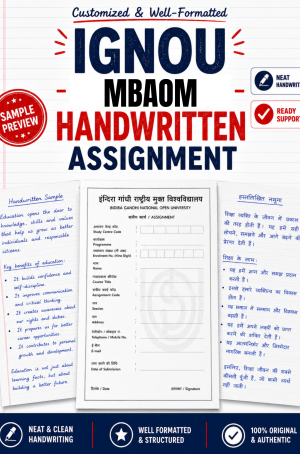
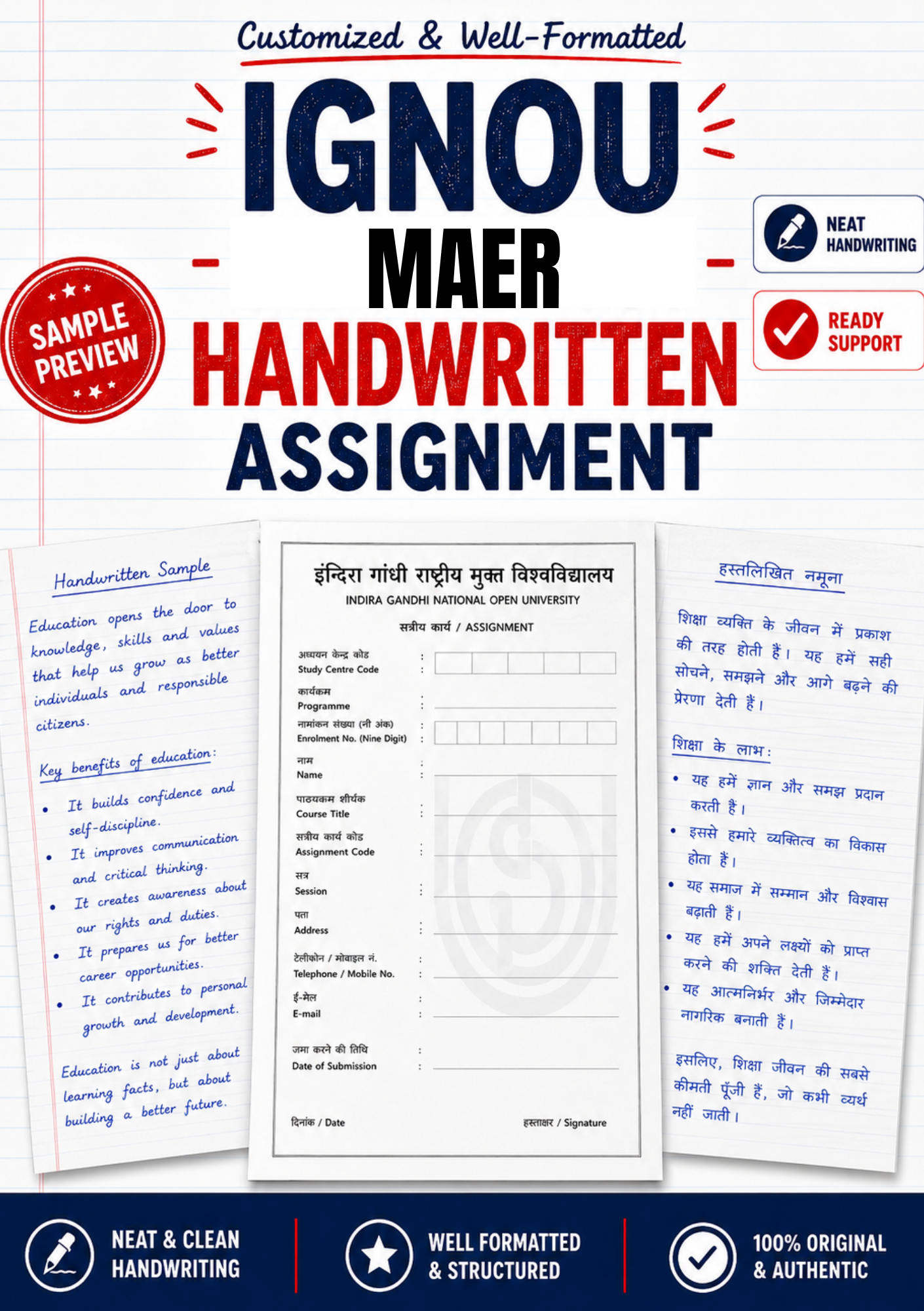
The second is an IGNOU-format front page for each code, already carrying the programme code MAER, the course code, the assignment code exactly as the file you downloaded prints it, and the session. Your name, enrolment number, signature and study centre code are deliberately left blank, because those are yours to write in on the day you submit.
The third is a printed copy of the official TMA paper the answers were written against. On MAER this matters more than it does on most programmes, because SOVET has circulated several MER files whose question sets differ completely between cycles, and a counter clerk comparing your answers against the wrong year’s questions is a problem that a stapled paper solves in ten seconds.
The fourth is a plain delivery slip with the codes counted out on it, so you can check fifteen papers against fifteen bundles without opening every staple. No soft copy or PDF is sold. Nothing in the packet is a scan, a download link or a file transfer, and there is no version of this order that arrives on a phone.
Where the ₹320 Line Stops on an MER Order
The rate is ₹320 per subject, hard copy only, with courier included in that price and no separate shipping charge. A subject means one MER code with one question paper against it. MER-001 is one subject. MER-001 and MER-002 together are two subjects, priced at ₹640. The figure does not change because a code sits in Semester I rather than Semester IV, and it does not change because a paper happens to be long.
Four things sit inside that figure and are never billed separately: the writing itself, the IGNOU-format front page, the printed copy of the question paper, and the courier. Handwriting matching is also inside it, which is covered in its own section below.
What sits outside it is anything that is not a Tutor Marked Assignment. The MERP-001 and MERP-002 project courses are not priced here at all, because they are not TMA work and no MER-style question paper is issued for them. Study material, help books and guess papers are separate shelves on this store and are linked further down. There is no minimum order: one subject or fourteen, same rate. A learner clearing one carried-forward paper pays ₹320 and is not steered towards a semester bundle.
Delivery depends on your pin code and is confirmed for your order before you pay. No figure is promised on this page.
A Soft-Copy Reference or a Written Set: Telling the Two Apart Before You Pay
Two very different things sit behind the phrase people type into a search box, and buying the wrong one wastes a cycle. A solved assignment is a soft-copy reference file of model answers for a course code and session, meant to be read and learned from. A handwritten assignment is the answers written out by hand on A4 and submitted in hard copy at the study centre. The first teaches you what to write. The second is the thing you actually hand over.
| Point of difference | MAER solved assignment | MAER handwritten assignment |
|---|---|---|
| Format | Soft copy, read on a screen or printed for your own reading | Hard copy, written by hand on A4 in blue or black ink |
| What you do with it | Read it, understand the argument, then write your own answer | Fill in the front page and hand it in at the study centre |
| Who it suits | Learners who intend to write MER-001 to MER-015 themselves and want a worked reference for the shape of an answer | Learners who have the understanding but not the writing hours before the SOVET cut-off |
| Price basis on this store | Priced per course code on the solved-assignment shelf, a separate product line | ₹320 per subject, hard copy only, courier included |
| Can it be submitted as it is | No. It is reference material, not a submission | Yes, once your name, enrolment number, signature and study centre code are filled in |
Scroll the table sideways on a narrow screen.
The point that decides it is printed on the SOVET paper itself. The MER-006 instruction reads that you should attempt the questions and submit this assignment to the coordinator of your study centre, and the MER-007 paper repeats the same instruction in almost identical words. A submission to a coordinator is a physical act at a counter. A downloaded file does not satisfy it, however good the answers inside it are, and printing that file out does not convert it into a handwritten submission either.
So the honest scoping is this: a solved assignment is a reference to write from, and it is not a submission. If what you want is the worked answers to read and learn from, the right place is the store’s own MAER solved assignment shelf, where the MER codes are listed one by one, and this page is not trying to sell you that. This page sells the written hard copy only.
Fifteen MER papers, one handwriting, one courier bundle.
₹320 for one course code. Hard copy. Courier already inside that figure. Any cycle, including a semester you are repeating.
Send Your MER Code List For A Quote
Send the codes exactly as your registration confirmation spells them, the semester you are in, and your pin code.
The Fifteen MER Codes That Carry a Question Paper
MAER is built from seventeen courses across four semesters, and the Common Prospectus for July 2026 puts the total at 64 credits. Summing the table independently gives 64, so the stated figure and the rows agree, which is worth saying because prospectus tables do not always survive that check. Fifteen of the seventeen carry a Tutor Marked Assignment. The titles below are the prospectus spellings; where a SOVET paper spells one differently, the difference is listed in the conflict section rather than quietly corrected here.
| Code | Title of the course | Credits | Semester |
|---|---|---|---|
| MER-001 | Business Environment | 4 | I |
| MER-002 | Fundamentals of Entrepreneurship | 4 | I |
| MER-003 | Business Ideation and Opportunity Identification | 4 | I |
| MER-004 | Business Development and Entrepreneurial Competencies | 4 | I |
| MER-005 | IPR & Technology Commercialization | 2 | II |
| MER-006 | Management of New and Small Enterprises | 4 | II |
| MER-007 | Government Initiatives & MSME Development | 2 | II |
| MER-008 | Finance & Accounting | 4 | II |
| MER-009 | Marketing Management | 4 | III |
| MER-010 | Organizational Management and Labour Relations | 4 | III |
| MER-011 | Start Up, Incubation and Business Ethics | 4 | III |
| MER-012 | Business Research Methods & Applications | 4 | III |
| MER-013 | IT and Entrepreneurship | 4 | IV |
| MER-014 | Innovation and Strategic Management | 4 | IV |
| MER-015 | Social Entrepreneurship | 4 | IV |
Scroll the table sideways on a narrow screen.
Two rows in that list behave differently from the other thirteen. MER-005 and MER-007 are 2-credit courses sitting in a programme where every other taught course is worth 4. That halving does not reach the assignment. Both papers are printed with a maximum of 100 marks, the same as the 4-credit papers around them, so the writing load per code is not halved even though the credit is. A learner budgeting time by credit value will under-budget those two.
The other thing worth reading off the table is that the semester totals are perfectly even at 16 credits each. Nothing about MAER lets you carry a light semester, which is why learners repeating a single paper alongside a full semester tend to be the ones who run out of writing days first.
The Two MERP Courses That Carry No Question Paper
MERP-001 and MERP-002 are the reason the arithmetic on this programme trips people up. Seventeen courses are registered, but only fifteen assignment papers exist, and nobody is going to send you a fifteenth-and-a-half paper for the missing two. Both project courses are worth 4 credits each and both sit at the end of a year rather than inside a taught block.
| Item | Detail as the prospectus states it |
|---|---|
| MERP-001 | Project I, 4 credits, placed at the close of Semester II. No Tutor Marked Assignment is issued. |
| MERP-002 | Project II, 4 credits, placed at the close of Semester IV. No Tutor Marked Assignment is issued. |
| Year One total | 32 credits across Semesters I and II, counting MERP-001. |
| Year Two total | 32 credits across Semesters III and IV, counting MERP-002. |
| Exit award | A learner completing the first year, 32 credits over two semesters, may exit with a PG Diploma in Entrepreneurship (PGDER). |
| Programme total | 64 credits, 17 courses, four semesters, English medium, run by SOVET. |
Scroll the table sideways on a narrow screen.
The exit threshold is worth noticing for a practical reason that has nothing to do with the project itself. Because the PGDER exit is drawn at exactly the Year One line, the eight assignments from Semesters I and II are the ones standing between a learner and a usable diploma if they decide not to continue. A MER-005 paper left unwritten does not just sit as a gap on a grade card; it sits on the diploma route as well. If the project side is what you are actually stuck on, the store keeps that separately, both as reference material for the MERP-001 and MERP-002 report and synopsis and as a bound hard-copy version of the same.
Where IGNOU’s Own MAER Papers Contradict Each Other
Everything in this section was found by reading SOVET’s own files against each other and against the Common Prospectus. None of it is a criticism of the university; open-university paperwork spans decades and templates get carried forward. It is set out because a learner who does not know about it will guess, and guessing on a cut-off date is expensive.
Seven disagreements found in IGNOU’s own MAER documents, plus two in this store’s own pages.
1. Two different December cut-offs. The combined MAER booklet on IGNOU’s assignment index prints 15 March for the June term-end examination and 15 September for the December one. The MER-015 file served under the SOVET folder for the 2025-2026 cycle prints the same 15 March, but 15 October for December. Same university, same programme, two dates a month apart.
2. The cover prefix changes between booklets. One MAER cover reads “Assignments (MAER 001-015)”. Another reads “Assignments (MER 001-015)”. MAER is the programme code and MER is the course prefix, and the two are not interchangeable, but the covers use them as if they were.
3. A cover line that cannot be right. One MAER booklet cover carries the line “1st to 15th Semester”. MAER has four semesters. The other booklet cover prints “1st to 4th Semester”, twice, in two different capitalisations.
4. The assignment code has no settled shape. Across the files read for this page the same field appears as MER-001/TMA with no year at all, as MER-010/TMA/2022, as MER-001/TMA/2023-2024, as MER-002/TMA/2023-24, as MER-011/TMA 2023-24 with the slash missing, and as MER-15/TMA/2025-26 with the course number dropped to two digits. One file also prints MER-005/TMA/2003-24, which is a typing slip for 2023-24.
5. MER-005 contradicts itself on one page. The header line on that paper reads “COVERAGE: ALL BLOCKS” while the instruction two lines below reads that the assignment is based on Blocks 1 and 2 of the course. The same paper then says to answer any ten questions and lists eleven.
6. The instruction line is not uniform. Some MER papers say to attempt all the questions, MER-006 and MER-009 say to attempt any five, and MER-005 asks for ten of eleven at ten marks each. There is no single MAER question pattern to assume.
7. Three course titles are spelled two ways. The prospectus prints Commercialization, Organizational and “Start Up, Incubation”; the SOVET papers print Commercialisation, Organisational and “Startup Incubation” with no comma. A 2025-2026 cover also prints “Course Tile” where it means Course Title.
8. In house, and this store’s own fault. An older MER-001 solved-assignment page on shrichakradhar.com still prints a fixed delivery window, and other legacy pages on this store print two further windows that disagree with it. Delivery cannot honestly be stated as a figure because it depends on your pin code, so no figure appears on this page and the legacy ones are being removed.
9. In house, second item. This store currently exposes two different URLs for the MAER books shelf, one ending ma-entrepreneurship-maer and one ending ma-entrepreneurship-books-maer. Only one should exist, and that is being consolidated.
The practical handling is simple. Whichever MER file your codes actually came from is the one that governs your submission, and its dates and its assignment code are the ones written onto your front page. Where a code appears with two spellings, the version printed on your own downloaded file wins, because that is the version the evaluator is holding.
March, September or October: The Dates SOVET Actually Prints
MAER does not run on the deadline regime most aggregator pages describe, and that is the single most common way a MAER learner gets caught out. The School of Management Studies prints 31 October and 30 April. The School of Social Sciences runs on a different pair again. SOVET prints neither.
What the MAER files print is a June and December framing rather than a July and January one. If you intend to sit the June term-end examination, the assignments go to the coordinator of your study centre by 15 March. If you intend to sit the December term-end examination, one live file says 15 September and another says 15 October, as set out above. Both files add that the university may intimate a different date, and the 2025-2026 file words it as being subject to university guidelines issued from time to time on the IGNOU website.
Two things follow from that date. Assignments carry 30 per cent of the final course result and the term-end examination carries the remaining 70 per cent. Submission is also not optional in the way a low-weight component might suggest, because the MAER booklet states plainly that submitting the assignments on schedule is what makes you eligible to appear in the term-end examination at all. Missing the date does not cost you 30 marks. It costs you the sitting.
The general national deadline chatter, which circulates 30 September, 31 October, 31 May and 31 March in different years, is written for programmes that are not yours. Read your own file, and confirm anything that matters against IGNOU’s own assignment download service before you rely on it.
Reading an MER Assignment Code That Changes Shape Between Files
The assignment code is the string printed near the top of each MER paper, and it is what an evaluator uses to tell one cycle’s answers from another’s. On a settled programme you can describe its shape in one sentence. On MAER you cannot, which is why this page shows the variants instead of inventing a rule.
Read left to right, the field is built from the course code, the letters TMA meaning Tutor Marked Assignment, and usually a session. The MER-015 paper issued for the 2025-2026 cycle prints MER-15/TMA/2025-26. Note what happened: the course code at the top of that same page is printed MER-015 with three digits, and the assignment code below it drops to MER-15 with two. Both are on the same sheet.
Other MER files drop the session entirely and print only the course code and TMA, which leaves nothing on the page to tell a 2022 answer set from a 2026 one except the questions themselves. One file breaks that pattern for a single course and prints MER-010/TMA/2022 while its fourteen siblings print no year at all.
What this means for an order is narrow and practical. The assignment code written on your front page is copied character for character from the file your codes came from, including the two-digit form if that is what your file prints, and including a missing session if that is what your file prints. A front page that is tidier than the paper it accompanies is a front page that does not match, and matching is the whole job of that sheet.
Your Own Handwriting, Taken From a Photo You Send
Send a photo of a page you have written yourself and the handwritten set is matched to your handwriting at no extra charge. The reason this exists is that MAER learners frequently submit across several cycles, and a grade card built from four semesters of submissions in four visibly different hands invites a question nobody wants asked at a counter.
One writer takes the whole order, so fifteen MER papers submitted together look like one person wrote them, because in effect one person did. Where an order spans two cycles, the same sample is used again for the second batch so the second bundle matches the first.
What Makes a Usable Sample Photo
Half a page of your ordinary writing is enough, and ordinary is the operative word. A page written slowly and carefully for the photograph produces a match to handwriting you do not actually use, which defeats the point. Write a few lines the way you write when you are taking notes, photograph it flat in daylight without a flash, and send it on WhatsApp before anything is paid. You see the writer’s match against your sample first, and the order only proceeds if you are satisfied with it.
English Only, Any Semester, Any Backlog Cycle
The service covers all mediums IGNOU issues the TMA paper in, at the same price. On MAER that reduces to a single option, because the Common Prospectus gives the medium of instruction for this programme as English and nothing else. There is no Hindi MER paper to write against, so a request for a Hindi MAER set is a request for something SOVET does not issue, and saying so plainly is more useful than taking the order and improvising.
Any session is accepted, current cycle or older, including backlog courses, at the same ₹320 per subject. This carries real weight on a semester-wise programme. A learner in Semester IV clearing a MER-007 carried from Semester II needs a paper from an older cycle, not the current one, and the two papers may share nothing but a course code. Send the file you actually downloaded, or say which session your record shows, and the answers are written against that.
Re-registration gaps have the same effect. Two learners who entered MAER in the same year can be holding entirely different MER question sets by their fourth semester, which is why this page asks for your codes and your session rather than assuming a standard list. If you would rather write the set yourself, the general method is laid out in the companion guide to preparing an IGNOU handwritten assignment from the official paper on this publisher’s editorial site.
Not sure whether 15 September or 15 October governs your file.
Send the cover page of the MER file you downloaded and the date printed on it is read back to you before anything is ordered. ₹320 per subject, courier included, no cycle refused.
What SOVET Needs From You, and Nothing Beyond It
Five details settle a MAER order. Anything asked beyond these five is not needed to write your papers.
- Your MER codes. Written as your registration confirmation spells them, including the leading zeros if your record uses them.
- Your semester and session. Semester I to IV, and the admission cycle your codes belong to, because a backlog code needs an older paper.
- The cover page of your downloaded file, if you have it. This is the fastest way to settle both the assignment code format and the December date question.
- Your handwriting sample photo. Half a page, ordinary writing, daylight.
- Your delivery address with pin code. Used to confirm the courier route for your order before payment.
Not needed: your enrolment number, your password, your Samarth login, your date of birth, or a scan of your identity card. None of those are required to write an answer set, and none should be sent to any assignment service. The enrolment number goes on the front page in your own hand, on the day you submit.
Once the MAER Bundle Is in Your Hands
Open the packet and count the staples against your code list before anything else. Fifteen codes should give fifteen bundles, each with its own front page on top and its question paper behind.
Then fill in the blanks on each front page by hand: name, enrolment number, study centre code, signature and the submission date. Use the same pen throughout. The front page is the sheet a counter clerk reads first, and a half-filled one is the most common reason a bundle is handed back.
You sign the declaration on the assignment cover page, so you should read and review the content before submitting it, and satisfy yourself that it represents your own understanding of the course. On MAER this is more than a formality on two papers in particular. MER-003 asks you to explain a business idea that comes to your mind, and MER-004 asks you to assess whether you have the basic requirements to be a successful entrepreneur. Those are first-person questions about you, and an answer you have not read and made your own is an answer you cannot defend.
Submit at your allotted study centre, take an acknowledgement or a stamped receipt, and photograph it. Assignment status can take weeks to appear against a grade card, and a receipt is the only thing that settles an argument in the gap.
What Else MAER Learners Pull Off the Shelf
A written set solves the submission. It does not solve the December examination, and MAER learners usually assemble the rest of the shelf around it. Concept reading for the MER blocks sits on the MA Entrepreneurship study-guide shelf, which is where learners go when MER-008 Finance and Accounting turns out to expect a funds-flow statement rather than an essay.
For the term-end examination itself, the pattern-spotting material is filed under MAER guess papers built from earlier MER question sets. Learners who want the worked answers for one specific code rather than the whole programme often start from a single product such as the MER-001 Business Environment reference set and add codes from there.
Learners in other programmes, or MAER learners ordering for a relative in a different one, can start from the handwritten assignment section that covers every IGNOU programme. If your programme has no dedicated page yet, the open order route for any course code and any session handles it. The full index of master’s-level reference answers across programmes sits at the master’s degree assignment listing, and the store-wide entry point for reference PDFs is the solved assignment hub with its course finder.
What MAER Learners Want Settled Before They Pay
Can a printed solved assignment be submitted if the answers in it are correct?
No. Correctness is not what the instruction turns on. The MER papers ask you to submit the assignment to the coordinator of your study centre, and study centres across programmes treat printed or typed answer sets as failing the handwritten requirement, which is listed among the errors that get a bundle handed back. A solved assignment is a reference to write from. Printing it does not convert it into a submission.
What actually differs between the MAER solved assignment and this handwritten set?
Format and purpose. The solved assignment is a soft-copy reference file of model answers for a MER code and session, sold separately on this store’s MAER solved-assignment shelf, and its job is to show you how an answer is built. The handwritten assignment is that content written out by hand on A4, with a front page and the question paper attached, couriered to you ready to hand in. One is for learning. One is for submitting.
Can MER answers be typed if the handwriting is genuinely unreadable?
That is a decision for your Regional Centre, not for a publisher. Learners with a documented reason, such as an injury or a disability affecting writing, have in some cases been permitted a typed submission after applying in advance. The route is to ask your Regional Centre Coordinator before the cut-off rather than to submit typed work and hope. Nothing on this page should be read as permission.
Which December date applies to MAER, 15 September or 15 October?
Both are printed by IGNOU on live MAER files, which is exactly the problem. The combined MAER assignment booklet prints 15 September; the MER-015 file served for the 2025-2026 cycle prints 15 October. The date that governs you is the one printed on the file your codes actually came from, and both files add that the university may notify something different. Send the cover page and it is read back to you.
Do MERP-001 and MERP-002 need a handwritten assignment?
No. Neither project course carries a Tutor Marked Assignment, and no MER-style question paper is issued for them. They are assessed through project work, which is a different submission with its own format and its own timetable. Fifteen codes carry a paper; the two MERP courses do not, and they are not priced on this page.
MER-005 is only 2 credits, so is its paper shorter?
No, and this catches people out. MER-005 IPR and Technology Commercialization and MER-007 Government Initiatives and MSME Development are both 2-credit courses, while every other taught MAER course is 4. Both papers are still printed with a maximum of 100 marks. One MER-005 paper asks for ten answers at ten marks each from a list of eleven questions, which is more separate answers than most of the 4-credit papers demand.
My paper says MER-15 and my study material says MER-015. Which one goes on the front page?
Whichever one your own downloaded file prints in the assignment-code line. The 2025-2026 MER-015 file prints MER-015 as the course code and MER-15 in the assignment code, on the same sheet. The front page is there to help an evaluator match your bundle to a paper, so it is copied from the paper, not tidied up.
Is the MAER assignment available in Hindi medium?
Not as IGNOU issues it. The Common Prospectus gives English as the medium of instruction for MAER, and the MER papers are circulated in English only. Any service offering a Hindi MAER set is offering something the university does not publish for this programme. The all-mediums position on this page means whatever IGNOU actually issues, which here is one medium.
Can a MER code from an old session still be written now?
Yes, and at the same rate. A backlog MER paper from an earlier cycle is written against that cycle’s questions, not against the current ones, because the question sets change substantially between cycles on this programme. Say which session your record shows, or send the old file, and that is the paper the answers are written against.
How many MER codes fall in one MAER semester?
Four taught codes in Semesters I, III and IV, and four taught codes plus MERP-001 in Semester II. Every semester carries 16 credits, so a full-semester order of taught papers is four subjects, except Semester IV where MERP-002 sits alongside MER-013, MER-014 and MER-015 without adding a paper.
Does one MAER booklet cover both the July and the January cycle?
The 2025-2026 file states on its face that the assignments are valid for two admission cycles, July 2025 and January 2026. That is a real convenience and a real trap: it means a learner admitted in January is writing against a file dated to the previous July, and should not go looking for a separate January paper that does not exist.
If assignments are pending, does that block the PGDER exit?
The exit route is drawn at the first-year line, 32 credits across Semesters I and II, and a course is not complete until both its assignment and its examination are done. So the eight taught papers from those two semesters are the ones that matter for the diploma route. Your Regional Centre is the only authority on your specific completion position.
Is the front page included, and how much of it needs filling in?
It is included free with every code, already carrying the programme code, course code, assignment code and session. You fill in your name, enrolment number, study centre code, submission date and signature by hand. The 2025-2026 SOVET file prints its own fill-in block with those same fields, and prints “Course Tile” where it means Course Title, which is worth knowing so the typo does not make you doubt the file.
What does one MER subject cost, and is courier extra?
The rate is ₹320 per subject, hard copy only, with courier included in that price and no separate shipping charge. There is no packing fee, no per-page charge and no handwriting-matching charge. There is no minimum order: one subject or fourteen, same rate.
Will all fifteen papers look like they came from the same person?
Yes. One writer is assigned to your order and keeps it, and the same handwriting sample is reused if you come back for a later semester. Consistency across a four-semester programme is the practical reason the sample photo is collected at the start rather than per order.
Where Every Line on This Page Came From
Three sources sit behind this page and they are kept apart deliberately, because they carry different authority and go stale at different speeds.
The IGNOU Common Prospectus, July 2026. Section 3.69 supplied the programme structure: the seventeen courses, the course titles and credits in the table above, the 64-credit total, the English medium, the eligibility, the four-semester pattern, the School of Vocational Education and Training as the owning school, and the PGDER exit option at 32 credits. The credit column was summed independently against the stated total before the table was published here, and it reconciles at 64.
Live SOVET assignment files on IGNOU’s own servers. Three were opened for this build: the combined MAER booklet carrying MER-001 to MER-015 on the assignment index, a second combined MAER file for the 2023-24 cycle, and the MER-015 file served for the 2025-2026 cycle under the SOVET folder. Everything in the conflict box, the two cut-off dates, the assignment-code variants, the marks patterns and the cover-page wording was read off those files, not carried over from another programme.
This publisher’s own commercial terms. The ₹320 rate, the hard-copy-only format, the included courier, the free front page, the included question paper, the handwriting matching and the no-minimum-order position are Shri Chakradhar Publication’s own terms of trade. They are not IGNOU policy and are not presented as such.
Important Notice
Shri Chakradhar Publication Pvt. Ltd. and shrichakradhar.com form an independent IGNOU study-support publisher. This is not the official website of Indira Gandhi National Open University, is not affiliated with, endorsed by or authorised by the university, and no page on this site should be treated as an official IGNOU communication.
Programme structures, course codes, submission dates and rules change, and only ignou.ac.in and your Regional Centre can confirm the current position for your enrolment.
You sign the declaration on the assignment cover page, so you should read and review the content before submitting it, and satisfy yourself that it represents your own understanding of the course.
No claim is made about the marks any assignment will receive, about how an evaluator will assess it, or about whether it will be accepted. Assignment evaluation is entirely a matter for IGNOU.
Send Your MER Code List and Start the MAER Order
₹320 per subject, hard copy only, courier included in that price. Fifteen MER codes carry a paper; the two MERP project courses do not.
Start The MAER Order On WhatsApp
Repeating a single carried-forward paper rather than a full semester: quote one backlog MER code.
Delivery depends on your pin code and is confirmed for your order before you pay. No figure is promised on this page.