

Description
In short. Shri Chakradhar Publication prepares the Tutor Marked Assignment answers for M.Sc. (Geography), the 80-credit MSCGG programme run by IGNOU’s School of Sciences, written out by hand and posted to you as a submission-ready bundle, one course code at a time across the twenty-one codes on the structure: MGG 001 to MGG 013 for the theory papers, MGGL 001 to MGGL 005 for the practicals, one MGGE elective in the fourth semester, and MGGP 001 for the eight-credit project. The rate is ₹320 per subject, hard copy only, with courier included in that price and no separate shipping charge. No soft copy or PDF is sold. All three MSCGG booklets opened for this page instruct learners to use foolscap size writing paper with a four-centimetre margin on the left, top and bottom, and to complete Part A, Part B and Part C separately before submitting them together, so the bundle is written to that instruction rather than to the A4 pattern most other IGNOU schools print. Any session is accepted, current cycle or older, including backlog courses, at the same ₹320 per subject. Orders go to WhatsApp +91 93546 37830 with your code list and your admission cycle.
What Lands on Your Doorstep
One order covers one course code. What travels in the parcel is a physical set of pages, tied in question order, with nothing to print and nothing to download at your end.
- The written answer set. Part A, Part B and Part C of the MSCGG paper for that code, answered by hand in full, on foolscap sheets with the margin the booklet asks for.
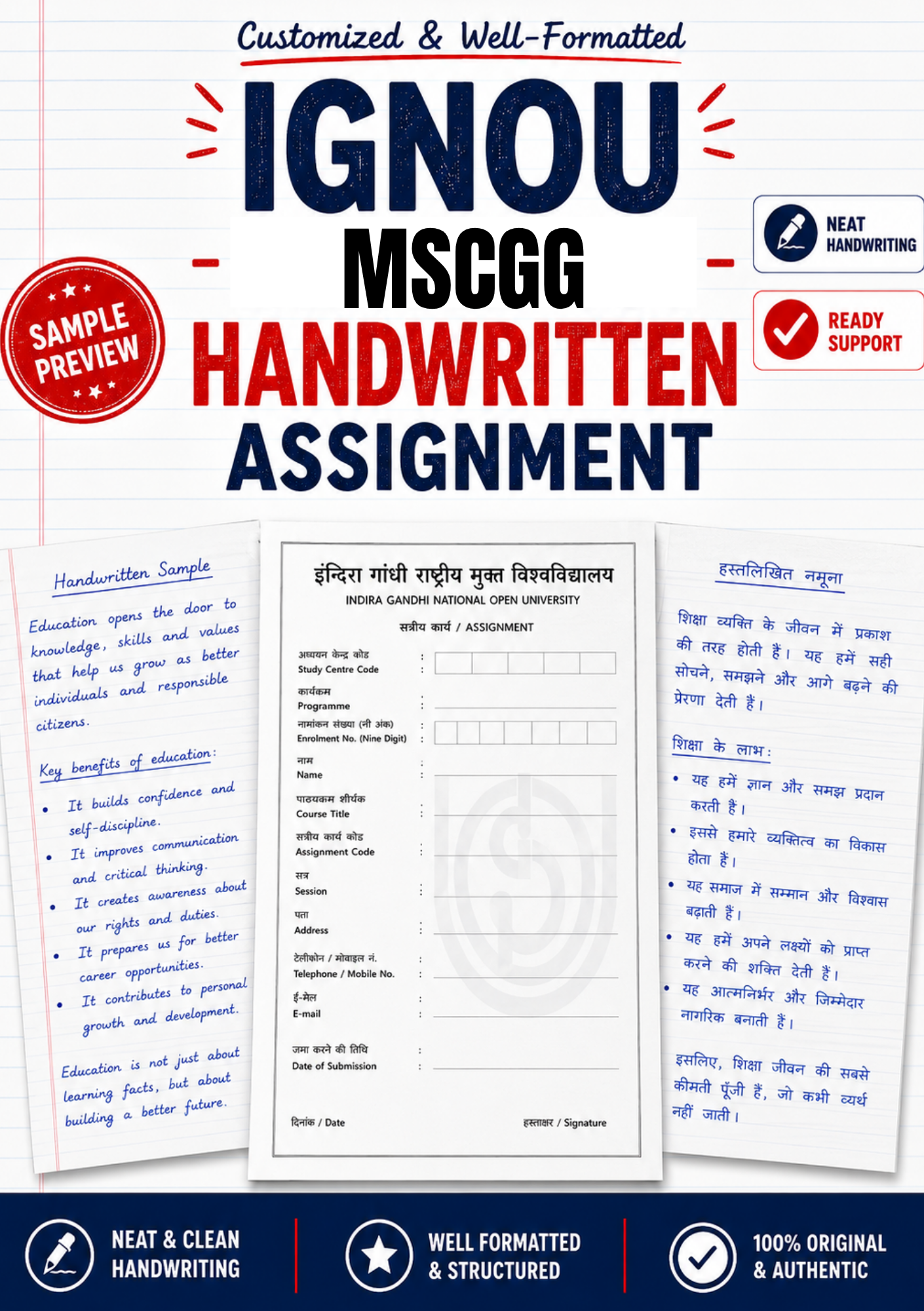
- A blank IGNOU-format cover sheet, free with every order. The MSCGG booklets ask for enrolment number, name, address, course code, course title, assignment number, study centre and date at the top of the first page, and the sheet carries those fields laid out in that order.
- A printed copy of the official TMA paper for the code and cycle you name, so the evaluator can read the question beside the answer.
- Nothing digital. No soft copy or PDF is sold.
You fill in your enrolment number and study centre by hand, sign the declaration, and hand the bundle in. Shri Chakradhar Publication does not complete those fields for you, because the declaration is yours to make.
Where the ₹320 Stops
Pricing on this page is one number with nothing bolted on afterwards, and the honest half of that is naming what the number does not buy.
Inside the rate: the writing itself, the free cover sheet, the printed question paper, and the courier to your address. There is no minimum order: one subject or fourteen, same rate. Outside the rate: nothing is charged separately, and no express tier, packing fee or handling fee exists to be sold to you later.
What the rate cannot buy is a result. No claim is made about the marks any assignment will receive, about how an evaluator will assess it, or about whether it will be accepted. Assignment evaluation is entirely a matter for IGNOU. The MSCGG booklets set the pass bar for the assignment itself at 35 per cent of 100 marks, and where that bar falls for your answers is the evaluator’s judgement, not a seller’s promise.
Timing is the other thing the rate does not fix. Delivery depends on your pin code and is confirmed for your order before you pay. No figure is promised on this page.
Reference File or Submission Bundle: Telling the Two Apart
Two different things get sold under names that sound alike, and MSCGG learners lose money on the confusion every cycle. Worth defining both once, plainly.
A solved assignment is a soft-copy reference file of model answers for a course code and session: you read it, you understand the shape of the answer, and you write your own pages from it. A handwritten assignment is the answers written out by hand and submitted as a hard copy at the study centre. The first is study material. The second is the object the counter accepts.
| Point of difference | Solved assignment | Handwritten assignment |
|---|---|---|
| Format | Soft copy, typed, read on a screen | Foolscap sheets, written by hand, posted to you |
| What you do with it | Read it, then write your own answers from it | Add your details, sign the declaration, hand it in |
| Who it suits | Learners with time to write but not to research | Learners short of writing hours, or writing for several codes at once |
| Rate on this store | Priced per code on the MSCGG solved-assignment shelf | ₹320 per subject, courier inside that figure |
Scroll the table sideways on a narrow screen.
IGNOU’s own instruction settles what can be handed in. Instruction 6 on the MGG-002 booklet for 2026-27 reads that answer sheets are to be submitted to your Study Centre within the due date and that sheets received after the due date shall not be accepted, and instruction 2 on the same page limits you to foolscap writing paper. A downloaded file satisfies neither line. Printing a solved assignment does not convert it into a submission, and nothing on this page should be read as suggesting otherwise.
If a reference file is what you actually want, the store’s course-wise MSCGG solved assignment shelf carries those per code and per session, and that is the correct place to buy one. This page sells the written bundle only.
One code, one rate, no arithmetic afterwards.
₹320 per subject · written by hand on foolscap · courier already inside the figure · MGG, MGGL, MGGE and MGGP codes all treated the same way.
Every MGG Code on the MSCGG Structure
The July 2026 Common Prospectus prints the MSCGG structure at section 3.54 as four semesters carrying twenty credits each, totalling eighty. That total was checked by summing the table rather than trusting the printed figure, and it holds only if exactly one of the three MGGE electives is counted, which is what the note under the table specifies.
Two things on this table are worth flagging before you read it. MGG 001 and MGG 008 carry two credits each and the prospectus marks them “to be taken together”, which makes them the only sub-four-credit codes in the whole programme. And five of the twenty-one codes are practicals under the MGGL prefix, a heavier laboratory load than most IGNOU postgraduate programmes carry.
| Code | Title of the course | Nature | Credits |
|---|---|---|---|
| MGG 001 | Introduction to Geograhical Thought | Theory | 2 |
| MGG 008 | Advances in Geographical Thought | Theory | 2 |
| MGG 002 | Geomorphology | Theory | 4 |
| MGG 003 | Regional Geography of India | Theory | 4 |
| MGG 004 | Population and Settlement Geography | Theory | 4 |
| MGGL 001 | Cartography | Practical | 4 |
| MGG 005 | Climatology | Theory | 4 |
| MGG 006 | Economic Geography | Theory | 4 |
| MGG 007 | Environmental Geography | Theory | 4 |
| MGG 010 | Urban Geography | Theory | 4 |
| MGGL 002 | Methods of Geographical Analysis: Quantitative and Qualitative | Practical | 4 |
Scroll the table sideways on a narrow screen.
| Code | Title of the course | Nature | Credits |
|---|---|---|---|
| MGG 009 | Social Geography | Theory | 4 |
| MGG 013 | Oceanography | Theory | 4 |
| MGG 011 | Geographical Information System (GIS) | Theory | 4 |
| MGGL 003 | Geospatial Analysis | Practical | 4 |
| MGGL 004 | Field Survey Methods: Physical and Socio-Economic | Practical | 4 |
| MGG 012 | Introduction to Remote Sensing | Theory, compulsory | 4 |
| MGGL 005 | Remote Sensing Techniques | Practical, compulsory | 4 |
| MGGE 002, 003 or 004 | One elective, chosen by the learner | Theory, elective | 4 |
| MGGP 001 | Project | Project, compulsory | 8 |
Scroll the table sideways on a narrow screen.
MGGP 001 sits outside what this page sells. It is a project, not a Tutor Marked Assignment, and the prospectus splits it in two: synopsis and topic finalisation happen in the third semester, and registration for the project happens in the fourth. If the project is what you are stuck on, the store’s bound project report shelf is the right counter, and the companion editorial site carries a full walkthrough of the MGGP-001 synopsis and report.
The MGGE Elective You Pick in Semester Four
Three elective codes are printed. You take one. That single choice is why two MSCGG learners in the same batch will hand in different fourth-semester bundles, and why the code you read off your own registration confirmation matters more than any list on any website.
| Code | Title of the course | Credits |
|---|---|---|
| MGGE 002 | Natural Resources Management | 4 |
| MGGE 003 | Natural Hazards and Disaster Management | 4 |
| MGGE 004 | Hydrology and Water Resources | 4 |
Scroll the table sideways on a narrow screen.
Note the numbering. The list starts at MGGE 002, and no MGGE 001 appears anywhere in the July 2026 Common Prospectus. Whether a first elective was withdrawn or never issued is not something the prospectus explains, so it is recorded here as an open gap rather than filled in with a guess.
Three MSCGG Booklets, Three Different Stories
Three live MSCGG assignment files were opened on ignou.ac.in for this page, and they disagree with each other on points that decide when you submit and what the code on your paper means. Naming those disagreements is more useful to you than smoothing them over.
Read this before you write a date in your diary.
1. Two live booklets swap the two cut-offs. The MGG-002 file valid from 1 July 2026 to 30 June 2027 prints 30 September 2026 for the January 2026 admission cycle and 31 March 2027 for the July 2026 admission cycle. The MGG-007 file valid from 1 January 2026 to 31 December 2026 prints the reverse pairing: 31 March 2026 for the January cycle and 30 September 2026 for the July cycle. The MGG-011 file for 2025-26 follows the MGG-002 pattern. Two of three point one way. Neither ordering is invented here, and both files are live.
2. The MGG-011 booklet is filed in the wrong school folder. Its own cover page names the School of Sciences, yet the file sits under the School of Social Sciences path on ignou.ac.in while every other MGG file sits under the School of Sciences path. A learner searching the SOS listing alone will not find it.
3. The MGG-002 cover contradicts the prospectus on semester. Section 3.54 of the July 2026 Common Prospectus places MGG 002 Geomorphology in the first semester. The live 2026-27 booklet for the same code prints “2nd Semester” on its cover.
4. One code, two titles, in one document. The MSCGG table calls MGG 011 “Geographical Information System (GIS)”. The MA Economics Group A specialisation table in the same prospectus calls the same code “Geographical Information System-I” and attributes it to a “MA Geography Programme of IGNOU”. No MA Geography programme appears anywhere in that prospectus; the only geography master’s degree in it is MSCGG under the School of Sciences.
5. The prospectus spells one word two ways, one row apart. MGG 001 is printed as “Introduction to Geograhical Thought” and MGG 008 as “Advances in Geographical Thought”. The table above reproduces both exactly as printed rather than silently correcting either.
6. Two assignment-code formats run at once. MGG-002 and MGG-007 both carry the code year 2026 while covering different validity windows, and MGG-011 carries a two-year span, 2025-26. The year in the code does not by itself tell you which window you are in.
7. The header field changes between booklets. MGG-002 and MGG-007 ask for ENROLMENT NO. at the top of the first page. MGG-011 and MGG-012 ask for ROLL NO. instead.
8. An in-house one. This store’s own MSCGG shelves label codes as “MGG 1”, “MGG 4” and “MGG 7” with a space and no zero padding, while IGNOU prints MGG-001, MGG-004 and MGG-007. The store labelling is being corrected. Order using the format on your registration confirmation and the codes will be read correctly either way.
None of this is fixable from outside the university. What it changes is how you should behave: open the booklet for your own code from IGNOU’s own assignment service, read the two dates off instruction 7, and treat any date circulating on a third-party page, including aggregator figures such as 15 September or 31 May, as unverified until your own file agrees with it.
Which Cut-Off Applies to Your Admission Cycle
Assignments carry 30 per cent of the final course result and the term-end examination carries the remaining 70 per cent. That weighting is why the cut-off matters more than it looks: instruction 8 on each of the three MSCGG booklets opened for this page states that you cannot fill the examination form for a course until the assignment for it has been submitted.
The two dates printed across the three MSCGG files opened for this page are 30 September and 31 March. Which one attaches to which admission cycle is exactly what the booklets disagree on, so the safe reading is the one your own file gives. Two further lines from instruction 7 apply whichever ordering holds: sheets received after the due date shall not be accepted, and a learner who misses the window has to obtain the following year’s assignment and submit against that instead. On the MGG-002 file that replacement is the 2027-28 assignment; on the MGG-007 file it is the 2027 assignment. Which is another way of saying that a missed cycle costs you a fresh set of questions, not an extension.
Backlogs are handled at the same rate. Any session is accepted, current cycle or older, including backlog courses, at the same ₹320 per subject.
What MGG-002/TMA/2026 Actually Tells You
The assignment code on the paper is not decoration. It is how a study centre confirms that what you handed in belongs to the window you were registered in, and on MSCGG it reads in three pieces.
The first piece is the course code, MGG-002. The second is TMA, marking it a Tutor Marked Assignment rather than a term-end paper. The third is the year or year span, and this is where MSCGG is inconsistent: MGG-002 and MGG-007 both print 2026, while MGG-011 prints 2025-26. Because the same year can sit on two files covering different validity windows, the code alone will not tell you which set of questions you hold. The validity line under the course title will, so read that instead.
Foolscap, Four Centimetres and Three Parts
Three formatting instructions repeat identically across all three MSCGG booklets, and they differ from what most IGNOU schools print. Instruction 2 restricts you to foolscap size writing paper, and adds that it should not be of a very thin variety. Instruction 3 asks for a four-centimetre margin on the left, top and bottom of the answer sheet, not on the left alone. Instruction 5 asks you to complete Part A, Part B and Part C separately and then submit them together as one bundle.
The paper size is the one that catches people out. Advice circulating online for other IGNOU programmes says A4, and for those programmes it is correct. The MSCGG files say foolscap. Bundles prepared here follow the MSCGG instruction.
The question pattern is stable across the three files: Part A carries four questions of ten marks, Part B carries three questions of ten marks, and Part C is a set of six short notes at five marks each, adding to one hundred. All questions in Parts A and B are compulsory. Where a booklet prints no per-question word limit, none is invented here.
Your Sample Page Sets the Hand
The writing is matched to yours rather than to a house style. Send a photo of a page you have written yourself and the handwritten set is matched to your handwriting at no extra charge.
The sequence deliberately puts you first. The sample goes across, a specimen page comes back for you to look at, and only then does payment come into it. Nobody should be asked to pay before seeing whether the hand is close enough to pass at a counter that has seen your writing on an examination script.
Photographing the Sample Page
A usable sample is a full page, not a line. Write eight or ten lines of ordinary prose, in the pen you normally use, on ruled paper, and photograph it flat in daylight with the whole page in frame. Avoid shooting at an angle, avoid shadow across the sheet, and avoid a page written unusually neatly for the photograph, because a hand that looks nothing like your examination script is the one thing that draws attention.
English Only, Any Cycle, Backlogs Included
The service covers all mediums IGNOU issues the TMA paper in, at the same price. On MSCGG that resolves to one: section 3.54 of the July 2026 Common Prospectus records the medium of instruction as English, and all three assignment files opened for this page are printed in English only. There is no Hindi MSCGG paper to order, and any listing offering one is describing something IGNOU does not currently issue.
Session coverage is wider than the medium. A 2022-23 backlog code, a code you deferred, and the current cycle are all quoted the same way, because the work is the same work. What changes between them is only which set of questions has to be sourced, and older MSCGG files are still retrievable from IGNOU’s own assignment download service.
Send Five Things and Stop There
Orders are quoted from five pieces of information. Anything beyond these five is not needed and should not be sent.
- Your course codes, spelled as your registration confirmation spells them: MGG, MGGL or MGGE, whichever you are registered against.
- Your admission cycle, January or July, and the year, because that decides which of the two cut-offs governs you.
- The session printed on the booklet you downloaded, such as 2026 or 2025-26.
- A photo of a page in your own handwriting.
- Your delivery pin code, which is what the timing estimate is built from.
Enrolment numbers, scanned identity cards, grade cards and payment screenshots are not required to place an order and should be kept to yourself.
Nothing is paid before you have seen the handwriting.
₹320 per subject, hard copy, courier included · sample page reviewed first · any MSCGG cycle including backlogs.
When the Bundle Reaches You
The parcel arrives and four short steps sit between it and a stamped receipt.
Check the code and session on the question paper against the file you downloaded, because a mismatched cycle is the one error that cannot be fixed at the counter. Fill in the cover sheet in your own hand and sign the declaration. Photograph or photocopy the full bundle before you part with it, which is exactly what instruction 6 on the MSCGG booklets advises when it says to retain a copy of your answer sheets. Then hand it in at the Study Centre allotted to you, and collect the receipt.
Keep the receipt until the marks appear against that code on your grade card. It is the only proof that the bundle was submitted inside the window, and it is the document that resolves a status query months later.
What Else MSCGG Learners Pull Off the Shelf
Handwritten bundles are rarely the only thing an MSCGG learner needs in a given cycle, and the store carries the adjacent material on separate shelves.
For revision rather than submission, the MSCGG guess-paper collection works on the term-end side of the 70 per cent rather than the assignment side of the 30. Because the GIS and remote sensing codes sit at the overlap between two programmes, MSCGG learners often find the geoinformatics reference books useful for MGG 011 and MGG 012, and the geoinformatics assignment shelf for the same reason. The shorter PG diploma in geoinformatics titles cover similar ground at diploma depth.
Learners who came in through the undergraduate route, or who are helping a sibling through it, will find the BSCG geography books and the matching BSCG geography assignment shelf under the bachelor’s tree rather than this one. Learners registered on a programme with no dedicated page yet can use the customised handwritten order, and the whole handwritten range sits under the handwritten assignment hub. A printed compilation across programmes is available as the bound solved-assignment book, which is reference material and not a submission.
If you would rather write the pages yourself and only need the method, the companion editorial site publishes a step-by-step guide to preparing an IGNOU handwritten assignment at no charge.
What MSCGG Learners Want Settled First
Is MSCGG the same as MA Geography?
No, and the confusion has a traceable source. The July 2026 Common Prospectus lists exactly one geography master’s degree, M.Sc. (Geography), code MSCGG, run by the School of Sciences. The phrase “MA Geography Programme of IGNOU” appears once in that document, inside the MA Economics specialisation table describing where MGG 011 was adopted from, and there is no such programme in the prospectus. If your registration confirmation says MSCGG, the codes on this page are yours.
Which paper size should MSCGG answers be written on?
Foolscap. Instruction 2 on the MGG-002, MGG-007 and MGG-011 booklets all say to use only foolscap size writing paper, and not of a very thin variety. Advice you will find online telling IGNOU learners to use A4 is correct for several other schools and wrong for MSCGG. Bundles prepared here are written on foolscap with the four-centimetre margin instruction 3 asks for on the left, top and bottom.
My booklet and a website give different last dates. Which one counts?
The booklet for your own course code, every time. Two live MSCGG files currently swap the two cut-offs between admission cycles, and aggregator pages circulate further figures such as 15 September and 31 May that match neither. Download your file from IGNOU’s assignment service, read instruction 7, and use the pair printed there against your own admission cycle.
Can I hand in a printed solved assignment PDF instead?
No. A solved assignment is a soft-copy reference file of model answers you write from; a handwritten assignment is the answers written out by hand and handed in as a hard copy. The MSCGG booklets restrict you to foolscap writing paper and require the parts to be completed and submitted together, so a printout does not meet the instruction. Reference files for MSCGG codes are sold separately on the solved-assignment shelf linked above.
What is the difference between MGG-011 and MGGL 003?
MGG 011 Geographical Information System (GIS) is a four-credit theory course in the third semester and carries a written Tutor Marked Assignment; the 2025-26 file for it runs from a note on geography, cartography and GIS through spatial data models, overlay, visualisation and spatial decision support systems. MGGL 003 Geospatial Analysis is a four-credit practical in the same semester. Both are ordered here at the same rate, but the practical is assessed differently, so send the code exactly as registered.
Why can I not find the MGG-011 assignment on the School of Sciences page?
Because the file is not filed there. The MGG-011 booklet names the School of Sciences on its own cover page, but the PDF itself sits under the School of Social Sciences path on ignou.ac.in, while every other MGG file sits under the School of Sciences path. Searching the SOS listing alone will not surface it. Searching by course code rather than by school does.
Are MGG 001 and MGG 008 ordered as one subject or two?
Two. The prospectus prints them as two credits each and marks them “to be taken together”, which describes the registration pairing rather than a merged paper. IGNOU issues a separate assignment file against each code, so each is quoted at ₹320 per subject like any other. They are simply the smallest two codes in an eighty-credit programme otherwise built on fours and one eight.
Do you write the MGGP 001 project as well?
No. MGGP 001 is an eight-credit project, not a Tutor Marked Assignment, and it is not sold on this page. The prospectus splits it across two semesters: synopsis and topic finalisation in the third, registration for the project in the fourth. Bound project reports sit on the store’s separate project shelf, and the companion editorial site carries a full MGGP-001 walkthrough.
Which MGGE elective should I send you?
Whichever one appears on your registration confirmation. Three are printed, MGGE 002 Natural Resources Management, MGGE 003 Natural Hazards and Disaster Management and MGGE 004 Hydrology and Water Resources, and the prospectus note says you opt for any one of them in the fourth semester. The eighty-credit total only balances if one is counted, so do not send all three unless you have genuinely registered for more than one.
Is there a Hindi version of the MSCGG assignment?
Not at present. Section 3.54 of the July 2026 Common Prospectus records the medium of instruction for MSCGG as English, and the three live files opened for this page are English only. The service covers all mediums IGNOU issues the TMA paper in, at the same price, which on MSCGG means the English paper because that is the only one issued.
How many marks do I need on the assignment to pass it?
The MSCGG booklets state that the three parts total one hundred marks and that 35 per cent of that is needed to pass the assignment. Note what this page does not do with that figure. No claim is made about the marks any assignment will receive, about how an evaluator will assess it, or about whether it will be accepted. Assignment evaluation is entirely a matter for IGNOU.
I am from an arts background. Am I eligible for MSCGG?
The prospectus records the eligibility for MSCGG as a graduate in any stream, which is unusually open for a master of science and does not require geography at bachelor’s level. That is the university’s rule, not this publisher’s, and admission questions belong with IGNOU or your Regional Centre. What it means practically is that many learners on this programme meet the MGGL practicals and the GIS codes without prior background.
Is MSCGG registered year wise or semester wise?
Both descriptions appear in the same prospectus, which is why the question keeps coming up. The programme-list table records the mode of examination for MSCGG as year wise, while section 3.54 lays the courses out across four semesters. The adjacent MSCGI row in the same table is recorded as semester wise. Order against your codes rather than against a semester label and the distinction stops mattering.
How many separate orders is a full MSCGG year?
It depends on the codes you are registered against, not on a fixed number. Each semester on the printed structure carries twenty credits spread across five or six codes, and IGNOU issues one assignment file per code. There is no minimum order: one subject or fourteen, same rate. Send the code list and the quote is simply ₹320 multiplied by however many codes are on it.
Will you fill in my enrolment number on the cover page?
No, and that is deliberate. The cover sheet arrives blank in IGNOU’s format, with the fields the MSCGG booklets ask for laid out in order. You sign the declaration on the assignment cover page, so you should read and review the content before submitting it, and satisfy yourself that it represents your own understanding of the course.
Where Each Line on This Page Came From
Important Notice
Send Your MGG Code List
₹320 per subject. Hard copy only. Courier already inside that figure. Written on foolscap to the instruction your own MSCGG booklet prints, with a free IGNOU-format cover sheet and a printed copy of the question paper in the same parcel.
Send the codes as your registration confirmation spells them, your admission cycle, the session on the booklet you downloaded, a photo of a page in your own hand, and your pin code. Delivery depends on your pin code and is confirmed for your order before you pay. No figure is promised on this page.