

Description
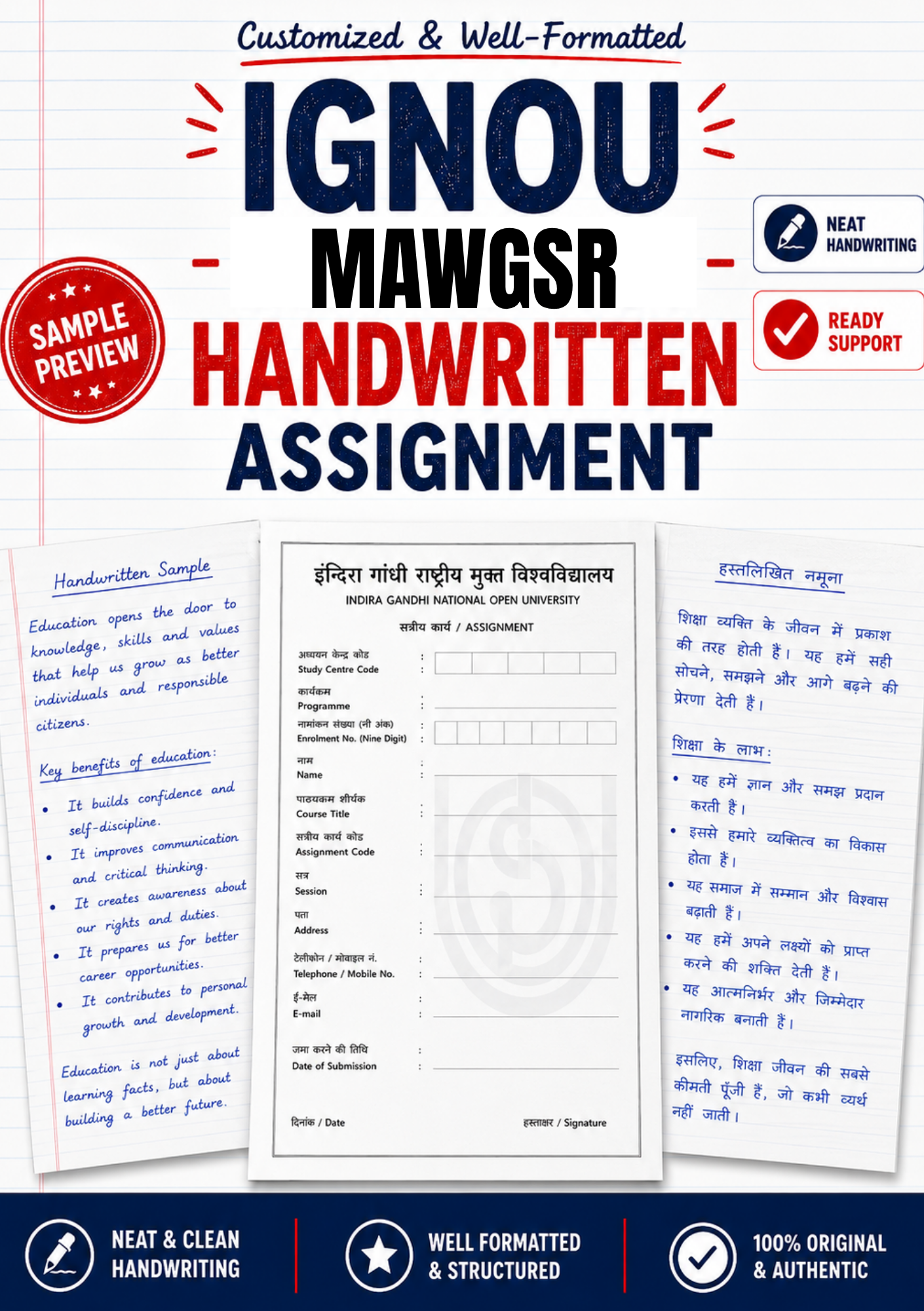
In short. A handwritten assignment is the answer set for IGNOU’s Tutor Marked Assignment questions, written out by hand on A4 and handed in as a hard copy, and for MAWGSR, the 80-credit Master of Arts in Women’s and Gender Studies run by the School of Gender and Development Studies over four semesters, Shri Chakradhar Publication prepares that set one course code at a time. Every course in this programme carries eight credits, which is why the whole degree fits into twelve taught codes across two specialisation routes plus the eight-credit MWGP 101 Project Work, and why a single learner writes only nine assignments in two years. The rate is ₹320 per subject, hard copy only, with courier included in that price and no separate shipping charge. No soft copy or PDF is sold. The service covers all mediums IGNOU issues the TMA paper in, at the same price, which for MAWGSR resolves to English, because section 3.50 of the Common Prospectus for July 2026 records the medium of instruction as English and nothing else. Any session is accepted, current cycle or older, including backlog courses, at the same ₹320 per subject. Send the codes exactly as your registration record spells them, say which of the two specialisations you took, and give a delivery pin code. Delivery depends on your pin code and is confirmed for your order before you pay. No figure is promised on this page.
What Lands on Your Desk When the Packet Opens
The parcel holds paper and nothing else. Inside it are the handwritten answer sheets for each MWG or MANE code you ordered, written on A4 in a single consistent hand, one course to a set so that nothing has to be pulled apart at the study centre. IGNOU’s own MWG-101 booklet for 2024-25 states the requirement plainly: assignments need to be handwritten and each assignment should be submitted as a separate single document, with two assignments never combined and answers to individual questions never split into separate documents. The sets arrive already organised that way.
A blank IGNOU-format front page travels with every set, free with every order, so the enrolment number, programme code, course code and study centre code go on in your own hand at your end rather than in someone else’s. A copy of the official TMA paper for that code is included as well, which matters more on this programme than on most, because SOGDS papers print the question and the block reference together and an evaluator reading a bare answer sheet has no way of checking which block you were told to draw on.
What does not arrive is a file. No soft copy or PDF is sold. There is no download link waiting in an account, no scan sent afterwards, and no typed version supplied alongside the handwritten one. The physical set is the product, and the courier is already inside the ₹320.
Where Your ₹320 Stops, and Where It Does Not
The rate is ₹320 per subject, hard copy only, with courier included in that price and no separate shipping charge. On MAWGSR that figure does not move with the size of the paper, because there is no variation to move with: every taught course in the programme is worth eight credits, and every SOGDS booklet fetched for this page prints the same hundred marks and the same instruction to attempt any two questions. An eight-credit MWG 102 in Semester 1 and an eight-credit MWG 111 in Semester 4 are the same job.
Inside the rate sit the writing itself, the paper and ink, the blank IGNOU front page, the copy of the question paper, and the courier to your address. Outside it sit three things worth naming so that nobody is surprised. The first is the project. MWGP 101 Project Work carries eight credits but carries no Tutor Marked Assignment, so it is not a per-subject line here at all and belongs with the store’s project material instead. The second is anything typed. The third is a promise about how the work will be received. No claim is made about the marks any assignment will receive, about how an evaluator will assess it, or about whether it will be accepted. Assignment evaluation is entirely a matter for IGNOU.
There is no minimum order: one subject or fourteen, same rate. A learner clearing a single backlogged MANE 004 pays per paper exactly what a learner ordering a full Semester 2 pays per paper.
Reference File or Submission Copy: Telling the Two Apart
These two words get used interchangeably in WhatsApp groups and they describe two different objects. A solved assignment is a soft-copy reference file of model answers for a course code and a session, downloaded and read. A handwritten assignment is the answers written out by hand on A4 and submitted in hard copy at the study centre. One is something you read from. The other is something you hand in.
| Point of difference | Solved assignment | Handwritten assignment |
|---|---|---|
| Format | Soft copy, read on a screen | Hard copy on A4, written by hand |
| What you do with it | Read it, then write your own answers from it | Add your details to the front page and submit it |
| Who it suits | A learner who has time to write and wants a reference for MWG 005 method questions or MWG 107 block references | A learner short of the fortnight that nine long answers takes |
| Rate on this store | Priced separately in the solved-assignment shelf | ₹320 per subject, courier included |
Scroll sideways to see the full table on a narrow screen.
The scoping has to be honest in both directions. A downloaded reference file is not a submission and cannot be handed in as one, and every SOGDS booklet fetched for this page carries the same warning: assignments with plagiarised material copied directly from course books or any other external sources will not be accepted. A reference is a place to start from, not a page to copy. If a reference file is what you actually want for this programme, the Women and Gender Studies solved-assignment shelf carries the MWG codes course by course and is the right place to go instead of this page.
Nine papers, one message, one rate.
₹320 per subject, hard copy, courier included. Send your MWG and MANE codes and your specialisation.
The Twelve Taught Codes Behind an 80-Credit Degree
Section 3.50 of the Common Prospectus for July 2026 sets MAWGSR out as an 80-credit two-year programme delivered over four semesters, with a compulsory first year and a choice of two specialisations after it. Every entry in the table below is worth eight credits, and the credits were summed independently against the printed total of 80 before this page was written. The first year alone accounts for 40 of them, which is exactly the threshold at which the prospectus allows an exit with the PG Diploma in Women’s and Gender Studies.
| Semester | Code | Official title in the prospectus | Credits |
|---|---|---|---|
| Year 1, Semester 1 | MWG 101 | Theories of Women’s & Gender Studies | 8 |
| Year 1, Semester 1 | MWG 102 | Gender and Power | 8 |
| Year 1, Semester 2 | MWG 103 | Constructing Gender through Arts & Media | 8 |
| Year 1, Semester 2 | MWG 104 | Gendered Bodies & Sexualities | 8 |
| Year 1, Semester 2 | MANE 004 | Gender and Society | 8 |
| Year 1 total | Exit point for the PG Diploma | 40 |
Scroll sideways to see the full table on a narrow screen.
Two things in that table are worth pausing on. MANE 004 does not belong to Women’s and Gender Studies at all in origin: the MANE prefix is IGNOU’s Anthropology series, and the course sits inside MAWGSR as a borrowed paper. A learner searching for it under an MWG prefix will not find it, and a supplier who assumes all five first-year codes share one prefix will miss it. The second is that these same five codes, unchanged, are the entire content of PGDWGSR as printed in section 8.44. The exit award and the standalone diploma are the same forty credits.
Choosing Between Gender, Literature and Culture and Women’s Studies
The second year is where two learners admitted in the same July stop holding the same papers. The prospectus requires one specialisation to be chosen after the first-year credits are complete, and the third and fourth semesters are then specific to it. What the printed table hides is that one code is common to both routes, so the second year is four papers wide, not six.
| Semester | Gender, Literature and Culture | Women’s Studies | Credits each |
|---|---|---|---|
| Year 2, Semester 3 | MWG 005 Research Methods | MWG 005 Research Methods | 8 |
| Year 2, Semester 3 | MWG 106 Gendered Nation | MWG 109 Women & Social Structure | 8 |
| Year 2, Semester 4 | MWG 107 Postmodernism & Gender | MWG 110 Women in Political Process | 8 |
| Year 2, Semester 4 | MWG 108 Gender & Life Narratives | MWG 111 Women in the Economy | 8 |
| Year 2, Semester 4 | MWGP 101 Project Work | MWGP 101 Project Work | 8 |
Scroll sideways to see the full table on a narrow screen.
MWG 005 is the single most misread code on this programme. It is printed twice in the prospectus, once under each specialisation heading, which reads at a glance as though there are two Research Methods papers. There are not. IGNOU’s own eGyanKosh record for the course titles it Research Methods and marks it as common to both specialisations, and no code numbered MWG 105 appears anywhere in section 3.50. The 100-series numbering simply skips a step and a three-digit code with a leading zero sits in the gap. Order it once, whichever route you took.
MWGP 101 sits in both columns and carries no Tutor Marked Assignment. The prospectus describes it as a research study or an internship of one to three months with an approved organisation, closed by a viva voce, which is project work rather than assignment work. Learners on that stage should look at the bound project shelf for this programme rather than ordering it as a subject here.
Four Programme Codes, One Degree: Untangling MAWGS and MAWGSR
This is the part of a MAWGSR order that goes wrong most often, and it goes wrong because IGNOU’s own documents disagree with each other. The disagreements below were found by reading the prospectus, the live assignment booklets and IGNOU’s published datesheet against one another, and each one is named here rather than quietly resolved.
Six places where the documents behind this programme do not line up.
1. IGNOU’s revised June 2025 term-end datesheet lists MAWGS, MAWGSR, PGDWGS and PGDWGSR as four separate live programme codes in the same line. The Common Prospectus for July 2026 prints only MAWGSR and PGDWGSR. Learners admitted before the revision may still hold papers under the older two.
2. The 2024-25 booklet for MWG-101 sits in a folder path named MAWGSR on IGNOU’s assignment portal, but its own cover page reads “Masters in Women’s and Gender Studies (MAWGS)”. The 2025-26 booklets in the same series read “MA in Women’s and Gender Studies (MAWGSR)”. The folder and the cover disagree.
3. The same 2024-25 booklet prints its assignment number two ways on one sheet: MWG-101/AST/TMA-2024 in the submission table and MWG 101/AST/TMA-2024 in the course block below it. One has a hyphen, the other a space.
4. Course titles differ between IGNOU documents. Section 3.50 of the prospectus prints MWG 107 as “Postmodernism & Gender” while the live booklet prints “Gender and Postmodernism”. MWG 108 is “Gender & Life Narratives” in the prospectus and “Gender and Lifenarratives”, as one word, on the booklet.
5. Titles differ inside the prospectus itself. MWG 102 is “Gender and Power” in the MAWGSR table at section 3.50 and “Gender & Power” in the PGDWGSR table at section 8.44. MWG 103 is “Constructing Gender through Arts & Media” in one and “Constructing Gender Through Arts & Media” in the other. The Anthropology paper is “MANE 004” in section 3.50 and “MANE 4” in section 8.44. Section 8.44 also opens its career-options paragraph with “Students completing the Master’s Degree” on what is a PG Diploma page.
6. Disclosed in-house: this store carries two separate project shelves for one programme, one filed under MAWGS and one filed under MAWGSR, and the MAWGSR shelf describes the programme using the MAWGS code in its own text. That duplication is this publisher’s error, not IGNOU’s, and it is queued for correction.
None of this is resolved on your behalf, because it cannot be. Programme structures, course codes, submission dates and rules change, and only ignou.ac.in and your Regional Centre can confirm the current position for your enrolment. What is done instead is simple: the codes are written on the sheets exactly as your registration record spells them, so that a study centre matching a submission against its own list finds what it expects to find.
The Cut-Off Your SOGDS Paper Refuses to Print
Most IGNOU schools print two dates on the booklet cover, one for each session. The School of Gender and Development Studies does not. Both 2025-26 MAWGSR booklets fetched for this page carry a submission column that says only this: check assignment submission deadlines on the IGNOU website or by contacting your Regional Centre. No date appears in that column at all.
The booklet then contradicts itself. Directly under the empty column it says that the last date of submission for all assignments is mentioned above. Nothing is mentioned above. The 2024-25 booklet in the same series has the same empty column and drops that sentence, which suggests the line is a template carry-over rather than a missing date. Either way, the paper you download for MWG 107 or MWG 108 will not tell you when it is due.
That silence is why the figures circulating for this programme conflict so badly. Aggregator sites currently publish 31 March, 30 September, 30 April, 31 May and 15 September for IGNOU assignment cut-offs in the same twelve-month window, some of them describing extensions granted in earlier years as though they were the standing rule. None of them is quoted here as a MAWGSR date, because IGNOU has not printed one on a MAWGSR paper. What the booklet does state is the consequence: examination forms for the term-end examination will only be accepted if the relevant assignments have been submitted by the given deadline, whatever your Regional Centre sets that deadline to be.
The practical position for a learner ordering here is to treat the Regional Centre’s answer as the only date that exists, and to order far enough ahead of it that a courier transit and a study centre queue both fit inside the gap. Assignments carry 30 per cent of the final course result and the term-end examination carries the remaining 70 per cent. On a programme where each paper is worth eight credits, missing one submission window costs a ninth of the internal marks for the whole degree.
What AST Means in MWG108/AST/TMA-2025
The assignment number printed on a SOGDS paper is not the same string other schools use, and reading it wrongly is a common reason a set comes back for correction. A live 2025-26 example reads MWG108/AST/TMA-2025. Four parts, in order.
- MWG108. The course code, printed on the assignment line without the space that the prospectus uses. The prospectus writes MWG 108. The booklet writes MWG108. Both refer to the same paper.
- AST. Assignment. SOGDS carries this segment where most other schools go straight from the code to TMA, so a MAWGSR number has four segments where an MMPC or MEG number has three.
- TMA. Tutor Marked Assignment, the graded coursework component as opposed to the term-end paper.
- 2025. The single opening year, even though the cover of the same booklet reads Academic Year 2025-26. SOGDS prints a span on the cover and a single year in the code.
Copy the string from the booklet you downloaded rather than reconstructing it, and copy the year from the code line rather than from the cover. A set written against MWG108/AST/TMA-2025 is answering a specific paper, and papers are replaced each cycle. Last year’s MWG 108 questions asked about life narratives and feminist art criticism against supplied images; this year’s may not. Ordering against a superseded paper is the one avoidable failure on this programme, and it is avoided by sending the booklet you actually hold.
Your Own Hand, Copied From a Photo You Send
An evaluator who has been reading the same learner’s submissions across a semester notices when the handwriting changes between courses. Consistency across the set matters more than elegance. Send a photo of a page you have written yourself and the handwritten set is matched to your handwriting at no extra charge. The same writer then carries that hand across every code in the order, so a Semester 3 MWG 005 and a Semester 4 MWG 110 arriving weeks apart still look like one person’s work.
What Makes a Usable Sample Photo
Half a page of ordinary writing is enough, and rough notes work better than a careful specimen, because a matched hand should reproduce how you write when you are not thinking about it. Shoot in daylight, keep the page flat, and include both upper-case and lower-case letters somewhere in the frame. The sample is reviewed and a specimen line comes back before anything is paid for, which is the point at which you decide whether the match is close enough. Nothing is written and nothing is charged until you have seen it.
English Only, Any Semester, Backlogs Included
The service covers all mediums IGNOU issues the TMA paper in, at the same price. On MAWGSR that sentence has a narrow application, because the prospectus records the medium of instruction for this programme as English, with no Hindi stream listed at section 3.50 and no Hindi booklet in the SOGDS folder for the MWG series. Its sibling programme at the same school, MAGD, is printed as English and Hindi. MAWGSR is not. If you have been told a Hindi MWG paper exists for your session, send the booklet and it will be checked against the portal rather than assumed.
Session coverage is broader. Any session is accepted, current cycle or older, including backlog courses, at the same ₹320 per subject. This matters unusually much on a semester-wise programme. The prospectus lists MAWGSR with a semester-wise mode of examination while its own sibling MAGD is year-wise, and a semester structure with a maximum duration of four years produces a great many learners carrying one stray paper from an earlier cycle alongside their current semester. A lateral-entry learner who completed PGDWGSR and joined the second year directly is another ordinary case: the prospectus permits exactly that, and such a learner orders only the second-year codes.
The Five Things to Send Before Writing Starts
Nothing else is needed, and sending more slows the quote down rather than speeding it up.
- The course codes. Written the way your registration record spells them, whether that is MWG 101 with a space, MWG-101 with a hyphen, or MANE 004 with its Anthropology prefix. Do not translate them into what a book seller’s listing shows.
- The specialisation. Gender, Literature and Culture, or Women’s Studies. This decides whether Semester 3 and 4 mean MWG 106 to MWG 108 or MWG 109 to MWG 111.
- The session on the booklet cover. Not the year you enrolled. The academic year printed at the top of the paper you downloaded.
- The handwriting sample photo. Half a page in your own hand.
- The delivery pin code. The address the set travels to, which is what the dispatch estimate is calculated against.
A quote comes back per paper, not per bundle.
₹320 for each MWG or MANE code, with the courier and the front page already inside the figure.
When the Courier Arrives at Your Address
Three things happen at your end, and they are yours to do rather than anyone else’s. Fill in the blank front page with your name, enrolment number, programme code, course code, study centre code and email address, because the booklet asks for exactly those details on every submitted assignment. Read the answers through. You sign the declaration on the assignment cover page, so you should read and review the content before submitting it, and satisfy yourself that it represents your own understanding of the course.
Then submit each course as its own document, in the way the booklet specifies, and keep the acknowledgement. Do not staple two courses together to save a trip. Keep a photograph of each set before it leaves your hands, because a submission that goes missing between a study centre and a grade card is far easier to argue about with an image than without one.
After that the file is IGNOU’s. No claim is made about the marks any assignment will receive, about how an evaluator will assess it, or about whether it will be accepted. Assignment evaluation is entirely a matter for IGNOU.
What Women’s and Gender Studies Learners Add to the Same Order
Orders on this programme rarely arrive alone, partly because eight-credit courses carry more reading than four-credit ones and partly because the second year splits. Learners preparing for the term-end paper alongside the assignment usually pick up the condensed guide books written against the MWG syllabus at the same time, and closer to the examination the question-pattern papers built from previous MWG sittings tend to follow.
Learners who exited at forty credits or entered laterally often need material for the diploma stage, and the bound diploma project work for Women’s and Gender Studies covers that side. Because MANE 004 is an Anthropology paper and because the school runs two gender programmes side by side, a fair number of learners are also registered for or transferring credits from MAGD; both the Gender and Development Studies book shelf and the course-wise reference answers for the MAGD codes get used that way. Undergraduate learners feeding into this programme from a BAG gender discipline can find their own papers on the gender and development shelf inside the Bachelor of Arts assignments, and the Women’s Empowerment and Development diploma papers serve the certificate-level route into the same subject area.
If your programme is not MAWGSR at all, the full handwritten shelf covering every IGNOU programme is the place to start, and a single made-to-order set for any session and any code exists for learners holding a mixed bag of papers across two programmes.
Things MAWGSR Learners Check Before Paying
How many handwritten assignments does a MAWGSR learner actually have to write?
Nine over the whole degree. Five in the first year, which is MWG 101, MWG 102, MWG 103, MWG 104 and MANE 004, and four in the second, which is MWG 005 plus one paper in Semester 3 and two in Semester 4 on whichever specialisation you chose. MWGP 101 Project Work carries eight credits but no Tutor Marked Assignment, so it is not one of the nine.
What does a MAWGSR handwritten assignment cost for each course code?
The rate is ₹320 per subject, hard copy only, with courier included in that price and no separate shipping charge. It is the same figure for every code on this programme, because every taught course here is worth eight credits and every SOGDS booklet carries the same hundred marks.
Is my programme code MAWGS or MAWGSR, and does it change the order?
IGNOU’s revised June 2025 datesheet lists both as live codes, alongside PGDWGS and PGDWGSR, while the July 2026 Common Prospectus prints only the revised pair. It does not change the rate or the writing. It changes which booklet applies to you, so send the programme code exactly as your registration record shows it and the paper is matched to that rather than to an assumption.
Why is one code written MWG 005 when everything around it is a 100-series number?
Because it is the Research Methods paper shared by both specialisations, and IGNOU never renumbered it into the revised series. No code called MWG 105 exists in section 3.50 of the prospectus. MWG 005 appears twice in the printed table, once under each specialisation heading, which reads like two courses but is one. Order it once.
What is the last date for submitting a MAWGSR assignment?
The booklet does not print one. Both 2025-26 MAWGSR papers fetched for this page carry a submission column that asks you to check the IGNOU website or contact your Regional Centre, and then contradict themselves by adding that the last date is mentioned above when nothing is. Your Regional Centre is the only source that can give you a date, and the aggregator figures circulating for this programme disagree with each other by months.
Can a downloaded solved assignment PDF be printed and submitted instead?
No. A solved assignment is a soft-copy reference file of model answers to read from, not a submission, and every SOGDS booklet states that assignments with material copied directly from course books or any other external sources will not be accepted. A printed file also fails the format requirement, since the 2024-25 booklet for this programme states outright that assignments need to be handwritten.
What is the difference between buying the solved assignment and buying this?
The solved assignment is a file you read and then write from in your own words. This is finished handwritten paper you add your details to and hand in. If reading and writing yourself is the plan, the solved-assignment shelf for this programme is the correct page. If the fortnight that nine long answers takes is not available, this one is.
Is MANE 004 really part of a Women’s and Gender Studies degree?
Yes. MANE is IGNOU’s Anthropology prefix and MANE 004 Gender and Society sits inside the MAWGSR first year at Semester 2, worth the same eight credits as the MWG papers around it. The prospectus writes it as MANE 004 in the MAWGSR table and as MANE 4 in the PGDWGSR table, so both spellings refer to the same course.
How many questions does a SOGDS paper ask, and how long should the answers be?
Both 2025-26 booklets fetched for this page print three questions worth fifty marks each and instruct you to attempt any two, for a hundred marks in total. The 2024-25 booklet adds a recommended length of about a thousand words per answer. The 2025-26 papers drop that guidance, so no word count is invented here that IGNOU has stopped printing.
Will a set written for the previous academic year still work?
Only if you are ordering against that year’s paper deliberately, as a backlog. TMA papers expire and are replaced each cycle, and MAWGSR papers change their questions from year to year even where the code stays the same. Send the session printed on the booklet cover and the set is written against that specific paper.
Do the two specialisations cost different amounts?
No. Gender, Literature and Culture and Women’s Studies both amount to four assignment-bearing papers in the second year, all eight credits each, and the rate is ₹320 per subject either way. The specialisation only tells the writer which booklets to work from.
Is MAWGSR taught in Hindi?
The Common Prospectus for July 2026 records the medium of instruction for this programme as English, and no Hindi MWG booklet appears in the SOGDS assignment folder. The school’s other gender programme, MAGD, is listed as English and Hindi, which is probably where the confusion comes from. The service covers all mediums IGNOU issues the TMA paper in, at the same price, so if a Hindi paper is issued for your session it is written at the same rate.
I exited with the PG Diploma and came back for the second year. What do I order?
Only the second-year codes. The prospectus permits a learner who has completed PGDWGSR to take admission directly into the second year of MAWGSR, and the five first-year codes are already behind you because PGDWGSR is built from exactly those five. So the order is MWG 005 plus the three specialisation papers.
Can I see the handwriting before I pay anything?
Yes, and that is the intended order of events. Send a photo of a page you have written yourself and the handwritten set is matched to your handwriting at no extra charge. A specimen line in the matched hand comes back before payment, and nothing is written until you have looked at it.
Which Document Each Fact on This Page Came From
Three separate sources sit behind this page and they are kept apart on purpose, because they carry different weight.
The IGNOU Common Prospectus, July 2026. Section 3.50 supplied every course code, official title and credit figure, the 80-credit total, the four-semester structure, the two specialisation routes, the 40-credit exit with the PG Diploma in Women’s and Gender Studies, the lateral entry from PGDWGSR into the second year, the English medium of instruction, and the semester-wise mode of examination. The credits were summed independently and matched the printed total of 80 before any of it was used. Section 8.44 supplied the PGDWGSR table used to cross-check the first-year titles.
Live TMA booklets from ignou.ac.in. Three were fetched: MAWGSR-108 and MAWGSR-107 for 2025-26 from the SOGDS assignment folder, and MWG-101 for 2024-25 from the programme index. They supplied the assignment-number format, the empty submission column, the plagiarism statement, the handwritten-submission instruction, the three-questions-attempt-two pattern, the fifty-mark split, and the booklet spellings of the course titles that differ from the prospectus. Nothing about dates was carried across from another school, because SOGDS prints none. You can open the papers yourself from IGNOU’s assignment download service, and the specific 2025-26 booklet quoted above is the MWG 108 paper on ignou.ac.in.
This publisher’s own commercial terms. The ₹320 per-subject rate, the hard-copy-only format, the inclusion of courier and the free front page, the handwriting match from a sample photo, the absence of a minimum order and the refusal to print a delivery figure are Shri Chakradhar Publication’s terms, not IGNOU’s, and are stated as such wherever they appear. If you would rather write the set yourself, the editorial companion at ignouproject.com’s MWGP 101 guide for this programme covers the second-year project stage in detail.
Important Notice
Shri Chakradhar Publication Pvt. Ltd. and shrichakradhar.com form an independent IGNOU study-support publisher. This is not the official website of Indira Gandhi National Open University, is not affiliated with, endorsed by or authorised by the university, and no page on this site should be treated as an official IGNOU communication.
Programme structures, course codes, submission dates and rules change, and only ignou.ac.in and your Regional Centre can confirm the current position for your enrolment.
You sign the declaration on the assignment cover page, so you should read and review the content before submitting it, and satisfy yourself that it represents your own understanding of the course.
No claim is made about the marks any assignment will receive, about how an evaluator will assess it, or about whether it will be accepted. Assignment evaluation is entirely a matter for IGNOU.
Order Your MWG and MANE Codes
The rate is ₹320 per subject, hard copy only, with courier included in that price and no separate shipping charge. Paper only, and one code or nine at the same figure.
Two ways to start. Send your MWG and MANE codes with your specialisation and pin code, and a per-paper figure comes back. Or send the handwriting sample photo first if you would rather see the match before discussing codes at all.
Start the MAWGSR order on WhatsApp Send the handwriting sample first