

Description
In short. MAPFHS is the Master of Arts (Population and Family Health Studies), an eighty-credit degree run year wise over two years by the School of Extension and Development Studies, and every one of its taught courses is worth eight credits rather than the four or six most IGNOU master’s papers carry. Eleven taught codes can hold a Tutor Marked Assignment on this degree: MEDS-071 to MEDS-075 in the first year, then MEDS-047, MEDS-076 and MEDS-077 from the same school in the second, alongside MSOE-002 from sociology, MWG-111 from gender studies and MANE-004 from anthropology, while the eight-credit MEDSP-071 Project Work carries no question paper because it is a report. Shri Chakradhar Publication prepares that handwritten set one course code at a time. The rate is ₹320 per subject, hard copy only, with courier included in that price and no separate shipping charge. No soft copy or PDF is sold. The service covers all mediums IGNOU issues the TMA paper in, at the same price, which on this degree resolves to English, because section 3.49 of the July 2026 Common Prospectus and the MAPFHS Programme Guide both record the medium of instruction as English and nothing else. Send your codes, the year you sit in, the five second-year entries you registered and your pin code, and the handwriting sample comes back before any payment is discussed.
What Comes Out of the Envelope
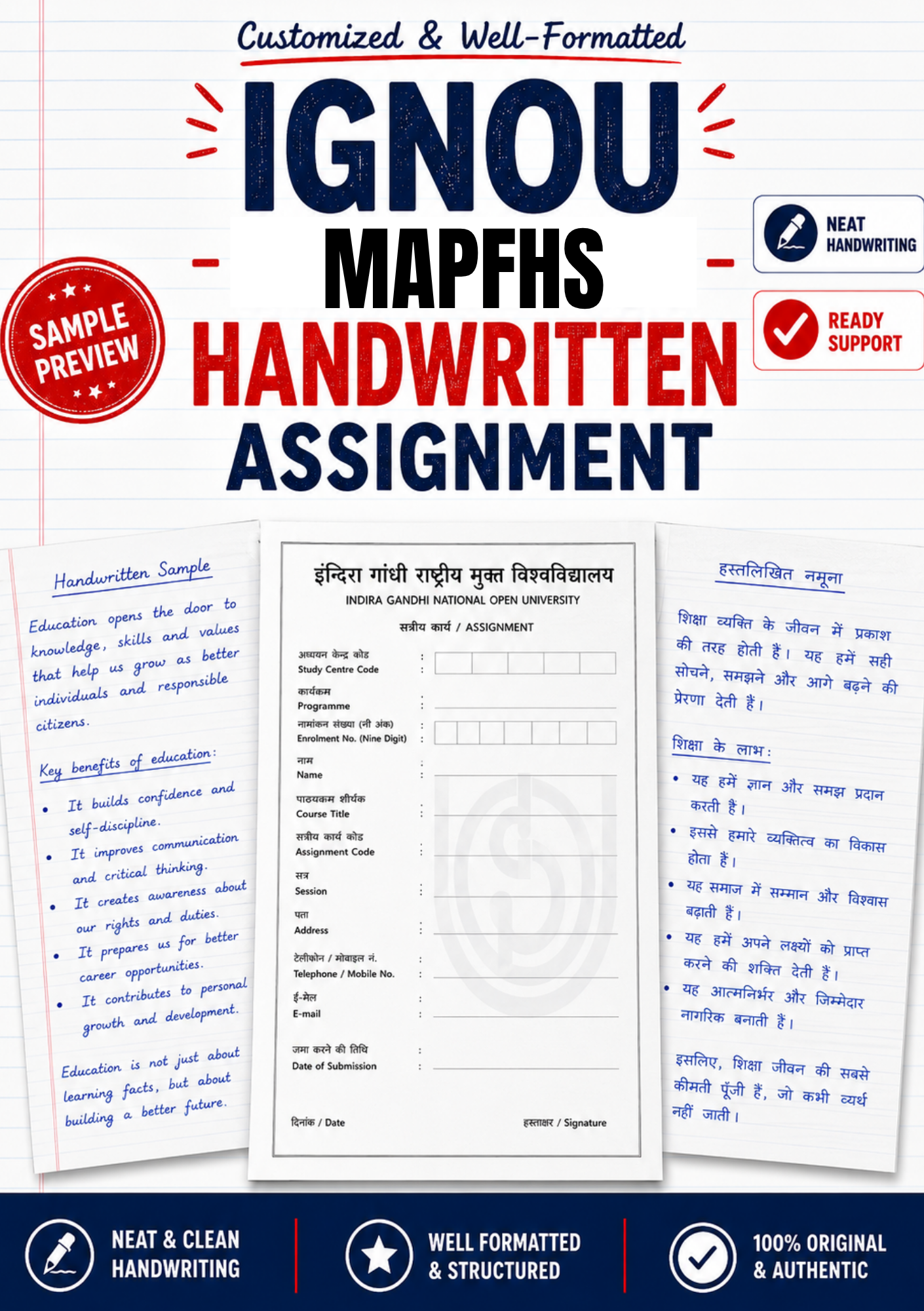
Four physical things travel in a MAPFHS parcel and nothing else does. The first is the answer set itself, written by hand in blue or black ink on A4, one bundle per course code, with the question number written above each answer the way the MEDS booklet asks. The second is an IGNOU-format front page for each code, free with every order, laid out to the fifteen-field cover the School of Extension and Development Studies prints rather than to a generic template. The third is a copy of the official Tutor Marked Assignment paper the answers were written against, so that whoever receives the bundle can see the questions beside the responses. The fourth is nothing more exotic than the packaging, because courier is already inside the rate.
What does not travel is a file. No soft copy or PDF is sold. There is no download link, no drive folder and no scanned mirror of the set sent afterwards, and a learner who wants a digital reference to read from rather than a bundle to submit is looking for a different product entirely, which is dealt with further down this page.
The MAPFHS cover page is worth naming separately because it asks for more than most. The MEDS-077 file published by the school prints a cover with fifteen lines on it, including the father’s or mother’s name, the regional centre and its code, the course coordinator, the date of submission and a signature block, and it then tells you in a separate note to attach the documents in serial order: cover page, IGNOU identity card, the assignment questions, then the handwritten answers. That order is printed on the paper, not inferred, and the front page supplied with each set follows it.
What ₹320 Buys per MEDS Paper, and What It Leaves to You
One code, one rate. The figure covers the writing, the front page, the copy of the question paper and the courier to your address. There is no minimum order: one subject or fourteen, same rate. A learner ordering only MEDS-075 because research methodology is the one they cannot face pays the same per-subject figure as a learner ordering a whole second year.
What the rate does not cover is the project. MEDSP-071 Project Work is an eight-credit report, not an answer set, and it is priced and handled separately from anything on this page. What the rate also does not cover is the part of the work that has to stay with you: reading what arrives, satisfying yourself that it says what you would say, and signing your name to it. You sign the declaration on the assignment cover page, so you should read and review the content before submitting it, and satisfy yourself that it represents your own understanding of the course.
And the rate buys no outcome. No claim is made about the marks any assignment will receive, about how an evaluator will assess it, or about whether it will be accepted. Assignment evaluation is entirely a matter for IGNOU. Delivery depends on your pin code and is confirmed for your order before you pay. No figure is promised on this page.
Reference PDF or Postable Hard Copy: Telling the Two Apart
Two products reach this store under wording that looks almost identical, and only one of them can be put in an envelope. A solved assignment is a soft-copy reference file of model answers prepared against one course code for one session, opened on a screen next to the study material so you can see how a question has been handled before you write your own version. A handwritten assignment is the answers written out by hand on A4 and submitted in hard copy, which is the thing IGNOU actually collects. The first is reading material. The second is a submission.
The distinction is not a marketing line, and the MEDS paper itself is where it becomes concrete. Instruction five on the MEDS-077 booklet tells the learner to write in their own handwriting with relevant references, and the note under the questions lists what to attach in serial order, ending with the entry it spells out as the handwritten assignments. The July 2026 Common Prospectus approaches the same rule from the other side and mentions typed submissions exactly once in four hundred and thirty-odd pages, in the accessibility provisions, where it records that students with disabilities holding a valid disability certificate are allowed to submit a typed assignment. A rule stated only through its exception is still a rule, and it is a more honest citation than the paraphrases that circulate on aggregator sites.
| Point of difference | Solved assignment | Handwritten assignment |
|---|---|---|
| Format | Soft copy, read on a screen or printed for your own reference | Hard copy, ink on A4, tied together |
| What you do with it | Read it, check it against the MEDS blocks, then write your own answer | Check it, sign the cover page, submit it |
| Who it suits | A learner with the evenings to write but not the reading time | A learner out of evenings before the cut-off |
| Rate on this store | Priced separately on the solved-assignment shelves | ₹320 per subject, courier included |
| Can it be handed in as it stands | No. It is a reference, never a submission | Yes, once you have read and signed it |
Scroll sideways on a phone to read the full comparison.
Be plain about the limit. A downloaded PDF of model answers cannot be printed and handed over the counter as your submission, and nothing on this page suggests otherwise. If the soft-copy route is the one that suits your week, the files sit on the master’s-degree solved-assignment shelves rather than here, and that is the correct place to look for them.
Send Your MEDS Codes and the Year You Sit In
₹320 per subject, hard copy, courier included, no separate shipping charge. One code or a full year at the same rate.
Message the codes exactly as your registration confirmation spells them, say whether you are in Year One or Year Two, name the five second-year entries you registered if you are in the second, and attach one photograph of your own handwriting. Start on WhatsApp at +91 93546 37830.
The Five First-Year MEDS Papers on This Order
The first year is fixed. Five compulsory theory courses, no electives, no choice, and each one carrying eight credits, which is why forty credits arrive in a single year on a degree with no semesters. The titles below are read off section 3.49 of the July 2026 Common Prospectus and cross-checked against the framework table in the MAPFHS Programme Guide.
| Course code | Official title | Type | Credits |
|---|---|---|---|
| MEDS-071 | Introduction to Population Studies | Theory | 8 |
| MEDS-072 | Population Theories, Policies and Programme | Theory | 8 |
| MEDS-073 | Social Groups and Family Health | Theory | 8 |
| MEDS-074 | Population and Development: Issues and Challenges | Theory | 8 |
| MEDS-075 | Research Methodology in Population and Family Health Studies | Theory | 8 |
| First-year total | 40 | ||
Scroll sideways on a phone to see the credit column.
That same block of five codes is the whole of the Post Graduate Diploma in Population and Family Health Studies, which section 8.23 of the prospectus prints at exactly forty credits with exactly these codes. It matters practically rather than academically: the note at the foot of section 3.49 records that a learner who has completed PGDPFHS can take admission directly into the second year of MAPFHS, which means a lateral-entry learner never orders a first-year MEDS paper at all and goes straight to the elective block below.
The Second-Year Seven, and Why Three Belong to Other Schools
The second year is where this degree stops behaving like a School of Extension and Development Studies programme. Seven entries sit in the table, five of them are taken, and three of the seven are papers owned by other faculties entirely: MSOE-002 is a Master of Arts (Sociology) elective, MWG-111 comes from gender studies and MANE-004 from anthropology. Their question papers are written by those disciplines, on those layouts, to those calendars, with those submission destinations, and a MAPFHS learner who registers one is answering a paper that was not drafted with this degree in mind.
| Course code | Official title | Paper published by | Type | Credits |
|---|---|---|---|---|
| MEDS-047 | Ecology, Environment and Urban Development | SOEDS | Theory | 8 |
| MEDS-076 | Public Health and Nutrition | SOEDS | Theory | 8 |
| MEDS-077 | Urbanization and Urban Development Challenges | SOEDS | Theory | 8 |
| MSOE-002 | Diaspora and Transnational Communities | SOSS, Faculty of Sociology | Theory | 8 |
| MWG-111 | Women in the Economy | School of Gender and Development Studies | Theory | 8 |
| MANE-004 | Gender and Society | SOSS, anthropology discipline | Theory | 8 |
| MEDSP-071 | Project Work (Population and Family Health Studies) | SOEDS | Project | 8 |
| Any five of the seven | 40 | |||
Scroll sideways on a phone to see the publishing school and credits.
The arithmetic is worth doing out loud, because the printed table does not close on its own. Forty first-year credits plus five second-year entries at eight credits each gives eighty, and eighty is the total the prospectus prints. That only works if MEDSP-071 counts as one of the five. Section 3.7 of the Programme Guide says so directly, recording that project work is offered as an elective and not a compulsory course and that the learner may take it as one of the five second-year electives. The prospectus table does not show it, because it puts an asterisk on the six theory electives and leaves the project unmarked, which reads as five theory papers plus a compulsory project and sums to eighty-eight. Sum the column before you trust the total, and then read the Guide to find out which reading was intended.
MEDS-047 is also shared. It appears in the MA (Urban Studies) second-year table at the same eight credits, which is why a MAPFHS learner who takes it is answering a paper that urban studies learners answer too.
Where the Prospectus, the Programme Guide and the Booklet Contradict Each Other
Everything below was found by reading IGNOU’s own documents against each other rather than by copying a summary from anywhere. None of it is a complaint. It is the list of things worth checking against your own paperwork before you commit to a date or a code.
Nine disagreements found across three official MAPFHS documents and this store’s own pages.
1. The July cut-off is printed two different ways. The MEDS-077 assignment file says the last date for the July session is 30 March and for the January session is 30 September. Section 5.0 of the MAPFHS Programme Guide says 31 March for July and 30 September for January. January agrees; July does not. The booklet sentence also ends mid-clause, trailing off after the words “in the respective”, so the fuller instruction it was meant to carry is missing from the published file.
2. Three different destinations are named for the same bundle. The cover of the MEDS-077 file says assignments should go to the Director, SOEDS, Block 15-F, Swami Vivekanand Bhawan, Maidan Garhi, by hand or by post, or be submitted at the respective Regional Centre. Section 3.3 of the Programme Guide says the responses go to the Coordinator of the Study Centre. Section 7.0 repeats the Study Centre and adds that you may send them to the Director of the School only if there is no counsellor for the programme. Ask your Regional Centre which one applies to you before posting anything.
3. The gender studies code is spelled two ways in one document. Section 3.49 of the prospectus prints MWG 111. The framework table in the Programme Guide prints MGW-111, with the middle letters swapped. The Guide’s own course-content heading a few pages later prints MWG-111 again. The title moves too, from Women in the Economy in the prospectus to Women in Economy in the Guide’s heading.
4. MEDS-072 has a singular and a plural title in circulation. Section 3.49 and the Programme Guide framework table both print Population Theories, Policies and Programme. Section 8.23 of the same prospectus, covering PGDPFHS, prints Programmes, and so does the Guide’s own course-content heading for the same code.
5. The credit column does not sum to the printed total as the table is marked. Six theory electives carry an asterisk, the note says choose any five, and the project sits unmarked beneath them, which adds to eighty-eight against a printed total of eighty. Section 3.7 of the Programme Guide resolves it by making the project one of the five, but the prospectus table alone does not.
6. The maximum duration is four years in one place and five in another. The prospectus programme table and section 1.7 of the Guide both say the maximum duration is four years and that admission is valid for four years. Sections 5.0 and 8.0 of the same Guide both refer to a maximum period of five years from the date of admission.
7. Two programme fees are live. The July 2026 prospectus table records ₹7,000 per year and ₹14,000 in total. Section 1.8 of the Programme Guide, which is dated January 2024, records ₹12,000 in total at ₹6,000 per year. Neither figure has anything to do with the ₹320 on this page, which is a publisher’s charge and not a university fee.
8. The MSOE-002 paper does not mention MAPFHS anywhere. The live 2025-26 file is headed Master’s Degree Programme in Sociology, names MSO Second Year, lists MSOE-001 to MSOE-004 with MPS-003 and MPA-016 as the courses it covers, prints Programme Code MSO, and carries the assignment code MSOE-002/AST/TMA/2025-2026. Its own instructions describe ten questions in two sections of five, while the printed paper carries eight, four per section. Its dates are 31 March 2026 for the July 2025 batch and 30 September 2026 for the January 2026 batch, and its destination is the Coordinator of the Study Centre allotted to you, which is not the destination the MEDS cover prints.
9. This store’s own pages are not yet consistent. Older shrichakradhar.com product bodies still quote ₹300 and 350 rupees per subject alongside the ₹320 stated here, still print delivery-day figures, and still carry superlative and no-rejection wording that this page does not stand behind. MAPFHS has a books shelf and a project shelf on this store but no solved-assignment or guess-paper shelf of its own, which is why the comparison section above points at the master’s-degree parent rather than a MAPFHS child. Those are corrections in progress, and saying so is more useful than leaving you to find the contradiction yourself.
30 March or 31 March: Which Cut-Off Your MEDS Paper Prints
The date on your own file wins over any date on any website, including this one. What can be reported is what the live files say. The MEDS-077 booklet, the only MAPFHS-specific assignment file this build could open, prints 30 March for the July session and 30 September for the January session. The MAPFHS Programme Guide prints 31 March and 30 September for the same two cycles, and attaches the assignment deadline to the term-end examination form deadline in the same line. One day apart, from the same school, about the same learner.
The second-year electives owned by other faculties run to their own calendars. The 2025-26 sociology file that carries MSOE-002 gives 31 March 2026 to the July 2025 batch and 30 September 2026 to the January 2026 batch, and it does so in a small table on the second page rather than in a single instruction line. A learner registered in the second year can therefore be working to a March date and a March date that are not the same March date, depending on which codes they picked.
Why it is worth the trouble. Assignments carry 30 per cent of the final course result and the term-end examination carries the remaining 70 per cent. On a degree where every course is worth eight credits, one missed file is a larger hole than it would be on a four-credit paper. Any session is accepted, current cycle or older, including backlog courses, at the same ₹320 per subject, so a cut-off already passed is a reason to order rather than a reason not to.
Dates also shift inside a cycle. IGNOU has issued blanket extensions before, and Regional Centres issue their own notices. Confirm the operative figure on ignou.ac.in and with your own centre. The only legitimate urgency here is the date printed on your own paper and whatever your centre has said since.
Why a MEDS Paper Carries No Assignment Code At All
Most IGNOU programmes print a string on the assignment page that identifies the paper and the cycle. Management papers print something like MMPC-001 slash TMA slash JULY slash 2026. The sociology file that carries MSOE-002 prints MSOE-002/AST/TMA/2025-2026, with AST for assignment and TMA for Tutor Marked Assignment and a two-year span at the end.
A MEDS paper prints none of that. The MEDS-077 file heads its question page with the words Assignment – 2, then Course Code: MEDS-077, then Maximum Marks: 100, and stops. There is no slash-separated code anywhere on it. The number after the word Assignment is the position of that paper within the programme file rather than a cycle identifier, which is why MEDS-071 to MEDS-075 carry Assignments 1 to 5 in the first-year set.
The practical consequence is small but real: if a study centre form asks you for the assignment code and your paper does not print one, quote the course code and the session shown at the top of the file instead of inventing a string. And if you have picked a second-year elective from another school, that one will have a code, in that school’s format, which is a difference worth expecting rather than being surprised by.
Ink Matched From a Page You Wrote Yourself
Send a photo of a page you have written yourself and the handwritten set is matched to your handwriting at no extra charge. The point is not novelty. It is that a MAPFHS learner in the second year may be submitting to two different destinations against papers from three different schools, and a set that reads as one person’s hand across all of it is simply less trouble than a set that does not.
What the Sample Photograph Needs to Show
One page is enough. Ordinary lined or plain A4, ordinary blue or black pen, daylight rather than flash, and the whole page in frame rather than a corner. Half a dozen lines of your normal writing at your normal speed tells more than a page written carefully for the camera, because the set is being matched to how you actually write. A return sample comes back to you on WhatsApp before any payment is discussed, and if it does not look like your hand, say so and it is redone rather than argued about; ask for that sample photo before committing to the ₹320 rate.
One Medium, Any Cycle, Backlogs Included
The service covers all mediums IGNOU issues the TMA paper in, at the same price. On this particular degree that sentence resolves to a single answer rather than a choice, because section 3.49 of the prospectus, the fee table in the same document and section 1.6 of the Programme Guide all record the medium of instruction as English, and no Hindi MEDS-07x assignment file surfaced anywhere on ignou.ac.in during this build. If IGNOU publishes one later, it is covered at the same rate, with no announcement needed here.
On cycles, the guiding line comes from the file itself. Every MAPFHS assignment page repeats the instruction that irrespective of the year of registration you must submit the latest assignments uploaded on the website, which means the newest file on the portal is the current one even for a learner who registered two cycles ago. Any session is accepted, current cycle or older, including backlog courses, at the same ₹320 per subject. A 2024 registration and a 2026 registration answering the same posted file is the ordinary case on this programme, not the exception. If you also want reading material to check the answers against, the shelves for that sit alongside the master’s-degree book listings.
The Six Lines That Let Writing Start
Nothing elaborate is needed to open an order, and nothing beyond this list is asked for.
- The course codes. Spelled the way your registration confirmation spells them, whether that is MEDS 073 with a space or MEDS-073 with a hyphen.
- Which year you sit in. First year or second year, because the first year is fixed at five codes and the second is whatever five entries you registered.
- Your second-year selections, if you are in the second year. Naming them matters, because three of them are published by schools other than SOEDS and are sourced from different files.
- The session on your paper. Read off the header of the file you downloaded, not guessed from the year you enrolled.
- Your delivery pin code. Delivery depends on your pin code and is confirmed for your order before you pay. No figure is promised on this page.
- One photograph of your handwriting. A single page, described above.
Your enrolment number, your name and the rest of the cover-page fields are filled in by you when the parcel arrives. They are not needed to start writing and are not asked for here.
Two Ways to Get a MAPFHS Set Moving
₹320 per subject, hard copy only, courier included, no separate shipping charge. There is no minimum order: one subject or fourteen, same rate.
If you already know your codes, send them straight through on +91 93546 37830 and the sample follows.
If you are not certain which second-year entries you are registered for, describe your position first and work it out over chat before anything is confirmed.
Once the Parcel Is in Your Hands
Open it and read it. That is the first and most important step, and it is the one learners skip. You sign the declaration on the assignment cover page, so you should read and review the content before submitting it, and satisfy yourself that it represents your own understanding of the course. If a passage does not sound like you, that is worth raising before the bundle goes anywhere.
Then fill in the cover page. The MAPFHS cover asks for your name, enrolment number, father’s or mother’s name, programme name and code, regional centre and code, course title and code, email, phone, the course coordinator, the date of submission, your address and your signature. Fill it in yourself in your own hand; the front page arrives laid out, not pre-filled with details nobody but you knows.
Then submit it to whichever destination applies to you, having checked which one that is. Get a receipt or an acknowledgement and keep it, because the school’s own guide says the study centre has to send the marks onward to the evaluation division, and a receipt is the only thing you hold if the grade card is slow. Keep a photocopy or a phone photograph of the pages too. The assignment result shows up on the grade card in its own time and is entirely IGNOU’s to decide.
What Else MAPFHS Learners Pick Up in the Same Order
Second-year learners ordering a handwritten set most often ask about the project in the same message, since MEDSP-071 counts as one of the five second-year entries and carries no question paper at all; that work is handled at the MEDSP-071 project report and synopsis desk rather than here. First-year learners more often ask for something to read against the population-theory blocks, and a MEDS-72 guide book covering the life-table and population-policy material is the usual answer.
Coming up to a June or December sitting, the revision request changes shape, and solved guess papers across the master’s programmes are what most learners want at that point. Because three second-year MAPFHS papers are owned elsewhere, learners taking them often go looking at the MA Sociology shelf that MSOE-002 actually belongs to, at the women’s and gender studies material behind MWG-111, or at anthropology revision sets for the MANE-004 side. Anyone who picked MEDS-047 will find the same course sitting in the MA Urban Studies listings, which share that code with this degree.
Learners studying MAPFHS alongside a family member or colleague on another programme usually end up browsing handwritten sets for programmes outside SOEDS, where the same rate applies across the store.
What Population Studies Learners Ask Before They Pay
Which MAPFHS course codes actually carry a question paper?
Eleven of the twelve entries in the programme. MEDS-071 to MEDS-075 in the first year, and MEDS-047, MEDS-076, MEDS-077, MSOE-002, MWG-111 and MANE-004 among the second-year electives. MEDSP-071 Project Work carries none, because it is a research report rather than an answer set.
Is the July cut-off 30 March or 31 March for a MEDS paper?
The published MEDS-077 file says 30 March. Section 5.0 of the MAPFHS Programme Guide says 31 March. Both are official IGNOU documents for the same programme and they differ by a day. Work to the earlier date if you want no argument, and confirm the operative one with your Regional Centre.
Do MAPFHS answers go to the study centre or to Block 15-F?
The MEDS-077 cover names the Director, SOEDS, Block 15-F at Maidan Garhi, by hand or post, or the respective Regional Centre. The Programme Guide names the Coordinator of the Study Centre, with the Director only if there is no counsellor. Ask your centre which route it wants before you post, because posting to the wrong address costs you the transit time.
Is MEDSP-071 Project Work covered by the ₹320 rate?
No. The ₹320 figure is per subject for a handwritten answer set written against a Tutor Marked Assignment paper. MEDSP-071 has no such paper. It is a project report and is priced and handled as separate work.
Can a printed solved assignment PDF be handed in for MEDS-073?
No. A solved assignment is a soft-copy reference file of model answers for one code and one session, meant to be read from while you write. It is not a submission and printing it does not turn it into one. The MEDS booklet asks for answers in your own handwriting and lists the attachment as the handwritten assignments.
What is the difference between a solved assignment and a handwritten one on this degree?
Format and purpose. The solved assignment is digital and exists so you can see how a question has been handled before writing your own version. The handwritten assignment is ink on A4, bundled with a front page and a copy of the paper, and is the physical thing that goes to the Director or the study centre. One is study support; the other is the submission.
Does IGNOU actually state anywhere that MAPFHS assignments must be handwritten?
Instruction five on the MEDS-077 file says you should write in your own handwriting with relevant references, and the attachment note names the handwritten assignments explicitly. The July 2026 Common Prospectus states the rule only through its exception, recording that students with disabilities holding a valid disability certificate are allowed to submit a typed assignment. That is the single mention of typed submissions in the whole document.
Is a typed MEDS answer set ever accepted?
Only under the accessibility provision above, and that is a matter between you, your Regional Centre and the disability certificate you hold. Nobody here can grant it or predict how a centre will treat a typed bundle from a learner outside that provision.
Why does the MSOE-002 paper name MSO and not MAPFHS?
Because sociology publishes it for its own learners. The 2025-26 file is headed Master’s Degree Programme in Sociology, prints Programme Code MSO, and lists the six elective courses it covers without naming MAPFHS on the cover. It is still the correct paper if MSOE-002 is one of your five registered entries; the cover simply was not written with this degree in mind.
My MEDS paper prints no assignment code. Is something missing from the file?
No. MEDS papers on this programme do not print a slash-separated assignment code at all. The question page carries the word Assignment with a number, the course code and the maximum marks, and nothing further. If a form asks for an assignment code, quote the course code and the session from the file header rather than constructing a string.
Is a Hindi MAPFHS paper available?
Not as far as this build could establish. The prospectus, the fee table and the Programme Guide all record the medium of instruction as English, and no Hindi MEDS-07x assignment file surfaced on ignou.ac.in. If one is published, it is written at the same rate.
The file on IGNOU’s index is dated 2024. Is it still the one to answer?
Every MAPFHS file repeats the line that irrespective of the year of registration you submit the latest assignments uploaded on the website. Whatever sits newest on the portal on the day you order is the current one. Check the index again on that day, because it changes without a notice going out.
How many second-year entries do I actually register?
Five, from a list of seven. Six theory electives plus MEDSP-071 Project Work, of which any five make up the forty second-year credits. Section 3.7 of the Programme Guide confirms that the project counts as one of the five rather than sitting on top of them.
Can a backlog MEDS code from an older registration still be ordered?
Yes. Any session is accepted, current cycle or older, including backlog courses, at the same ₹320 per subject. Send the code and the session heading from whichever file you are answering.
How much paper does one MEDS answer set actually run to?
Five questions at twenty marks each, with the paper stating a word limit of six hundred and the guidelines suggesting around five to six hundred words per answer. Written by hand on both sides of A4 with margins, as the booklet asks, that is a substantial bundle for a single course code, and there are up to five course codes in a year.
What does the MAPFHS cover page ask for that others do not?
It runs to fifteen fields, including the father’s or mother’s name and a named course coordinator line, and it is followed by a separate note setting the attachment order as cover page, IGNOU identity card, assignment questions, then the handwritten answers. That serial order is printed on the file rather than assumed.
Which Document Each Statement Above Came From
From the Common Prospectus, July 2026. The programme code, the School of Extension and Development Studies as the owning school, eligibility as graduation in any discipline, English as the medium, a two-year minimum against a four-year maximum, the year-wise mode across the January and July cycles, ₹7,000 per year and ₹14,000 in total, and every course code, official title, type and credit figure in both tables above, taken from section 3.49. The forty-credit PGDPFHS block and the lateral-entry note come from section 8.23 and the note at the foot of section 3.49. The typed-assignment accessibility provision comes from the student-support annexure of the same document. Credits were summed independently rather than taken from the printed total, which is how the eighty against eighty-eight discrepancy in the conflict box was found.
From live files on ignou.ac.in. The submission dates, the question pattern, the marks split, the cover-page fields, the attachment order and the absence of an assignment code were read off the published MEDS-077 assignment file for the MAPFHS second year. The comparison against a paper owned by another school was read off the 2025-26 sociology elective file that carries MSOE-002. The operational schedule, the thirty and seventy weightage split, the submission destination, the project-as-elective rule and the duration figures come from the MAPFHS Programme Guide published by SOEDS. The fee and duration were cross-checked against the university’s own MAPFHS programme page. Download your own copies from IGNOU’s assignment portal before ordering, because the posted file can change.
From Shri Chakradhar Publication’s own commercial terms. The ₹320 per-subject rate, courier inclusion, the free front page, the copy of the question paper, handwriting matching from a sample photograph, the absence of a minimum order, the acceptance of backlog sessions and the absence of any delivery-day figure are the publisher’s own terms and carry no university endorsement whatsoever. A learner who would rather write the answers personally and only wants something to read against will find the companion MAPFHS explainer on ignouproject.com more useful than this page, and a bound reference copy can be ordered separately as a hard-copy solved-assignment volume.
Important Notice
Shri Chakradhar Publication Pvt. Ltd. and shrichakradhar.com form an independent IGNOU study-support publisher. This is not the official website of Indira Gandhi National Open University, is not affiliated with, endorsed by or authorised by the university, and no page on this site should be treated as an official IGNOU communication.
Programme structures, course codes, submission dates and rules change, and only ignou.ac.in and your Regional Centre can confirm the current position for your enrolment.
You sign the declaration on the assignment cover page, so you should read and review the content before submitting it, and satisfy yourself that it represents your own understanding of the course. No claim is made about the marks any assignment will receive, about how an evaluator will assess it, or about whether it will be accepted. Assignment evaluation is entirely a matter for IGNOU.
Order Your MEDS Set
₹320 per subject, hard copy only, with courier included in that price and no separate shipping charge. No soft copy or PDF is sold. There is no minimum order: one subject or fourteen, same rate.
Send the course codes as your registration confirmation spells them, the year you sit in, the five second-year entries if you are in the second, your pin code, and one photograph of a page in your own handwriting. Open the order on WhatsApp at +91 93546 37830, or save the number and message it when your codes are confirmed.
Delivery depends on your pin code and is confirmed for your order before you pay. No figure is promised on this page.