

Description
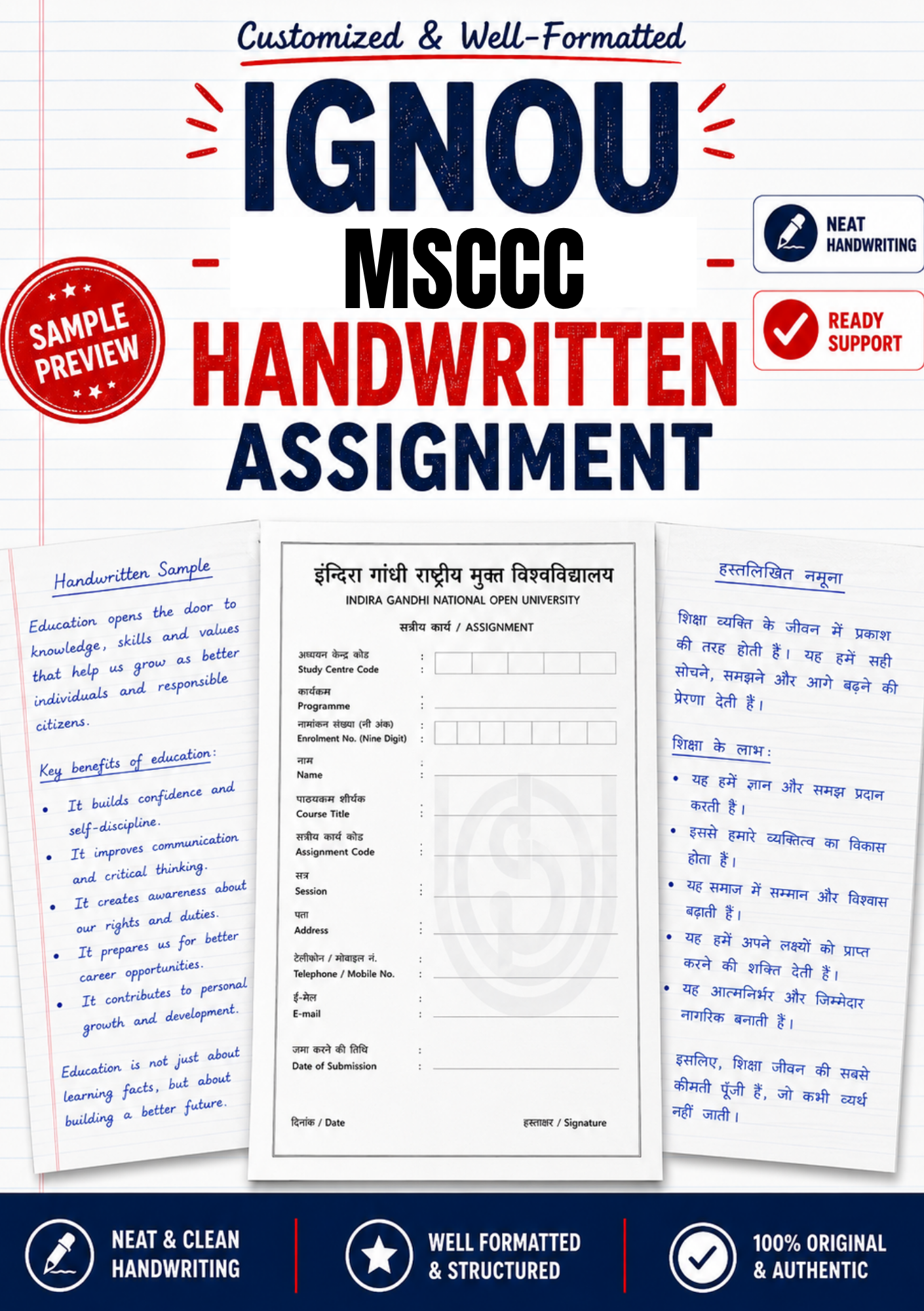
In short. A handwritten assignment is the answer set for IGNOU’s Tutor Marked Assignment questions, written out by hand and handed in as a hard copy, and for MSCCC, the eighty-credit Master of Science in Climate Change that the School of Interdisciplinary and Trans-disciplinary Studies opened to its first intake in the July 2026 cycle, a full registration runs to eighteen course codes across two years under seven prefixes, of which sixteen carry a theory paper and the two eight-credit codes MEVL 032 and MEVP 033 carry none. Shri Chakradhar Publication prepares that handwritten set one course code at a time. The rate is ₹320 per subject, hard copy only, with courier included in that price and no separate shipping charge. No soft copy or PDF is sold. The service covers all mediums IGNOU issues the TMA paper in, at the same price, which on this programme resolves to the English paper the July 2026 Common Prospectus records. Any session is accepted, current cycle or older, including backlog courses, at the same ₹320 per subject. Send a photo of a page you have written yourself and the handwritten set is matched to your handwriting at no extra charge. Assignments carry 30 per cent of the final course result and the term-end examination carries the remaining 70 per cent. Because IGNOU has published no booklet under the MSCCC label, each of your codes is governed by whichever school issued the file it appears in, and that file is what settles paper size, answer count and which counter takes the bundle. Orders run on WhatsApp at +91 93546 37830 with your codes and your year.
What Lands on Your Doorstep for a Climate Change Code
Each code travels as its own tied bundle rather than as one loose stack for the whole year, because MEV 021 and MEV 019 may be going to two different counters and a merged parcel cannot be split at the desk. Inside each bundle sit four things.
- The written answers. Blue or black ink on the sheet size the governing file names, question numbers written beside each answer, key terms underlined once, diagrams drawn by hand rather than printed and pasted in. A life cycle assessment diagram on MEV 024 and a regression plot on MEV 019 are drawn, not photocopied.
- An IGNOU-format cover sheet, free, and deliberately blank. The layout copied is the one your own file prints, because the Interdisciplinary Studies block asks for ten fields including your cycle of admission and the assignment code string, while the Engineering and Technology block asks for seven and has neither line on it. The enrolment rows and the signature are left for you.
- A copy of the official question paper the answers were written against, with its cover page attached, so the programme name and session the questions belong to are visible rather than assumed.
- The courier. The rate is ₹320 per subject, hard copy only, with courier included in that price and no separate shipping charge. Nothing is added at the door.
No soft copy or PDF is sold. If your Regional Centre asks for an upload as well as a hard copy, the scan is made from the bundle after it reaches you, which keeps the inked original in your hands until a receipt exists for it.
Inside the ₹320 on an MSCCC Paper, and What Sits Outside It
Six things the rate settles on a climate change order, and four it does not.
- Seven prefixes, one figure. A climate legislation paper under MEV, a sustainable development paper under MSD and a machine learning optional under MCS are quoted identically, even though the third was written by a different school for a different degree.
- The codes without a paper are removed before the total, not after it. MEVL 032 and MEVP 033 are named in the reply and struck from the quote, which is why an eighteen-code list is priced as sixteen.
- The file is identified before the writing starts. A code is traced to the booklet that published it, and the instruction line, paper size, margin and counter are read off that booklet. This is the step a MSCCC order fails at, and it is the reason a bundle can be right in content and wrong in every physical respect.
- Both paddings resolve. Whether your record prints MEV 021 or MEV-021, the code reaches the same paper instead of coming back as unrecognised.
- Handwriting matching costs nothing. Send a photo of a page you have written yourself and the handwritten set is matched to your handwriting at no extra charge.
- Ordering is by code, never by year. There is no minimum order: one subject or fourteen, same rate.
Outside it: no soft copy or PDF is sold, so there is no file to download and nothing to print. Delivery depends on your pin code and is confirmed for your order before you pay. No figure is promised on this page. The eight credits of MEVP 033 are supervised project work written up as a report and are quoted separately from assignment writing, never at the ₹320 rate. And no claim is made about the marks any assignment will receive, about how an evaluator will assess it, or about whether it will be accepted. Assignment evaluation is entirely a matter for IGNOU.
Reference File or Submission Bundle: Telling the Two Apart on MSCCC
Two things arrive on WhatsApp phrased almost identically, and only one of them can be handed across a counter, so both are defined before either is compared. A solved assignment is a soft-copy reference file of model answers for a course code and session, read on a phone or a laptop while you draft your own version. A handwritten assignment is the answers written out by hand on A4 and submitted in hard copy at the study centre, which is the physical object the university collects and records against your enrolment number.
The distinction bites harder on this programme than on most, because of what the climate papers ask for. MEV 024 wants the stages of a life cycle assessment set out and the spectral signatures of common earth surface features explained. On MEV 019 the printed questions reach into rank correlation, the two error types in hypothesis testing, and what the coefficients in a regression are actually doing. MEV 025 asks about the Paris Agreement and about gender mainstreaming as a route into climate action. Those answers carry statistics, named protocols and drawings inside them, and copying one off a screen without following the argument still produces pages a counsellor reads as unlearned.
| Point of difference | Solved assignment, soft copy | Handwritten assignment, hard copy |
|---|---|---|
| What it physically is | A PDF of model answers for one code and session | Tied inked sheets arriving by courier, A4 or foolscap as your own file demands |
| What you do with it | Read it against the blocks while writing your own answers | Fill the cover sheet, sign the declaration, hand it in |
| Who it suits | A learner short of grip on the climate blocks | A learner short of writing weeks |
| Handwriting | Does not arise | Matched from a photograph of your own hand, free |
| Where it is priced | On the store’s solved-assignment shelves, not on this page | ₹320 per subject, courier included |
Scroll the table sideways on a narrow screen to reach the handwritten column.
Every live file opened for this page settles the point in IGNOU’s own words rather than in this publisher’s. The Interdisciplinary Studies booklet instructs that you should write the answer in your own handwriting; the Engineering and Technology booklet states that these assignments submitted should be hand written in your own hand writing. Printing a downloaded PDF does not convert it into a submission, and neither product replaces the climate blocks IGNOU already posted to you. If the reference file is what you actually came for, the store keeps the MEV-coded model answers on its soft-copy solved assignments filed under Environmental Science, which is where the MEV series has been catalogued since long before the climate degree opened.
Eighteen Codes Sent, Sixteen Priced, Two Named and Removed
Paste the codes exactly as your registration confirmation spells them. The reply names which of them carry a live question paper today, which school published each file, what that school asks for on sheet size and answer count, and quotes only the papers that exist. MEVL 032 and MEVP 033 come back flagged, not charged.
₹320 per subject · hard copy · courier included · no minimum order
Send your MSCCC code list and get it priced · Ask which of your codes actually have a paper
The Ten First-Year Climate Codes That Are Also a Whole Diploma
Section 3.45 of the IGNOU Common Prospectus for July 2026 places MSCCC in the School of Interdisciplinary and Trans-disciplinary Studies, records eligibility as graduation in any discipline, sets a two-year minimum against a four-year maximum, and records the medium of instruction as English. The programme summary table on the fee pages records the mode of examination as year wise across the January and July cycles, which is the line that separates this degree from its neighbours: the M.Sc. in Environmental Science and the M.A. in Environmental Studies are both examined semester wise in the same school, and MSCCC is not.
The credits below were added rather than accepted. Year one holds ten four-credit courses, so forty. Year two holds four four-credit compulsories, a laboratory course worth eight, a project worth eight and the two optionals you actually register at four apiece, so forty again. The two halves reach the eighty that section 3.45 prints at the foot of its table. Adding every printed row instead, all five optionals rather than the two you choose, gives ninety-two, and that gap of twelve is the arithmetic proof that the optional block is a choice rather than a list.
| Code as the MSCCC table prints it | Official title | Type | Credits |
|---|---|---|---|
| MEV 021 | Introduction to Climate Change | Theory | 4 |
| MEV 022 | Impacts of Climate Change | Theory | 4 |
| MEV 023 | Mitigation and Adaptation to Climate Change | Theory | 4 |
| MEV 024 | Climate Change Assessment Tools | Theory | 4 |
| MSD 019 | Global Strategies to Sustainable Development | Theory | 4 |
| MEV 025 | Climate Change and Society | Theory | 4 |
| MEV 026 | Climate Change and Water | Theory | 4 |
| MEV 027 | Climate Change and Energy | Theory | 4 |
| MEV 028 | Climate Change and Agriculture | Theory | 4 |
| MEV 029 | Climate Change and Disaster Risk Reduction | Theory | 4 |
Scroll the table sideways on a narrow screen to reach the credits column.
Ten papers, forty credits, and one fact worth holding before you download anything: those same ten courses at those same forty credits are the entire Post Graduate Diploma in Climate Change. Look at section 8.43 and you find MEV-021 to MEV-029 with MSD-019, adding to exactly forty; look back at section 3.45 and that diploma is named as the award for exiting at the end of year one. The diploma is also sold on its own. A first-year master’s learner and a diploma learner are therefore answering the identical ten Tutor Marked Assignments, and the only thing separating their two bundles at the counter is the programme code written on the cover sheet. Write yours deliberately, because the wrong one attaches your mark to the wrong award.
Second-Year Compulsories, Five Optionals to Pick Two From, and Two Codes With No Paper
Year two is where MSCCC stops behaving like an environment degree and starts borrowing. Three of the five optionals are ordinary Interdisciplinary Studies papers that sit as compulsory courses inside the M.A. in Environmental Studies. MIO 001 comes from the smart regions stable. MCS 224 comes from the computer science stable and appears in the same Engineering and Technology booklet that carries MEV 021, where the instruction line asks for every question to a printed word count. Choosing the machine learning optional does not merely change your subject for one paper. It moves that paper into a second rulebook.
| Code | Official title | Status | Type | Credits | Question paper |
|---|---|---|---|---|---|
| MEV 017 | Environmental Legislations | Compulsory | Theory | 4 | Yes |
| MEV 019 | Research Methodology for Environmental Science | Compulsory | Theory | 4 | Yes |
| MEV 030 | Climate Change, Waste Management and Circular Economy | Compulsory | Theory | 4 | Yes |
| MEV 031 | Climate Change and Governance | Compulsory | Theory | 4 | Yes |
| MEVL 032 | Climate Change Lab Course | Compulsory | Lab | 8 | None published |
| MEVP 033 | Project Work | Compulsory | Project | 8 | None published |
| MEVE 019 | Environmental Issues | Choose two | Theory | 4 | Yes |
| MEVE 014 | Biodiversity Conservation and Management | Choose two | Theory | 4 | Yes |
| MEV 014 | Sustainable Natural Resource Management | Choose two | Theory | 4 | Yes |
| MIO 001 | Introduction to Smart Regions: Smart Cities and Smart Villages | Choose two | Theory | 4 | Yes |
| MCS 224 | Artificial Intelligence and Machine Learning | Choose two | Theory | 4 | Yes |
Scroll the table sideways on a narrow screen to reach the question paper column.
Sixteen credits of an eighty-credit degree sit in the two rows marked None published, and none of that is assignment work. Both figures are unusual inside this school. The laboratory courses on the M.Sc. in Environmental Science run at four credits each and there are three of them; MSCCC folds all three into one course at eight. The project on the M.A. in Environmental Studies runs at six credits; MEVP 033 runs at eight, matching the Environmental Science dissertation rather than the Environmental Studies project. Neither code is quoted at the ₹320 assignment rate here, because there is no question paper behind either one to answer against. The project is a separate piece of work, and bound reports of that kind sit with the environment project reports supplied as hard copy.
The titles above were read off the prospectus with one deliberate correction, disclosed rather than silently applied: MEV 019 appears in the MSCCC table as Research Methodology for Environrriental Science. Two other tables in the same prospectus, plus the heading on the live booklet itself, all spell it Environmental. It is a character-level corruption, not a second course, and the correct spelling has been restored in the table. Reference material for those shared papers sits on the MAEVS shelf where the MEV 019, MEV 024 and MEV 025 blocks are catalogued.
Six Places IGNOU’s Own Climate Change Documents Disagree
Each item below was found by reading one IGNOU document against another, not by restating what is already circulating. The last item is an error on this publisher’s own sister site, disclosed here because disclosing it is the stronger position.
Conflicts current at the time of this review. Your registration confirmation and your Regional Centre outrank every line of it.
1. One compulsory code, two schools, opposite physical instructions. MEV 021 is compulsory in your first year. Its only live booklet belongs to a different degree entirely, a January 2026 Engineering and Technology file written for renewable energy learners. Instruction two on that file wants “foolscap size writing paper (but not of very thin variety)”. Instruction three wants a 4 cm margin down the left and across the top and bottom. Every question is to be attempted, a ten-mark answer is capped at 350 words and a twenty-mark answer at 550, and instruction seven sends the bundle to your regional centre. The Interdisciplinary Studies file carrying MEV 019, MEV 024 and MEV 025 asks for A4 with all pages tagged, any five questions answered, no word limit at all, and submission to the Coordinator of the Study Centre allotted to you. Both are current. Both are IGNOU’s.
2. Three date positions across three live files, one learner. The Engineering and Technology file prints the pair twice: submit by April 30, 2026 for the June term-end examination, or by September 30, 2026 for the December one. The Interdisciplinary Studies second-year Environmental Studies file prints no submission date whatsoever, only a validity heading of January 2025 to July 2026 Sessions with Valid from Jan 2025 to December 2026 in brackets beneath it. A third live Interdisciplinary Studies file, the Sustainability Science booklet numbered MASS-2/2026, prints 30th March for the June examination and 30th September for the December one. Same school as the second file, different dates. A MSCCC learner can hold codes governed by all three at once.
3. The lateral-entry footnote names the wrong award. Printed directly beneath the forty-credit Post Graduate Diploma in Climate Change table is a note stating that candidates having PGCCC from IGNOU may take lateral entry into the second year of the MSCCC programme. PGCCC is the Post Graduate Certificate in Climate Change, and section 10.3 records it as sixteen credits over four courses, three compulsory and one optional. The diploma the note sits under is PGDCCC and carries forty. A certificate holder entering the second year would be skipping twenty-four first-year credits the certificate never covered. Get the award named on your own admission letter confirmed before you order against a second-year code list.
4. The same ten codes are padded three ways in one prospectus. The MSCCC table prints MEV 021 through MEV 029 and MSD 019 with a space and three digits. The diploma table listing the identical ten courses prints MEV-021 through MEV-029 and MSD-019 with a hyphen. The M.Sc. in Environmental Science table in the same document prints the wider family as MEV 11 and MEV 17, two digits and no padding at all, and the certificate table prints its credits as 04 rather than 4. Search both paddings before concluding a paper has not been published.
5. Column headers and titles drift between the two climate tables. The MSCCC table heads its third column Type of Course; the diploma table heads the identical column Title of the Course, so the words Title of the Course appear twice in one header row. MEV 023 is Mitigation and Adaptation to Climate Change in the master’s table and Mitigation and adaptation to Climate Change in the diploma table. Neither is a second course.
6. Disclosed in-house: the code count on the companion article is short by two. The MSCCC handwritten assignment article on ignouproject.com states sixteen codes and fourteen answerable papers. Adding the sixteen compulsory rows gives seventy-two credits, not the eighty the prospectus prints; the two chosen optionals supply the missing eight. A full MSCCC registration is therefore eighteen codes and sixteen answerable papers. The article is queued for correction, and where it disagrees with this page on the count, this page governs.
Three Live Files, Three Different Answers About When Your Pages Are Due
On most programmes the deadline question has one answer. On MSCCC it has three, because the codes on a single registration were published by different schools in different booklets, and none of those booklets was written for MSCCC. Which position binds you depends entirely on which code you are writing.
Hold two separate questions apart and the confusion dissolves. Are these still the questions IGNOU will mark? is answered by the validity bracket printed on your own cover, which on the current Interdisciplinary Studies files reads December 2026. By when must the pages reach a counter? is answered by whatever printed pair sits in the file your code appears in, and by your Regional Centre where the file prints none. Neither file cancels the other. Each governs the paper it is printed on.
One line does appear in every file opened for this page, whichever school wrote it: assignments must be submitted within the stipulated time to be eligible for appearing in the term-end examination. The Engineering and Technology file puts it more bluntly, stating that you cannot fill the examination form without submission of the assignments. That turns a handwritten bundle from a scoring exercise into an entry gate, which is why a missing one costs more than the marks printed on it. Dates also move within a cycle and vary by Regional Centre, and IGNOU has extended a June figure well past June more than once, so confirm the operative date on ignou.ac.in and with your own centre before planning any writing. The only legitimate urgency on this page is the date printed on your own file.
What the TMA String on Your Cover Sheet Actually Encodes
The Interdisciplinary Studies cover block asks for an ASSIGNMENT CODE as a separate line from the COURSE CODE, and on MSCCC those two lines are not interchangeable. The course code is MEV 019. The assignment code is the longer string printed above question one in the booklet, and it is what ties your bundle to a particular cycle of questions.
Four conventions appear in the live files read for this page, which is more than most programmes manage across their whole catalogue. The Environmental Studies booklet prints MEV-019/TMA-01/January 2025 to July 2026 session for one paper and, three pages later, MEV-024/TMA with no assignment number and no session at all for another. On MEV 025 the same booklet prints MEV-025/TMA followed by a trailing slash. MSD 023 in that booklet carries a doubled slash, MSD-023//TMA-01, which is a typographical slip rather than a format. The Engineering and Technology file uses a shorter form entirely, MCS-226/TMA/2026, while the Sustainability Science booklet abandons course codes in the string altogether and numbers the whole file MASS-2/2026.
Two practical consequences follow. First, copy the string exactly as your own paper prints it rather than reconstructing it from a pattern, because on this programme there is no single pattern to reconstruct from. Second, where the string carries no session, as on MEV 024, the cycle your questions belong to has to be read off the booklet cover instead, which makes keeping that cover page with the bundle worth doing rather than optional.
One Hand Across Sixteen Climate Bundles
Send a photo of a page you have written yourself and the handwritten set is matched to your handwriting at no extra charge. On MSCCC the argument for doing so is partly arithmetic and partly routing. Sixteen separate bundles land against one enrolment number across a registration that can legitimately run four years, and MEVP 033 keeps that record open after the taught papers have finished. A hand that shifts halfway through is visible across that span in a way it never is on a four-paper year.
The routing reason is peculiar to this degree. Your bundles will not all reach the same counter. Codes governed by the Engineering and Technology file go to a Regional Centre; codes governed by the Interdisciplinary Studies files go to a Study Centre Coordinator. Two counters, one enrolment number, one record being assembled from both. Consistent handwriting is the one visible thread running through a submission history that is otherwise split down the middle by an accident of which school happened to publish which paper.
What Makes a Usable Sample Photograph
One page of anything you have written normally, shot flat in good light with the whole sheet in frame. Not a signature, not a printed form filled in block capitals, and not a page written unusually carefully for the purpose, because the slant, the letter heights and the joins you make without thinking are the parts that carry across a full course of answers. The photograph is used for the order it belongs to and discarded with it. Nothing is charged for the match, and nothing is paid before the sample comes back to you for approval.
English Only, Every Cycle, and Backlogs Taken the Same Way
The service covers all mediums IGNOU issues the TMA paper in, at the same price. On MSCCC that clause resolves to one paper rather than a choice, because section 3.45 of the July 2026 Common Prospectus records the medium of instruction as English, and every live file opened for this page is English. A Hindi MSCCC assignment offered anywhere deserves a question about which file it was written from.
Questions are tied to a cycle rather than to a code, and they stop being the right questions the moment that cycle ends. The current Interdisciplinary Studies files state that boundary as December 2026, after which the questions are replaced under unchanged course codes, and a learner who submits last cycle’s answers to this cycle’s questions has written the right subject and the wrong paper. Any session is accepted, current cycle or older, including backlog courses, at the same ₹320 per subject. Name the programme and the session printed on your own cover, and the answers follow the questions belonging to it rather than the questions that happen to be live today.
Backlogs matter more on MSCCC than the programme’s age suggests. Learners arriving laterally through the certificate or diploma route can carry an unfinished first-year code into a second-year registration, and a code left behind in an earlier cycle still has to be answered against the questions that cycle printed. The PGCCC climate change reference titles cover the certificate side of that route, and the PGDESD environment and sustainable development list covers the neighbouring diploma most often confused with it.
Six Lines That Turn a Code List Into a Quote
- The codes, spelled as your registration confirmation spells them. Padding and all. MEV 021, MEV-021 and mev021 all resolve, but sending the form your own record prints removes a round of checking.
- Year One or Year Two. MSCCC is examined year wise rather than by semester, so the year places your codes, and it also signals whether you arrived laterally through the certificate or diploma.
- The programme name printed on any booklet you managed to download. A cover reading Master of Arts (Environmental Studies) above a MEV 024 paper is exactly the sort of detail worth passing on. That one line identifies the instruction regime immediately and settles paper size, answer count and counter in a single step.
- A photograph of your own handwriting, if you want the set to look like your work. Matching costs nothing and the sample comes back for approval before anything is paid.
- Your pin code. Delivery depends on your pin code and is confirmed for your order before you pay. No figure is promised on this page.
- Anything your centre insists on. If your Regional Centre wants the question paper stapled in front, or a particular cover-sheet layout, or the bundles tied a certain way, say so at the start rather than after the parcel has been packed.
Nothing else is needed. There is no form on this page, no account and no login, and no soft copy or PDF is sold at any point in the exchange.
Two Rulebooks, Sixteen Papers, One Consistent Hand
Send the codes and the year. What comes back names the school governing each paper, what that school asks for on sheet size and answer count, the total at ₹320 per subject, and where your pin code stands for delivery before any money moves.
₹320 per subject · tied per code · courier inside the price · handwriting matched free
Check delivery for your pin code first · Hand over part of your climate set
Once the Bundle Is Stamped at the Counter
The counter is a checkpoint, not a finish line. Get the submission acknowledged in writing and photograph the pages before they leave your hands. Every booklet opened for this page asks for exactly that, in those terms, against the possibility that what you submitted is lost in transit.
From there the figure moves in three stages that sit on different screens and answer different questions. The centre records receipt. The counsellor’s award travels up to the Student Evaluation Division. Only then does a number attach itself to that course code on your grade card. A gap between the first stage and the third is ordinary rather than alarming, particularly in the weeks around a cut-off.
Two causes of a MSCCC course showing as incomplete are peculiar to this programme and worth ruling out before assuming a bundle went missing. The first is the split counter: if your Regional Centre holds one bundle and your Study Centre holds another, one may be recorded while the other is still in a tray. The second is the exit award, because a first-year code can be sitting administratively under the Post Graduate Diploma in Climate Change rather than under the master’s, which looks like a missing mark and is actually an attachment problem. Neither is resolved by resubmitting; both are resolved by asking the centre that holds the bundle.
What Else a Climate Change Enrolment Tends to Need
An assignment order is rarely the only line in a message from a first-intake learner, because so little published material exists for a programme whose first cohort has not yet sat a term-end examination.
The seventy per cent an assignment cannot reach is the larger half of the problem, and revision material for the shared environment codes does more for it than any bundle does. The MSCENV guide books covering the shared MEV blocks and the environment guess papers built from previous cycles both draw on codes MSCCC borrows, though any guess paper aimed at MEV 026 through MEV 031 deserves scepticism, since those courses have no examination history behind them yet. MSD 019 is filed on the Sustainability Science assignment shelf rather than with the environment codes, and MEV 021 sits with the renewable energy titles, which is the programme its only live booklet was written for.
Learners holding codes on more than one programme, or holding a code the climate tables do not list, are served by the open handwritten order that takes any code on any record, and the full programme-wise range sits on the handwritten assignment shelf covering every IGNOU programme. Question papers themselves are free from the university and should come from there whoever ends up filling the sheets: open the IGNOU assignment download service and search by course code rather than by programme, because there is no MSCCC folder to open yet.
What MSCCC Learners Ask Before They Send a Code List
How many handwritten assignments does a full MSCCC registration actually require?
Sixteen. A registration carries eighteen course codes: ten compulsory in the first year, six compulsory in the second, and two optionals chosen from a block of five. MEVL 032 Climate Change Lab Course and MEVP 033 Project Work carry eight credits each and no Tutor Marked Assignment behind either, which leaves sixteen papers to answer. The check is arithmetic rather than counting: the sixteen compulsory rows total seventy-two credits and the prospectus prints eighty, so the two chosen optionals supply the missing eight.
Why does one climate code want foolscap and another want A4?
Because IGNOU has published no booklet under the MSCCC label, so every paper you can download was issued by another school for another programme, and paper size is set by the issuing school rather than by your degree. The Engineering and Technology file carrying MEV 021 asks for foolscap of not very thin variety with a 4 cm margin on the left, top and bottom. The Interdisciplinary Studies file carrying MEV 019, MEV 024 and MEV 025 asks for A4 with all pages tagged. Both are current IGNOU instructions and neither overrides the other.
Is MEV 021 the same paper for MSCCC as it is for the renewable energy degree?
It is the same course code and the same published questions, because that Engineering and Technology booklet is the only live file carrying MEV 021. What differs is the programme code you write on the cover sheet and, in some cases, which counter takes the bundle. The questions themselves are not reissued per programme.
What is the submission date for a MSCCC assignment?
There is no single one, and this is the question the programme answers worst. The Engineering and Technology file prints April 30, 2026 for the June term-end examination and September 30, 2026 for the December one. The Interdisciplinary Studies Environmental Studies file prints no submission date at all, only a validity window running to December 2026. A third Interdisciplinary Studies file prints 30th March and 30th September. Read the file your own code sits in, then confirm the operative date with your Regional Centre, because dates move within a cycle.
Is the MSCCC first year the same thing as PGDCCC?
In assignment terms, yes. Section 8.43 of the July 2026 Common Prospectus lists MEV-021 through MEV-029 and MSD-019 as the entire Post Graduate Diploma in Climate Change at forty credits, and section 3.45 lists the identical ten courses as the MSCCC first year and names that diploma as the exit award. A diploma learner and a first-year master’s learner sit the same ten papers. The programme code on the cover sheet is what separates the two bundles.
The prospectus says PGCCC holders can enter the second year laterally. Is that right?
That note is printed beneath the forty-credit PGDCCC table but names PGCCC, which section 10.3 records as a sixteen-credit certificate of three compulsory courses and one optional. A certificate at sixteen credits and a diploma at forty are not interchangeable entries into a second year built on forty. Whichever award you hold, get the entry route confirmed against your own admission letter by your Regional Centre before ordering a second-year code list, because a wrong assumption there changes which codes you owe.
Do I write MEV 021 or MEV-021 on the cover sheet?
Copy whichever form your own registration confirmation and your own booklet print, and keep them consistent within a bundle. The July 2026 prospectus itself prints the identical ten courses two ways: with a space in the MSCCC table and with a hyphen in the diploma table. Both paddings resolve to the same paper when you send an order here, so the padding is a question for your cover sheet rather than for your quote.
Some of my codes returned no assignment file at all. Have I searched wrong?
Probably not. MSCCC opened to its first intake in July 2026 and several taught codes in the MEV 026 to MEV 031 range had no published assignment file at the time of this review. Search both paddings and search by course code rather than by programme, since there is no MSCCC folder on the portal. If the result is still empty, your Regional Centre is the only place that can say what will be accepted for your batch in the meantime, and the position changes without notice.
Can I print a solved assignment PDF and submit that instead?
No. A solved assignment is a soft-copy reference file of model answers for a course code and session; a handwritten assignment is the answers written out by hand on A4 and submitted in hard copy at the study centre. Printing the first does not convert it into the second. The Interdisciplinary Studies booklet instructs that you should write the answer in your own handwriting, and the Engineering and Technology booklet states that these assignments submitted should be hand written in your own hand writing. Both are IGNOU’s wording, not this publisher’s.
Is a typed climate change assignment accepted anywhere on this programme?
No live file read for this page permits one. Both instruction sets read for MSCCC codes ask for handwriting explicitly, and neither offers a typed alternative. Where a learner genuinely cannot write by hand, that is a conversation with the Regional Centre before submission rather than a format choice to make at home.
How many questions do I answer on each MSCCC paper?
It depends on the file, and the count is not the same twice. The Interdisciplinary Studies papers print 100 marks as five questions at twenty each and instruct you to answer any five, which on MEV 019 means five from eight and on MEV 024 and MEV 025 means five from six, because only six are printed. The Sustainability Science file prints four questions at twenty-five marks and asks for all of them. The Engineering and Technology file asks you to attempt all questions to printed word limits. Read the two lines above question one before planning an evening around a number.
Do you sell a MSCCC solved assignment PDF as well?
Not on this page. No soft copy or PDF is sold here at all. The store’s soft-copy model answers for the MEV series are catalogued under Environmental Science, which is where the shared codes have always sat, and they are a reference to write from rather than a submission to hand in.
Does MEVP 033 come with a handwritten assignment?
No. MEVP 033 Project Work is eight credits of supervised work written up as a report, and IGNOU publishes no Tutor Marked Assignment behind it. It is not quoted at the ₹320 per subject rate and it is named and removed from a code list rather than billed. The same applies to MEVL 032 Climate Change Lab Course, also eight credits with no published paper.
Can I order handwritten assignments for a backlog climate code from an earlier cycle?
Yes. Any session is accepted, current cycle or older, including backlog courses, at the same ₹320 per subject. Send the session printed on the cover of your own file along with the code, since the questions are replaced under unchanged course codes when a cycle closes and the answers have to follow the questions attached to your cycle rather than the current one.
Can you promise a mark, or promise the bundle will not be turned away?
No claim is made about the marks any assignment will receive, about how an evaluator will assess it, or about whether it will be accepted. Assignment evaluation is entirely a matter for IGNOU. What is within this publisher’s control is that the answers are written against the paper your own file publishes, in the format that file specifies, and delivered to the address you give.
Is shrichakradhar.com an IGNOU website?
Shri Chakradhar Publication Pvt. Ltd. and shrichakradhar.com form an independent IGNOU study-support publisher. This is not the official website of Indira Gandhi National Open University, is not affiliated with, endorsed by or authorised by the university, and no page on this site should be treated as an official IGNOU communication.
Which Document Each Statement on This Page Came From
From the IGNOU Common Prospectus, July 2026. Everything structural on this page traces back to section 3.45: which school runs the degree, that any graduate may apply, that teaching is in English, that two years is the floor and four the ceiling, the full code list with titles, types and credits attached, the line telling you to pick two optionals from five, the award you leave with if you stop at the end of year one, and the eighty-credit figure printed under the table. That total was verified by addition rather than accepted: forty in the first year, forty in the second, against ninety-two if every printed optional row were counted instead of the two taken. The diploma table in section 8.43 gave the ten-course, forty-credit list that matches year one line for line, together with the footnote sitting under it. Section 10.3 supplied the sixteen-credit certificate structure that footnote conflicts with. The M.Sc. Environmental Science and M.A. Environmental Studies tables supplied the padding comparison and confirmed the MEV 019 title spelling. Row 71 of the fee-page summary is where the annual examination mode and the yearly fee were read off.
From live IGNOU assignment booklets. Reading only one would have risked mistaking a single file’s template quirk for a programme-wide rule, so three were opened and compared side by side. The Environmental Studies second-year booklet for the January 2025 to July 2026 sessions supplied the A4 instruction, the ten-field cover block, the Study Centre Coordinator counter, the absence of any submission date, the December 2026 validity bracket, three different assignment-code conventions and the question patterns on MEV 019, MEV 024 and MEV 025. The Engineering and Technology booklet dated January 2026 for the M.Sc. in Renewable Energy and Environment supplied the foolscap instruction, the 4 cm margin, the seven-field cover block, the April 30 and September 30 pair, the examination-form line, the Regional Centre counter and the 350 and 550 word limits, and its cover elective list is where MEV 021 and MCS 224 appear. The Sustainability Science booklet numbered MASS-2/2026 supplied the third date pair of 30th March and 30th September, the instruction to write on both sides of A4, the compulsory identity-card page and the 500-word answer guidance, and its course list is where MEV 025 and MSD 019 appear a second time. All three print the 30 per cent weightage.
From Shri Chakradhar Publication as publisher. The rate, the hard-copy-only rule, the medium clause, the backlog clause, the absence of a minimum order and the free handwriting match are commercial choices made by this publisher alone. The rate is ₹320 per subject, hard copy only, with courier included in that price and no separate shipping charge. No soft copy or PDF is sold. There is no minimum order: one subject or fourteen, same rate. Delivery depends on your pin code and is confirmed for your order before you pay. No figure is promised on this page. The university sets none of those terms and takes no part in them.
Important Notice
Shri Chakradhar Publication Pvt. Ltd. and shrichakradhar.com form an independent IGNOU study-support publisher. This is not the official website of Indira Gandhi National Open University, is not affiliated with, endorsed by or authorised by the university, and no page on this site should be treated as an official IGNOU communication.
Programme structures, course codes, submission dates and rules change, and only ignou.ac.in and your Regional Centre can confirm the current position for your enrolment.
You sign the declaration on the assignment cover page, so you should read and review the content before submitting it, and satisfy yourself that it represents your own understanding of the course.
No claim is made about the marks any assignment will receive, about how an evaluator will assess it, or about whether it will be accepted. Assignment evaluation is entirely a matter for IGNOU.
Order Your MSCCC Climate Codes
Send the code list. Working out which school owns each paper, and what that school asks for on the sheet, is the job here. First year or second, Study Centre regime or Regional Centre regime, every code tied on its own with the cover sheet its own file specifies sitting on top and left blank for your signature. MEVL 032 and MEVP 033 are named and struck from the total rather than quietly billed.
₹320 per subject · one code or the whole year · courier inside the price · hand matched at no cost
Order your MSCCC papers at ₹320 each · Start with a single code and see the bundle
WhatsApp +91 93546 37830 · Shri Chakradhar Publication Pvt. Ltd. · an independent study-support publisher operating separately from the university.