

Description
In short. Shri Chakradhar Publication prepares handwritten answer sets for IGNOU’s Master of Arts in Adult Education, covering the eleven MAAE theory papers that carry a tutor-marked assignment: MAE-001, MAE-002, MAE-003, MAE-004, MAE-006 and MES-016 in the first year, and MAE-005, MES-131 plus the MAEE, MESE and MLL electives in the second. The rate is ₹320 per subject, hard copy only, with courier included in that price and no separate shipping charge. Each ordered code arrives written by hand on A4, with a free IGNOU-format cover sheet and a copy of the official MAAE assignment page for that year, and the handwriting is matched to a sample photo you send first. MAAE issues one booklet per year of study rather than one per course code, that booklet covers the January and the July session together, and it prints no submission date anywhere on it, so the codes and the cycle you send are what determine which paper is used. Any session is accepted, current cycle or older, including backlog courses, at the same ₹320 per subject.
Inside the Parcel That Reaches Your Door
An MAAE order is a physical thing, not a download. What travels is a stack of A4 sheets in one envelope, one set per course code you named, each written straight through in a single hand.
- The written responses. Three answers per course, because every MAAE theory paper sets exactly three questions and asks for roughly 500 words on each. A six-code first year therefore runs to eighteen answers.
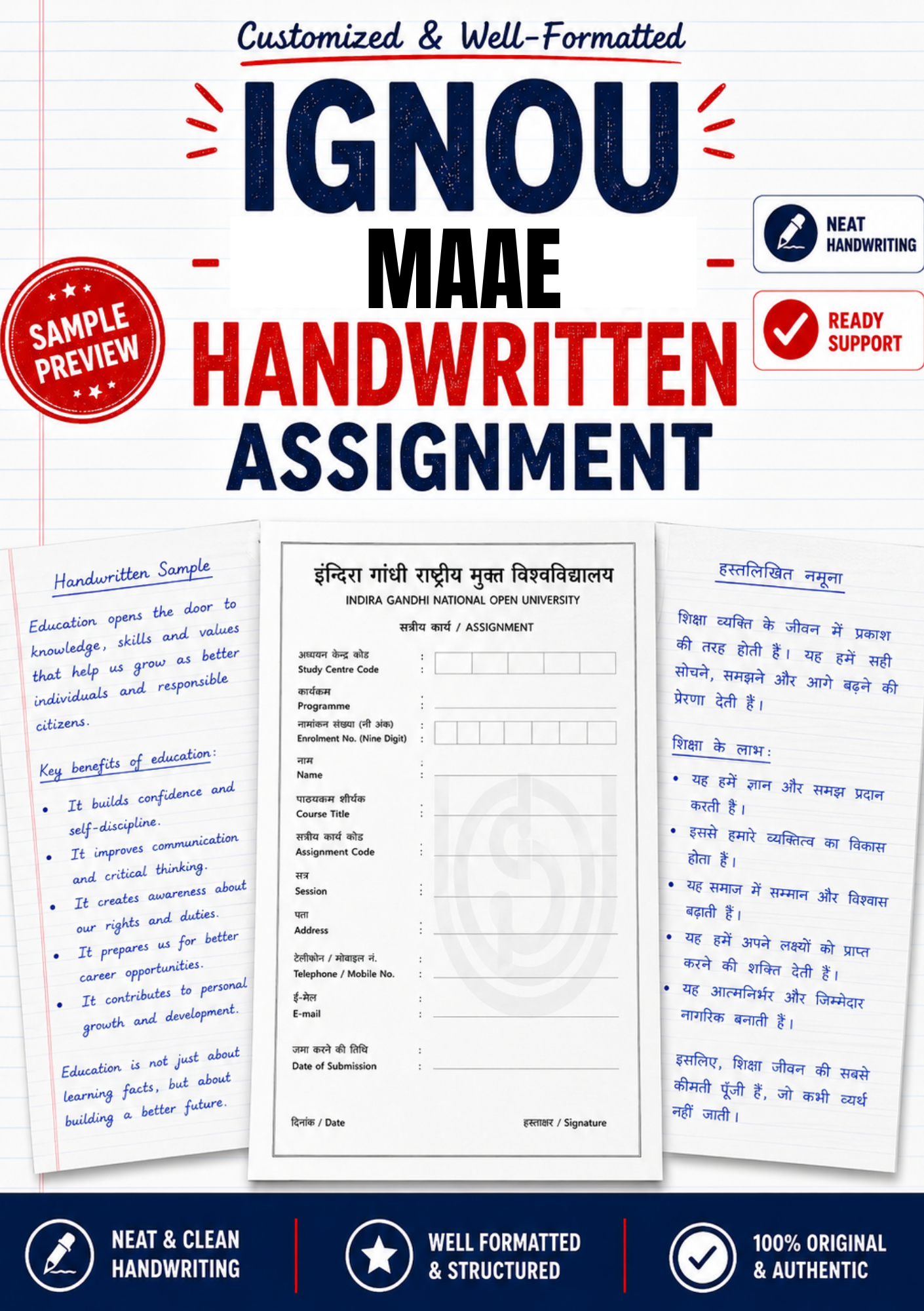
- A cover sheet per course. Laid out the way the School of Education Programme Guide asks for it: enrolment number, name, address and date on the top right, then course title, course code, assignment code, programme code and academic session in the centre, with the top left corner left blank for office use. Your name and signature stay empty for you to fill in.
- The question paper. The MAAE assignment page for the year you ordered against, printed and clipped in, so nothing has to be taken on trust.
- Nothing digital. No soft copy or PDF is sold.
The Programme Guide asks for a two-inch margin down the left of every sheet and at least four blank lines between the end of one answer and the start of the next, so an evaluator has somewhere to write. Both are built into the way the set is prepared, and each answer to a new question starts on a fresh page.
Where the ₹320 Goes, and Where It Stops
One figure covers the whole thing. There is no packing line, no courier line and no charge for the cover sheet.
- Inside the price: the writing itself, the IGNOU-format cover sheet, a printed copy of the question paper, matching the hand to your sample, and courier to your address.
- Outside the price: nothing is added later, and a one-paper order is quoted at the same per-subject figure as a full-year one.
- Not sold at any price: a digital version of the set.
- Not promised at all: a grade, an evaluator’s reaction, or acceptance at the counter.
Delivery depends on your pin code and is confirmed for your order before you pay. No figure is promised on this page. That is deliberate. An adult education learner attached to a Learner Support Centre in Aizawl and one attached to a centre in Ghaziabad do not get the same transit time, and a page that quoted one number would be wrong for one of them.
Reference PDF or Submission Copy: Telling the Two Apart
Two different products get called an assignment, and MAAE learners regularly buy one while needing the other.
A solved assignment is a soft-copy reference file of model answers for a course code and session. You read it, you take what you understand from it, and you write your own responses. A handwritten assignment is the answers written out by hand on A4 and submitted in hard copy at the study centre. One is study material. The other is the thing that is handed in.
| Point of difference | MAAE solved assignment | MAAE handwritten assignment |
|---|---|---|
| Format | Soft copy, read on a phone or laptop | Hard copy on A4, written in ink |
| What you do with it | Read it, then write your own answers from it | Attach the cover sheet, sign, hand it in |
| Who it suits | A learner with time to write and who wants a model to work from | A learner short of writing time, or carrying several MAE and MESE codes at once |
| Rate on this store | Priced per course code in the solved assignment section | ₹320 per subject, courier included |
| Counts as a submission | No. It is a reference to write from | Yes. It is the physical set that goes to the Learner Support Centre |
Scroll the table sideways on a narrow screen.
The MAAE booklets themselves are blunt about the destination. Both 2025 papers carry the same note: assignment responses may be submitted to the allotted Learner Support Centre either by hand or by registered or speed post, or by any other mode the University permits. Nothing in that note contemplates a downloaded file being handed over as it stands. A solved assignment is a reference to write from, and printing one out does not turn it into a submission.
If a soft-copy reference is what you actually want, it belongs on a different page of this store, not this one. The master’s solved assignment PDFs listed programme by programme are where those files sit, and the adult education codes should be looked up there rather than ordered here.
Send the codes, get availability back, then decide.
₹320 per subject, hard copy, courier included. Nothing is charged until you have seen a handwriting sample on a real A4 sheet.
First-Year MAE and MES Codes This Order Writes
MAAE runs to 80 credits over two years, split exactly 40 and 40. The first year holds seven courses: six theory papers of six credits each and one practical course of four. Six plus six plus six plus six plus six plus six plus four comes to forty, which is what the Common Prospectus states, so the table below has been checked against its own total rather than trusted on sight.
| Code | Official title | Credits | Assignment in the 2025 booklet |
|---|---|---|---|
| MAE-001 | Understanding Adult Education | 6 | Yes, three questions |
| MAE-002 | Policy Planning and Implementation of Adult Education in India | 6 | Yes, three questions |
| MAE-006 | Adult Learning and 21st Century Skills | 6 | Yes, three questions |
| MAE-003 | Knowledge Management, Information Dissemination and Networking in Adult Education | 6 | Yes, three questions |
| MAE-004 | Extension Education and Development | 6 | Yes, three questions |
| MES-016 | Educational Research | 6 | Yes, three questions |
| MAEL-101 | Community-based Practical Activities | 4 | No. Field activity report only |
Scroll the table sideways on a narrow screen.
The ordering above is IGNOU’s, not alphabetical. MAE-001, MAE-002 and MAE-006 sit together at the top because those three alone, at eighteen credits, trigger the Post Graduate Certificate in Adult Education. The 2025 first-year booklet prints its papers in that same sequence. MAE-003, MAE-004, MES-016 and MAEL-101 add the remaining twenty-two credits, and completing all seven earns the Post Graduate Diploma in Adult Education.
MAEL-101 is the one first-year course this order cannot help with. It has no tutor-marked assignment in the booklet, no term-end examination, and its entire grade comes from a compiled report of community activities you carry out yourself. Six of the seven first-year codes are writable. The seventh is fieldwork.
Second-Year Compulsory, Elective and Report Papers
The second year is also forty credits, arranged differently. Two compulsory papers of six credits, then three electives of six credits chosen from a list of six, then one report course of ten credits chosen from two. Twelve plus eighteen plus ten is forty, and forty plus forty is the eighty that both the Common Prospectus and the Programme Guide state.
| Code | Official title | Credits | Status |
|---|---|---|---|
| MAE-005 | Population and Development Education | 6 | Compulsory |
| MES-131 | Educational Technology: An Overview | 6 | Compulsory |
| MAEE-001 | Sustainable Development | 6 | Elective, choose any three |
| MAEE-002 | Basics of Legal Awareness | 6 | Elective, choose any three |
| MAEE-003 | Comparative Adult Education | 6 | Elective, choose any three |
| MESE-061 | Open and Distance Learning Systems | 6 | Elective, choose any three |
| MESE-062 | Vocational Education | 6 | Elective, choose any three |
| MLL-001 | Lifelong Learning: An Overview | 6 | Elective, choose any three |
| MAEP-001 | Dissertation | 10 | Report course, choose one of two. No assignment |
| MAET-001 | Case Study / Internship Reports | 10 | Report course, choose one of two. No assignment |
Scroll the table sideways on a narrow screen.
Note what the elective row means in practice. The 2025 second-year booklet prints assignments for all six elective codes even though you only ever register for three of them. That is why the code list you send matters more here than in a programme with a fixed core: two MAAE learners in the same batch can be sitting on completely different second-year sets, and only your registration or re-registration record shows which three are yours.
The ten-credit report course sits outside this order entirely. MAEP-001 is graded seventy per cent on the dissertation report and thirty per cent on a viva, MAET-001 is graded wholly on the case study or internship report, and neither carries a tutor-marked assignment. If a bound dissertation is the thing you are actually chasing, the bound hard copy support for the MAEP-001 dissertation is the section for it.
Where the MAAE Paperwork Contradicts Itself
These were found by reading IGNOU’s own documents against one another during this build, and by reading this store’s older pages against its current terms. None of them is a reason to panic. All of them are reasons to check your own record rather than trust a summary.
Disagreements found across MAAE sources in August 2026.
1. The two 2025 booklets punctuate course codes differently. The first-year paper hyphenates throughout, printing MAE-001 and MAE-002, while the second-year paper of the same session and the same school drops the hyphen and prints MAE 005, MES 131, MAEE 001 and MLL 001. The first-year paper also prints MES-016 with a stray space inside it.
2. The title of MAE-002 is misspelled twice inside one heading on the first-year booklet, where the Common Prospectus and the Programme Guide both give it as Policy Planning and Implementation of Adult Education in India.
3. Two different assignment-code conventions appear in IGNOU’s own MAAE material. The booklets head each paper simply Assignment: 01, while the Programme Guide’s own schedule table writes the same thing back to front, as 01: MAE-001.
4. The Programme Guide’s operational schedule twice tells you to submit original hand-written assignment responses, and a later section of the same guide says that if you feel your handwriting is not properly legible you may send typed responses instead. One document, two positions.
5. The Programme Guide states there are five second-year assignments for five theory courses. The second-year booklet prints eight, one for each of the two compulsory papers and one for each of the six electives, because it has to serve every possible elective combination.
6. The Common Prospectus describes MAAE as having entry and exit options at the PGDAE level, yet the same page awards a Post Graduate Certificate at eighteen credits and then says that certificate comes without any exit facility. An award that is not an exit.
7. No MAAE booklet prints a submission date at all, while the Programme Guide says the last date is usually the end of October for the December term-end examination and the end of April for the June one, and adds that it is sometimes extended. Third-party sites meanwhile circulated 31 May 2026, 16 August 2026 and 30 September 2026 as the last date for the same cycle.
8. The programme fee differs between documents. The Common Prospectus for July 2026 gives ₹8,700 per year and ₹17,400 in total, while the July 2024 Programme Guide still prints ₹7,700 per year and ₹15,400 in total.
9. In house, and worth stating plainly: older product pages on this store still carry a ₹300 handwritten rate, a delivery-time promise and a founding year that does not match the one used elsewhere on the site. Those are being corrected. The rate on this page is the current one.
Every line in that box was read off a live document during this build rather than carried over from a summary. Set your own admission record and re-registration record against the tables above before ordering, because those two papers are the only ones that describe your enrolment specifically.
Why No MAAE Booklet Prints a Due Date
This is the single biggest way MAAE differs from the management and humanities programmes, and it catches people out.
Open the 2025 first-year MAAE paper and you find four notes at the top: write your details on every response, submit to the allotted Learner Support Centre by hand or by registered or speed post, keep a copy for yourself, and answer all three questions in each course. There is no fifth note giving a date. The second-year paper of the same session carries the identical four notes and no date either. Two booklets, same school, same session, neither one printing a deadline.
The School of Education puts the schedule in the Programme Guide instead, and states it loosely rather than as a fixed calendar date. The guide says the last date for submission is usually the end of October where you are sitting the December term-end examination, and usually the end of April where you are sitting the June one, and that the University sometimes extends it. Note what that is anchored to. It is tied to the examination you intend to sit, not to whether you were admitted in January or in July.
Two things follow. First, the date you need is announced centrally each cycle and has been extended more than once in recent years, so the correct source is the current notice on the university’s main site or your Regional Centre, not a number printed on a supplier’s page. Second, submission is a gate. The Programme Guide is explicit that submitting the assignment responses is a pre-requisite for appearing in the term-end examination for that course, and that you should keep the study centre acknowledgement or the postal receipt, because a copy of it is attached to your examination form.
Assignments carry 30 per cent of the final course result and the term-end examination carries the remaining 70 per cent. For MAAE that split applies to the eleven theory papers only. MAEL-101 is graded entirely on its activity report, MAEP-001 splits seventy on the report and thirty on the viva, and MAET-001 is graded entirely on its report.
What “Assignment: 01” Means on Your MAE Paper
Learners moving into MAAE from another IGNOU programme often go looking for a code that is not there. There is no string of the shape MAE-001/TMA/JULY/2026 anywhere in the MAAE material, because MAAE does not use that convention.
What the booklet prints under each course heading is two words and a number: Assignment: 01. That is the whole code. It reads that way because MAAE sets exactly one assignment per theory course for the year, so there is no second or third to distinguish it from. The Programme Guide’s schedule table reverses the same two elements and lists it as 01: MAE-001, which is why you may have seen it written both ways.
Three things are worth carrying to the counter. The booklet is titled by session pair and year of study, in the form January and July 2025 sessions, for first year, so the two things that identify your paper are the year and whether you are in first or second year. The academic session and year go on the cover sheet as a separate field from the assignment code. And the Programme Guide asks you specifically not to overwrite while filling in the enrolment number, the course code, the assignment code or the programme code, which is a small instruction that turns into a rejected sheet more often than it should.
One practical consequence of the one-booklet-per-year design: a paper does not lapse the moment a session turns over the way a session-stamped paper does, but it is still replaced when the school issues the next year’s set. As of this build, the newest booklets on IGNOU’s own MAAE assignment index are the January and July 2025 pair, with 2024, 2023, 2022 and 2021 archived below them. The 2024 row is itself worth a look, because it lists both an original January and July 2024 paper and a separate revised first-year paper for the same session.
Your Own Hand, Copied From a Photo You Send
Send a photo of a page you have written yourself and the handwritten set is matched to your handwriting at no extra charge. This matters more for MAAE than for a programme with two or three papers, because an adult education learner ordering a full year is handing in eighteen answers written by the same person, and a change of hand halfway through a bundle is the thing a coordinator notices.
The reverse order also matters. A sample of the writing goes to you on WhatsApp on a real A4 sheet before anything is paid. You look at it, you say yes or no, and only then does the order start. If the sample does not look like something you would sign your name under, nothing has been spent.
What Makes a Sample Photo Usable
Half a page of your normal writing is enough. Plain daylight, the phone held flat above the page rather than at an angle, and no filter. Ordinary running handwriting works better than careful printing, because careful printing is not what you write like when you are eight answers deep. If you have an older assignment sheet that came back to you, a photo of that is ideal, since it shows the hand under real writing conditions.
English-Only Papers, Old Cycles and Carried-Over Courses
The service covers all mediums IGNOU issues the TMA paper in, at the same price. For MAAE that resolves to one medium. Both the Common Prospectus and the Programme Guide state the medium of instruction is English, and both 2025 booklets are printed in English throughout. There is no Hindi MAAE paper to order, so nobody is choosing between two versions here.
That is unusual enough to be worth flagging. Several School of Education codes that MAAE borrows, notably MES-016 and MES-131, also run inside programmes where a Hindi option exists. The medium attaches to the programme you are registered in, not to the code, so an MAAE registration means the English paper regardless of what a sibling programme offers.
MAAE learners hit backlogs in a specific and predictable way. The programme has a minimum duration of two years and a maximum of four, second-year entry requires a separate re-registration whether or not the first year was cleared, and the revised version of the programme has only been on offer since the January 2024 admission cycle. Between those three facts, a learner who paused for a year can easily be sitting on a mixed set: a first-year code from an older paper alongside a current second-year elective. Both can go in the same order at the same per-subject figure.
The Short List of Things to WhatsApp
Five items settle an MAAE order. Anything beyond them is not needed at this stage.
- Your course codes. Written out exactly as they appear on your record, for example MAE-004 and MESE-062. Both punctuations are understood, given that IGNOU uses both itself.
- First year or second year. This is what selects the booklet, because MAAE splits its paper by year of study rather than by course code.
- Your session. January or July, and the year, including an older cycle if you are clearing a backlog.
- A handwriting photo. Half a page in your normal hand.
- Your delivery pin code. Used to confirm transit before you pay, not to change the price.
What you do not need to send: your enrolment number, your Learner Support Centre code, a scan of your identity card, or any fee receipt. The cover sheet leaves those fields for you, which is the correct way round, since you are the one signing the declaration.
Mixed first-year and second-year codes in one packet?
That is normal for MAAE and costs the same per subject. ₹320 each, one hand throughout, one courier.
Once the Envelope Is in Your Hands
The set arrives finished but not submitted, and the last few steps are yours by design.
Fill in your name and sign the cover sheet. You sign the declaration on the assignment cover page, so you should read and review the content before submitting it, and satisfy yourself that it represents your own understanding of the course. For MAAE that reading has a second purpose: the Programme Guide notes that one of the three questions in each paper is meant to draw a reflective or application-oriented answer, and an evaluator who reads something that could not plausibly have come from you has been given a reason to look harder.
Then submit it the way the booklet describes, either by hand at your allotted Learner Support Centre or by registered or speed post to its Coordinator. Take the acknowledgement or keep the postal receipt. Photograph every page before it leaves you, because the Programme Guide warns that a set lost in postal transit is your problem to reconstruct, and a photograph makes that a reprint rather than a rewrite.
Nothing on this page forecasts what happens at the counter or in the evaluation. What the Programme Guide does state, and it is worth knowing rather than guessing, is the standard: MAAE is graded on a five-letter scale from A to E, you need at least a D in the continuous evaluation component and at least a D in the term-end examination separately for each theory course, and the average of the two must reach C. The guide also notes that a move to a ten-point system is under consideration.
Other MAAE and Adult-Education Material on This Store
The handwritten set answers one question. These sections answer the others, and most MAAE learners end up in two or three of them across a two-year run.
For reading behind the answers, the MAAE help books for the MAE and MES papers track the block-and-unit structure the Programme Guide sets out, and because MES-016 and MES-131 are shared codes, the MAEDU guide books covering MES-016 and MES-131 often carry the fuller treatment of those two. Closer to the examination hall, the MAAE guess papers built from earlier term-end sittings are the seventy per cent side of the split rather than the thirty.
Learners sitting on one of the two exit awards have their own shelves: the PGCAE certificate reading list covers the MAE-001, MAE-002 and MAE-006 block, and PGDAE study material for the first-year exit award extends that to the full seven-course first year. If you came in through the older standalone PGDAE and are entering the second year laterally, that second section is the one that matches what you already hold.
Two adjacent listings are worth knowing about. The MA Education assignment listings, where the same MES codes appear are a useful cross-check when an MAAE code is hard to find, and MA Distance Education material for the MDE papers sits next to MAAE in IGNOU’s own prospectus, closely enough that the MDE course table bleeds into the MAAE section when that document is machine-read.
For programmes outside adult education, the store’s full handwritten assignment section lists what else is written to order, and the open handwritten order form for any programme handles codes that have no programme page yet. Background on the degree itself, rather than on ordering, sits on the sister site in the MAAE programme write-up on ignouproject.com, which is the place to start if you would rather write the responses yourself.
What Adult Education Learners Ask Before They Pay
Does a PDF come with the MAAE handwritten set?
Nothing digital is issued against this order. What ships is the written sheets themselves, the cover sheet and the printed question paper, couriered to you. If a readable file is what you want, that is the solved assignment side of the store rather than this page.
Can a printed MAAE solved assignment be handed in at the Learner Support Centre instead?
It is not what a solved assignment is for. A solved assignment is a soft-copy reference to write from, and the MAAE booklet’s own submission note describes assignment responses going to the allotted Learner Support Centre by hand or by post, not a downloaded file being passed across as it stands. Treat the file as reading and the written sheets as the submission.
The MAAE Programme Guide says typed responses are allowed if handwriting is not legible, so why order a handwritten set?
That is an accurate reading of the guide, and it is stated here rather than hidden because it is true. The guide’s default is that you write the answers in your own handwriting, and it offers typing as a concession where legibility is the problem. Its own operational schedule then twice describes submitting original hand-written responses. The safe reading is that handwritten is the norm and typing is an exception your Learner Support Centre may or may not apply, so if you want typed responses accepted, ask your Coordinator before you produce them rather than after.
What is the actual difference between an MAAE solved assignment and this?
Format and purpose. The solved assignment is a soft-copy set of model answers you read and write from, priced per course code. This is the finished handwritten hard copy at ₹320 per subject with courier included, matched to your hand, with the cover sheet and the question paper in the packet. One is preparation. The other is the thing that gets submitted.
Which MAAE codes can actually be ordered?
The eleven theory papers that carry an assignment: MAE-001, MAE-002, MAE-003, MAE-004, MAE-006 and MES-016 from the first year, and MAE-005, MES-131 and your three chosen electives from MAEE-001, MAEE-002, MAEE-003, MESE-061, MESE-062 and MLL-001 in the second.
What about MAEL-101, MAEP-001 and MAET-001?
None of the three carries a tutor-marked assignment, so none of them is part of this order. MAEL-101 is a four-credit community practical graded wholly on a report of activities you perform yourself. MAEP-001 and MAET-001 are the ten-credit dissertation and case study or internship options, graded on their own reports. Because you register for only one of those two, fourteen of your eighty credits sit outside the assignment system altogether.
IGNOU’s MAAE index still shows 2025 as the newest booklet. Can a 2026 order still be placed?
Yes. Any session is accepted, current cycle or older, including backlog courses, at the same ₹320 per subject. Send your codes and your cycle, and availability comes back before payment. Because MAAE issues one booklet per year of study covering both the January and the July intake, the paper set against your codes is the one your registration points at, whichever year that turns out to be.
No date is printed on my MAAE booklet. When is it actually due?
Neither 2025 booklet prints one, which is correct rather than a misprint. The School of Education puts the schedule in the Programme Guide instead, describing the last date as usually the end of October where you sit the December term-end examination and usually the end of April where you sit the June one, and adding that it is sometimes extended. Because it moves and is announced centrally, check the current notice on ignou.ac.in or with your Regional Centre before you fix your own timeline.
The second-year booklet has eight elective assignments but I only registered for three. Which get written?
Only the three you send. IGNOU prints all six elective papers plus the two compulsory ones so that one booklet serves every possible combination, but you submit two compulsory and three elective responses. Your re-registration record is the thing that says which three are yours, so read the codes off that rather than off the booklet.
Is any part of MAAE available in Hindi?
Not as a medium. The Common Prospectus and the Programme Guide both give English as the medium of instruction for MAAE, and both 2025 booklets are English throughout. The service covers all mediums IGNOU issues the TMA paper in, at the same price, and for this programme that is one.
PGCAE and PGDAE learners take the same courses. Is it the same paper?
The course codes are shared, and IGNOU’s own archive of earlier term-end papers files them together under one folder covering the certificate, the diploma and the degree. The tutor-marked assignment booklets, though, are titled for MAAE alone on their covers and name no other award. Send your programme code along with your course codes so the right paper and the right cover sheet are used.
How closely does the writing match my own?
Send a photo of a page you have written yourself and the handwritten set is matched to your handwriting at no extra charge. The same writer handles every code in one order, so a full-year MAAE bundle reads as one hand from the first answer to the eighteenth. A sample on a real A4 sheet reaches you before you pay anything.
What is on the free cover sheet?
The layout the Programme Guide prescribes for MAAE: enrolment number, name, address and date at the top right, then course title, course code, assignment code, programme code and academic session and year in the centre, with the top left corner kept blank for office use. Your name and signature are left empty for you to complete on the day you submit.
Can an older MAE code from a paused enrolment be ordered alongside current papers?
Yes, and it is common in MAAE. The programme allows four years against a two-year minimum, second-year entry needs its own re-registration, and the revised version has only run since the January 2024 cycle, so mixed sets happen often. An older cycle and a current one are quoted at the identical per-subject rate and travel in the same packet.
How is the total worked out and when is anything paid?
Per subject, flatly. There is no minimum order: one subject or fourteen, same rate. Nothing is paid until availability is confirmed and you have approved a handwriting sample. Transit time is worked out from your pin code at that point and told to you before any money changes hands.
What is deliberately not promised here?
No claim is made about the marks any assignment will receive, about how an evaluator will assess it, or about whether it will be accepted. Assignment evaluation is entirely a matter for IGNOU. No delivery time is stated as a figure, and no outcome at the counter is guaranteed.
Which Document Each Line on This Page Came From
Three sources sit behind this page and they are kept apart on purpose, because they do not carry equal weight and two of them are outside this publisher’s control.
From the IGNOU Common Prospectus, July 2026. The programme title Master of Arts (Adult Education), the code MAAE, the School of Education as the offering school, the 80-credit structure split 40 and 40, every course code and official title in both tables above, the credit value of each, the elective rules, the PGCAE and PGDAE award thresholds, English as the medium, and the two-year minimum with a four-year maximum. Credits were summed and matched against the stated totals before the tables were written, because the MDE course table for MA Distance Education interleaves into the MAAE section when the document is machine-read, and an unchecked extraction would have carried MDE codes onto this page.
From two live tutor-marked assignment booklets. The January and July 2025 first-year paper and the January and July 2025 second-year paper, both from the School of Education, both read in full for this build. From those came the four submission notes, the absence of any printed date, the Assignment: 01 heading, the three-questions-at-500-words pattern, the courses that do and do not carry an assignment, and the code-punctuation and title discrepancies listed in the warning box. The Programme Guide for MAAE, dated July 2024, supplied the schedule wording, the cover-sheet layout, the grading scale, the assignment-code table and the typed-response passage.
From Shri Chakradhar Publication’s own commercial terms. The ₹320 per subject rate, hard copy only, courier included, the free cover sheet, the included question paper, handwriting matching at no extra charge, no minimum order, and acceptance of any session including backlogs. These are this publisher’s terms and are not IGNOU rules. Where the store’s own older pages state something different, the figure on this page is the current one and the older pages are being corrected.
Important Notice
Shri Chakradhar Publication Pvt. Ltd. and shrichakradhar.com form an independent IGNOU study-support publisher. This is not the official website of Indira Gandhi National Open University, is not affiliated with, endorsed by or authorised by the university, and no page on this site should be treated as an official IGNOU communication.
You sign the declaration on the assignment cover page, so you should read and review the content before submitting it, and satisfy yourself that it represents your own understanding of the course.
No claim is made about the marks any assignment will receive, about how an evaluator will assess it, or about whether it will be accepted. Assignment evaluation is entirely a matter for IGNOU.
Programme structures, course codes, submission dates and rules change, and only ignou.ac.in and your Regional Centre can confirm the current position for your enrolment.
Send Your MAE and MES Codes
The rate is ₹320 per subject, hard copy only, with courier included in that price and no separate shipping charge. There is no minimum order: one subject or fourteen, same rate.
Two ways in. Confirm availability for your MAAE codes if you already know which papers you are carrying, or put a question to the MAAE desk first if you are still working out whether a code carries an assignment at all.
No soft copy or PDF is sold. Delivery depends on your pin code and is confirmed for your order before you pay. No figure is promised on this page.