

Description
IGNOU MBA 1st Semester Book — Seven Core Courses in One Revision System
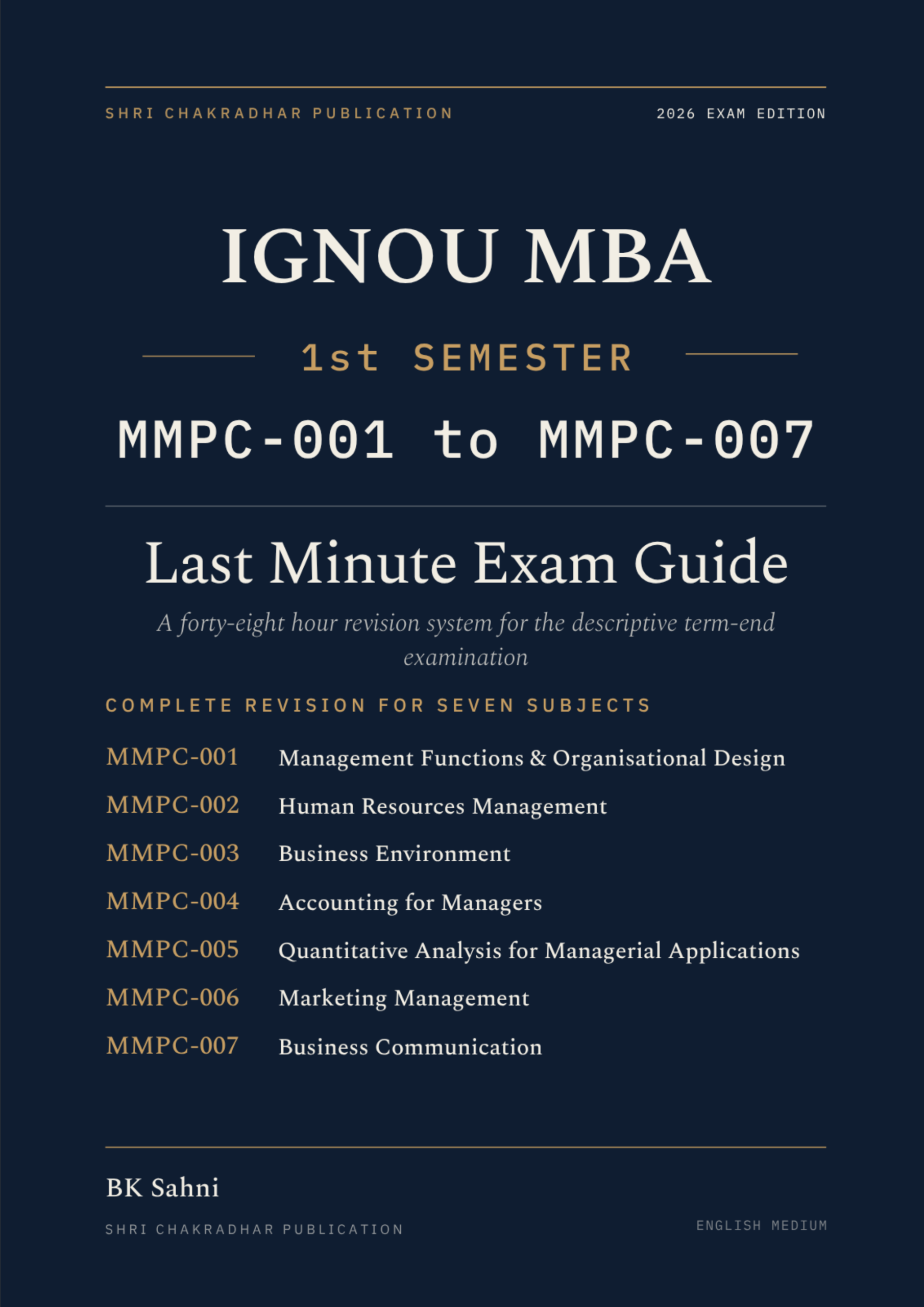
This IGNOU MBA 1st Semester Book places the English Medium MMPC-001 to MMPC-007 syllabus into a single 152-page revision companion issued as the 2026 Exam Edition. It belongs to our IGNOU books, study material and helpbooks range for all programmes and is intended for the preparation period after a student has already worked through the prescribed learning blocks. Its purpose is to organise the seven papers into priorities, recall aids, writing patterns and calculation routines.
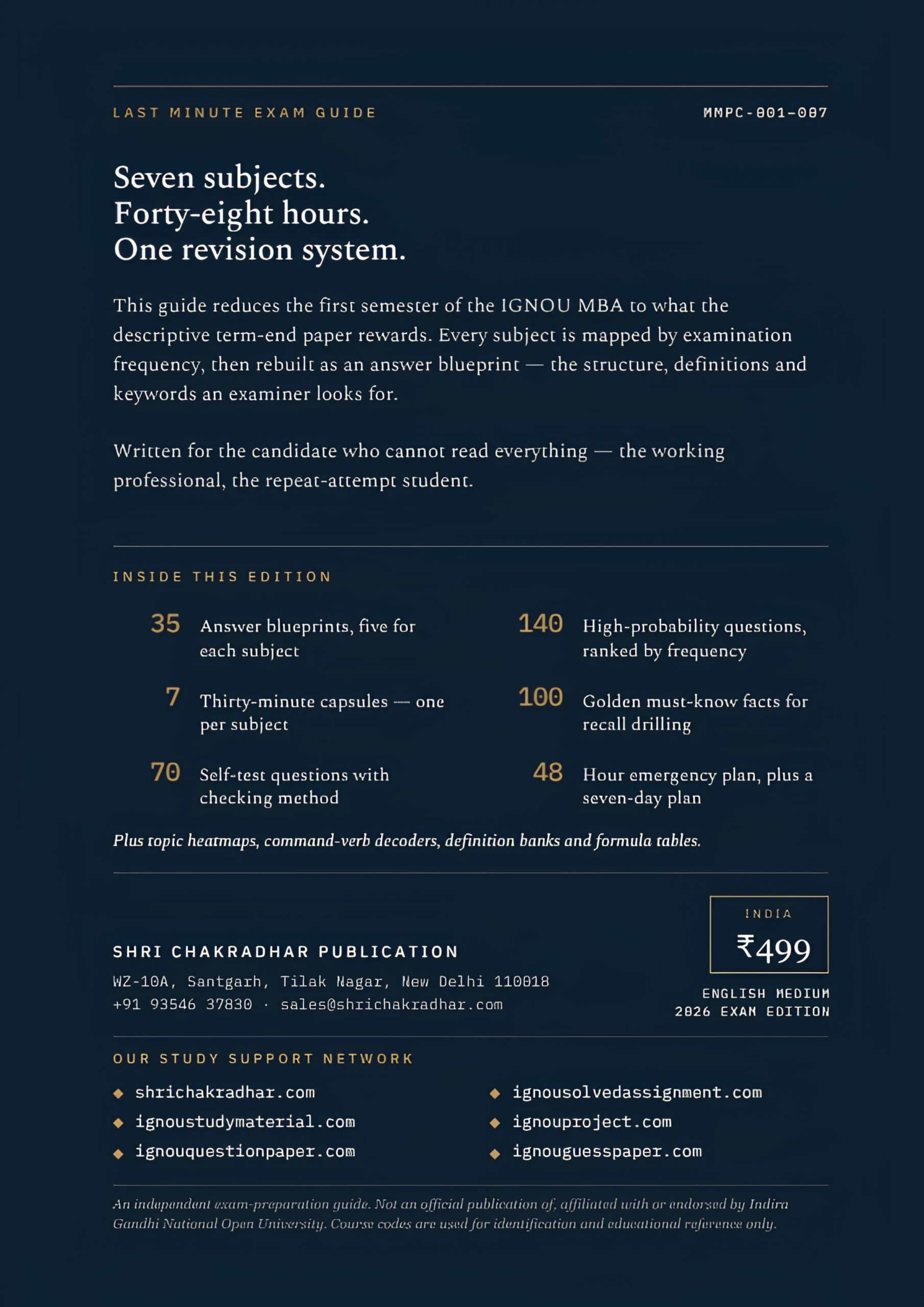
The volume does not attempt to teach every unit at full length. Instead, it assembles 140 selected questions with model responses, 35 adaptable Answer Blueprints, subject-level probability maps, examiner-verb explanations, quick tables, seven short capsules and semester-wide revision schedules. These elements support preparation for the June and December Term-End Examinations by showing learners how to retrieve concepts, arrange an answer and complete numerical work under limited time.
About the IGNOU MBA 1st Semester
The 1st semester of the IGNOU MBA introduces seven distinct managerial foundations: organisational design, human resources, the external business setting, managerial accounting, quantitative methods, marketing and business communication. The academic demands change noticeably from one course to another. Management and HRM rely on theorists and established models; Business Environment requires policy relationships; Accounting and Quantitative Analysis call for calculations; Marketing and Communication combine concepts with application.
Such variation can make revision feel disconnected, particularly for students studying away from a daily classroom. A standard six-section layout is therefore used in every subject chapter. Once the learner understands where the heatmap, blueprints, model answers, toolkit and capsule appear, movement between MMPC-001 and MMPC-007 becomes easier to manage.
What This Book Covers
The content is built as a coordinated examination-revision framework for each of the seven 1st Semester MMPC courses. Every chapter repeats the same navigational arrangement while changing the frameworks, formulas, examples and error warnings to suit the individual subject.
- Section A — Subject Opener and Topic Heatmap: sets out the course identity, block pattern, examination approach and a priority scale for major topics.
- Section B — Command Verb Decoder: translates question instructions into the form of response expected, including discussion, explanation, comparison, preparation and calculation.
- Section C — Five Answer Blueprints: groups related questions under transferable response plans, with concise model skeletons and relevant terminology.
- Section D — Twenty High-Probability Q&As: supplies a balanced selection of model answers, short notes, tables and numerical patterns, followed individually by an Exam Note.
- Section E — Revision Toolkit: compiles the thinkers, definitions, distinctions, formulas, checklists and frequent mistakes that matter to that course.
- Section F — Thirty-Minute Revision Capsule: provides four rapid-review boxes covering essential concepts, priority questions, opening lines and high-value keywords.
The complete book contains 35 blueprints and 140 model Q&As, because each of the seven subjects contributes five frameworks and twenty questions. It also contains seven heatmaps, seven verb decoders and seven half-hour capsules. Semester-level support includes a 7-day study sequence, a separate 48-hour emergency programme, 100 golden facts, 70 self-check questions with answers and an exam-day checklist.
Subject-wise Coverage
MMPC-001: Management Functions & Organisational Design
The MMPC-001 chapter connects classical and modern management ideas with a practical descriptive-answer pattern. Learners revise Taylor, Fayol, Mayo, Drucker, Mintzberg, Maslow, Herzberg and McGregor alongside POLC, planning, MBO, decision-making, organisation structures, delegation, leadership, control, ethics, governance and CSR. The blueprints group questions into evolution, planning, organising, motivation and ethical responsibility. Tables clarify Taylor against Fayol and centralisation against decentralisation, while the capsule concentrates on thinker attribution, SMART objectives, the Hawthorne Effect, managerial roles, Carroll’s Pyramid and the Companies Act reference used in the chapter.
MMPC-002: Human Resources Management
In MMPC-002, human-resource topics are converted into complete process chains and recognised models. Coverage begins with Edwin Flippo and the Harvard Model, then moves through HR planning, job analysis, recruitment, selection, induction, training, career development, compensation, appraisal, engagement, grievance handling, unions and succession. Performance evaluation receives detailed treatment through traditional scales, critical incidents, MBO, 360-degree feedback, BARS and assessment centres, together with rating distortions such as halo, horn and recency. Gallup Q12, UWES, Kirkpatrick and Dave Ulrich appear within the chapter’s thinker bank and rapid-review material.
MMPC-003: Business Environment
The Business Environment unit is arranged to help students present policy-heavy answers in a logical sequence. It includes internal and external forces, PESTLE analysis, the 1991 reform programme, industrial development, financial-sector change, growth and development, trade, BOP, direct and portfolio investment, global funding routes and institutions such as the IMF, World Bank and WTO. Comparative tables separate related ideas such as growth from development and FDI from FII. The revision capsule draws together LPG, current and capital accounts, foreign-exchange terminology, international institutions and trade-policy expressions for quick retrieval.
MMPC-004: Accounting for Managers
The Accounting for Managers chapter gives equal attention to explanation and computation. Students revisit accounting assumptions, statement analysis, cost behaviour, marginal and absorption costing, ABC, CVP, break-even, safety margin, budgeting, material and labour variances, cash flows, ratios, HRA and forensic investigation. The method consistently asks for the governing formula before substitution, full workings and a managerial reading of the outcome. Separate toolkit tables collect ratio, CVP and variance equations. Other answer patterns explain AS-3 or Ind AS-7 classifications, Ind AS 2 treatment, favourable and adverse notation, inventory effects on profit and distinctions between cash budgets and historical cash-flow statements.
MMPC-005: Quantitative Analysis for Managerial Applications
MMPC-005 consolidates the statistical material needed for problem solving and interpretation. The chapter addresses mean, median, mode, spread, coefficient of variation, skewness, probability rules, discrete and normal distributions, sampling, tests of hypotheses, chi-square, managerial decision criteria, correlation, regression and forecasting through time series. Its decision blueprint demonstrates certainty, risk and uncertainty, then relates EMV, EOL and the EVPI shortcut. Formula references cover grouped-data measures, Pearson and Spearman coefficients, regression lines, Z and t procedures and time-series components. Each numerical sequence ends with an interpretation requirement rather than stopping at the calculated value.
MMPC-006: Marketing Management
The MMPC-006 material connects marketing choices across the customer and product journey. It reviews the progression of marketing concepts, the goods and service mixes, buying behaviour, STP, product management, life-cycle stages, new-product work, price decisions, promotion, IMC, channel management, service quality and brand equity. Structured tables present demographic, geographic, psychographic and behavioural segmentation, alternative targeting strategies, PLC actions and skimming-versus-penetration logic. Indian business illustrations are integrated with the model answers. The final capsule compresses STP, MADS, IHIP, SERVQUAL, AIDA, IMC and Ansoff strategies into one last-review page.
MMPC-007: Business Communication
The final subject chapter develops communication answers from model to workplace use. It includes encoding, channels, decoding, feedback and noise; physical, semantic, emotional, organisational and cultural barriers; formal and grapevine systems; directional flows; the 7Cs; kinesics, proxemics and paralanguage; listening; presentations; reports; cross-cultural interaction; transactional analysis and ethical communication. Each barrier is linked to a remedy, which prevents incomplete list-only answers. The chapter’s toolkit also revises Shannon and Weaver, Mehrabian, Edward Hall, Hofstede, Eric Berne, LADDER and the correct distinction between an executive summary and a report introduction.
MMPC-001 to MMPC-007 at a Glance
| Code | Subject Title | Main Revision Area | What You Take Away |
|---|---|---|---|
| MMPC-001 | Management Functions & Organisational Design | Management schools, POLC, structure, leadership and responsibility | Thinker-led explanations and organised theory responses |
| MMPC-002 | Human Resources Management | Workforce planning, staffing, appraisal, rewards and relations | Complete HR process sequences and model-based answers |
| MMPC-003 | Business Environment | Environmental scanning, reforms, trade, BOP and institutions | Indian-policy analysis with clear conceptual distinctions |
| MMPC-004 | Accounting for Managers | Costing, ratios, CVP, budgets, variances and cash movement | Worked formula routines followed by decision interpretation |
| MMPC-005 | Quantitative Analysis for Managerial Applications | Data measures, probability, tests, decisions and forecasts | Correct method choice, transparent steps and conclusions |
| MMPC-006 | Marketing Management | Customers, STP, products, prices, communication and services | Interconnected frameworks for marketing application |
| MMPC-007 | Business Communication | Models, barriers, 7Cs, workplace flows and writing | Practical communication structure with barrier solutions |
Key Features — All Verified From the Book
- One 152-page combined book for the seven English Medium MBA 1st Semester core courses.
- 2026 Exam Edition prepared as a Last Minute Exam Guide.
- Five Answer Blueprints in every chapter, producing 35 reusable response plans overall.
- Twenty model Q&As for each course, amounting to 140 selected questions across the semester.
- An Exam Note after every answer, giving 140 separate reminders about distinctions, notation, examples or mistakes.
- One heatmap and one verb decoder per subject, for seven priority charts and seven instruction guides.
- Two application cases in every course, creating 14 case-based practice situations.
- Seven final-half-hour capsules, each arranged into four recall boxes.
- 100 cross-subject golden facts for compressed semester revision.
- 70 answer-backed self-test items, divided into ten checks for each course.
- A week-long plan and a two-day emergency schedule for different preparation windows.
- A final examination checklist included in the back matter.
Who Should Use This Book
The book is suitable for an IGNOU MBA learner who knows the basic course content but needs an organised final-stage revision resource. It addresses the situation faced by many distance students: seven unrelated-looking subjects, employment or household commitments, limited handwriting practice and uncertainty about how much detail a descriptive answer should contain.
It also serves students who want one method for both conceptual and quantitative work. Named theories, tables and Indian illustrations support the five mainly descriptive papers, while formula banks and worked sequences support Accounting for Managers and Quantitative Analysis. Because every chapter uses the same internal map, the reader can change subjects without rebuilding the study routine.
How This Book Helps Students
The guide helps by turning a large semester into a series of smaller actions. A heatmap indicates where revision attention may be concentrated. The verb section explains the difference between tasks such as discuss, distinguish, calculate and critically examine. Blueprints then show an order for definitions, frameworks, examples, analysis and conclusions, depending on the question.
After that planning stage, the twenty Q&As in each course illustrate the application of the method. Toolkits place names, definitions, comparison points and equations within a quick-reference section. The capsules, 100 facts and 70-question test offer progressively shorter recall formats. This movement from structure to practice to retrieval is useful when students must revise more than one subject in a day.
This Exam Guide and IGNOU’s Official Study Material
The prescribed university material remains the main learning source for these MBA courses. It explains each unit fully and establishes the syllabus context that a condensed examination book cannot reproduce. Learners may download the official IGNOU MBA study material free in PDF from eGyankosh and should consult the relevant blocks before relying on any brief answer or formula list.
This title performs a later function. It reorganises previously studied concepts around likely revision needs, response construction, numerical procedure and final recall. Used in that order, the official material provides depth and the guide provides compression. Used alone for first-time learning, the shortened treatment may not explain every assumption, exception or less prominent area of the syllabus.
Why Choose This Last Minute Exam Guide
The main distinction is not simply that seven courses share one cover; it is that each course is rebuilt around the kind of response it demands. Management answers foreground thinkers, HRM answers retain complete processes, policy topics follow cause and impact, calculations start from formulas, marketing uses decision matrices, and communication links barriers to remedies.
The book also states its limits. Heatmap ratings are estimates rather than promises, the 48-hour schedule is written for prior readers, and the prescribed IGNOU resources continue to hold primary authority. Students therefore receive a compact semester tool with clear boundaries instead of a claim that a revision companion contains every element of the programme.
About the Author — BK Sahni
BK Sahni (Bhavya Kumar Sahni) is an IGNOU education expert, author, and the founder of Shri Chakradhar Publication Pvt. Ltd. and ignouproject.com, and he has guided 5,00,000+ IGNOU distance-learning students since 2010. He writes the Last Minute Exam Guide series — including this book — building every title on the method he has refined across a decade of IGNOU-focused work: high-probability questions, reusable answer blueprints, topic heatmaps and quick-revision capsules aligned to the current IGNOU exam pattern. He also publishes open-access research-methodology guides for IGNOU students, archived with permanent DOIs on Zenodo and indexed on Google Scholar and ORCID (0009-0005-8092-459X). Learn more about his work at bksahni.com, or browse his complete catalogue of IGNOU books on the Amazon Author Store.
How to Use the Book Effectively
First scan the semester dashboard and assign study time with the subject heatmaps. Before writing, check the command-word table so the response format matches the question. Learn the logic of each blueprint, then close the sample and recreate the structure independently. Work through selected Section D answers by hand, particularly the accounting and statistics calculations. After practice, use Section E to check missing terms, formulas, comparison points and avoidable errors.
Extend this work with IGNOU solved previous years question papers and IGNOU solved guess papers where separate paper practice is required. Use the seven-day route for planned preparation and the 48-hour route only as revision, not first reading. Complete the self-test, revisit wrong responses and read the relevant capsule immediately before the examination. When the programme later reaches project work, the separate IGNOU projects, synopsis and dissertation support range can be consulted.
Frequently Asked Questions
What exact MBA papers are brought together in this 1st Semester guide?
All seven papers are included: MMPC-001 Management Functions & Organisational Design, MMPC-002 Human Resources Management, MMPC-003 Business Environment, MMPC-004 Accounting for Managers, MMPC-005 Quantitative Analysis for Managerial Applications, MMPC-006 Marketing Management and MMPC-007 Business Communication. Every course has a separate six-part revision chapter.
Is the product a single book, or will seven individual volumes arrive?
It is one 152-page combined book, not a seven-volume set. The English Medium 2026 Exam Edition keeps the subjects in independent chapters but applies the same navigation throughout. A student can therefore carry one semester guide while still moving directly to the relevant MMPC code and its dedicated revision tools.
How does this book support preparation for an IGNOU Term-End Examination?
It supports TEE revision through selected model responses, answer frameworks, examiner-verb interpretation, formula references, comparison tables and final-review capsules. These tools are prepared for the June and December examination cycle. They assist practice and recall, but they do not establish which questions will appear in a particular paper.
Are assignments, handwritten submissions and full previous papers part of the volume?
No, those items are outside this book. The volume contains 140 high-probability Q&As and 35 blueprints rather than solved assignments or complete PYQ papers. Separate IGNOU solved assignments and IGNOU handwritten assignments are available for students who require those distinct services.
May I study only this guide instead of reading the IGNOU course material?
No, it should not be used as the sole source of first-time learning. The guide condenses and rearranges selected content for examination revision, whereas the prescribed blocks explain the concepts comprehensively. Read the official units first, use this book to organise practice, and return to the source whenever a topic or calculation is not fully understood.
Which type of student is likely to benefit from this combined helpbook?
It is aimed at 1st Semester MBA students who have begun the syllabus and want a controlled revision process across seven courses. Working learners, students with scattered study hours and those who need help structuring long answers or showing numerical steps may find the uniform chapter method particularly convenient.
When is the 48-hour schedule appropriate to follow?
The two-day schedule is appropriate only as an emergency revision plan after earlier reading. It starts with the seven capsules, assigns focused blocks to numerical and theory papers, and finishes with the self-test, golden facts and checklist. The instructions also preserve adequate sleep rather than recommending uninterrupted last-night study.
Do the probability ratings confirm the listed questions for the paper?
No, the ratings do not promise question selection. The book describes them as estimates drawn from past-paper analysis and topic prominence within study material. They help a student sequence available time, but examiners may draw from any applicable syllabus area, so lower-priority material should not automatically be ignored.
Should I confirm the current programme structure before using this edition?
Yes, check www.ignou.ac.in for the latest MBA course list, date sheet, syllabus and instructions. Annual editions reflect the structure available during preparation, while university requirements can later be revised. Verification confirms that MMPC-001 through MMPC-007 apply to your admission cycle and examination registration.
Important Note on Syllabus Verification
IGNOU periodically updates its programme structure, assignment requirements, examination schedule and study material. Before purchasing and while preparing, students should verify the latest MBA syllabus, course list, date sheet and official instructions on the official IGNOU website (www.ignou.ac.in). This book is aligned to the MMPC-001 to MMPC-007 structure and refreshed as an annual exam edition, but official IGNOU sources are always the final authority.
Non-Affiliation Disclaimer
shrichakradhar.com is an independent educational publishing platform. This book and this website are not officially affiliated with, endorsed by, or operated by the Indira Gandhi National Open University (IGNOU). Course codes such as MMPC-001 to MMPC-007 are used solely to identify the subjects the book covers. IGNOU’s official study material and notifications remain the primary and authoritative sources for the programme.
Get Your Copy
Select this title when a single revision book is preferable to separate notes for all seven MBA 1st Semester papers. Pair it with the prescribed blocks, write from the blueprints, show every numerical step and save the capsules for immediate recall. To receive the digital edition, get the IGNOU MBA 1st Semester Book (MMPC-001 to MMPC-007) — Combined Last Minute Exam Study Guide as a soft-copy PDF on WhatsApp.